Showing posts with label Gildersome. Show all posts

Tuesday, March 21, 2017

William Bentley, tailor of Gildersome

Drawing of the first patented lockstitch sewing machine, 
invented in 1845 by Elias Howe and patented in 1846, 
15 years after William Bentley's death. He would have
done all his tailoring work by hand.
After posting a couple of articles about Ben Bentley my plan was to say something about his forebears and those of Harriet Smith, his wife. Unfortunately, there isn't a lot to say with any certainty about Ben's parents. 

His father, William Bentley, was born in Gildersome near Leeds and was baptised on Christmas day, 1785, at the parish church in nearby Batley. He was the son of Samuel Bentley, a clothier of Gildersome, and his wife Hannah Clough.

The baptismal records of several of William's children show that he was married to "Ann Wildrick", daughter of John Wildrick. I haven't been able to trace this Wildrick family or the marriage between William and Ann with any certainty. The only Ann Wildrick I've come across lived in Fishlake, near Doncaster, which is quite a long way from Gildersome and Leeds.

Possibly Wildrick is a variation on Weldrake, with several families by that name (or something similar) living in the Gildersome area. In 1785 a Nancy Weldrick, daughter of John Weldrick was baptised in Birstall, in the Cleckheaton parish, which is not far from Gildersome. Nancy is sometimes used as a diminutive form of Ann. Could this be "Ann Wildrick"?

Curiously, the only possible marriage I've come across for William and Ann, or Nancy, occurred in Oldham, Lancashire. William Bentley, tailor, "of Royton" (sic) married a Nancy Weldrake there on 3 June 1806. Unfortunately no details are given about their ages or their fathers' names. This date would fit in well with the dates of their children's births, but begs the question of why they would go to Oldham to marry. Was William there on business? Were they avoiding marrying in Gildersome for some reason? Or was this another couple entirely? For now it remains a mystery, and I'd be happy to hear any suggestions.

All the children of William and Ann were born in Gildersome. Matthew, the eldest, was born in 1808 and became a tailor like his father. John (1811) Ann (1813) and William (1815) followed before Ben arrived in 1819.

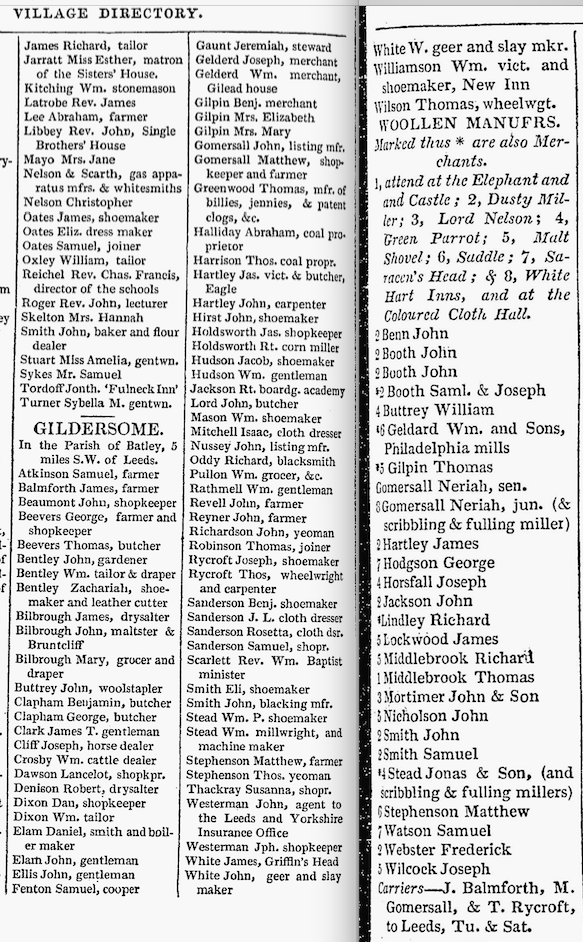
William's name appears in the 1826 General and Commercial Directory for the Borough of Leeds as one of the two tailors living in Gildersome, the other being William Dixon. In the 1830 Leeds and Clothing Directory he's listed as Wm. Bentley & Son, tailor (& draper). He probably had a shop front somewhere close to the Town Green, and would have sold fabric as well as making up clothing on commission and perhaps doing repairs. The first practical and commercially available sewing machine didn't appear until 1846, so he would have done everything by hand.

William died on 4 August 1831 at the relatively young age of 46. According to the Leeds Patriot and Advertiser on 20 August, he died "after a lingering illness". Ann, his wife, died in Gildersome in December 1849.

Image: By Frank Puterbaugh Bachman [Public domain], via Wikimedia Commons

Thursday, January 26, 2017

Ben Bentley


26 January 2017
Name:Ben BENTLEY117
Sex:Male
Father:William BENTLEY (1785-1831)
Mother:Ann Wildrick (1785-1849)
Individual Facts
Birth1819Gildersome, Yorkshire, England14,6,9,1214
Baptism22 Aug 1819 Gildersome, St Peter, Yorkshire, England7,10
Census1841 (age 22)Bramley, Yorkshire, England13
Census1851 (age 32)116 West St, Leeds, Yorkshire


Relation to Head of House: Head  Occupation: flour dealer; Leeds, Yorkshire, England1
MiscMar 1853–Apr 1853 (age 34)Letters to editor of Leeds Times; Leeds, Yorkshire, England
Residence17 Apr 1854 (age 35)"Residence: Dewsbury. Assistant in a corn mill"; Dewsbury, Yorkshire, England16
Miscellaneous6 Dec 1856 (age 37)Imprisoned for 4 years for embezzelement from his employer; York Assizes, Yorkshire - North Riding, England15
Census1861 (age 42)Flour and corn agent, Bond St, Dewsbury


Relation to Head of House: Head  Flour and corn dealer; Dewsbury, Yorkshire, England2
Census1881 (age 62)Market St, Dewsbury


Relation to Head of House: Head Marital Status: Married; Dewsbury, Yorkshire, England6
Census1891  (age 72)2 Market St, Dewsbury, Yorkshire


Relation to Head of House: Head  Married to Ann  Occupation corn dealer; Dewsbury, Yorkshire, England4
Death21 Sep 1897 (age 78)Westview, Cartworth, Holmfirth, Yorkshire11,14
Burial24 Sep 1897 age 78)Friends (Quaker) burial ground  Wooldale, Dewsbury, Yorkshire, England12,14
Probate7 Oct 1897 (age 78)Wakefield, Yorkshire11


Marriages/Children
1. Harriet SMITH (1817-1876)
Marriage21 Oct 1839 (age 20)Tong, Yorkshire, England5
Census (fam)1871 (age 52) Elm Wood, Dewsbury, Yorkshire3,22
ChildrenAlfred Pearson BENTLEY (1849-1922)
William BENTLEY (1841-    )
Martha Ann BENTLEY (1845-1861)
John Harry BENTLEY (1847-    )
Harriet BENTLEY (1851-    )
Walter Smith BENTLEY (1864-1939)
2. Ann DOVE (1835-1900)
MarriageDec Q 1877 (age 58)Dewsbury, Yorkshire, England
Notes:
1. Ancestry.com, 1851 England Census, Class: HO107; Piece: 2321; Folio: 787; Page: 19; GSU roll: 87549-87552.
        2. Ancestry.com, 1861 England Census, Class: RG 9; Piece: 3409; Folio: 114; Page: 42; GSU roll: 543127.
        3. Ancestry.com, 1871 England Census, Class: RG10; Piece: 4603; Folio: 8; Page: 10; GSU roll: 848395.
        4. Ancestry.com, 1891 England Census, Class: RG12; Piece: 3732; Folio: 13; Page: 19; GSU Roll: 6098842.
        5. Ancestry.com, West Yorkshire, England, Marriages and Banns, 1813-1935, West Yorkshire Archive Service; Wakefield, Yorkshire, England; Yorkshire Parish Records; Old Reference Number: 50D90/1/3/6.
        6. Ancestry.com and The Church of Jesus Christ of Latter-day Saints, 1881 England Census, Class: RG11; Piece: 4560; Folio: 13; Page: 20; GSU roll: 1342099.
        7. Ancestry.com, West Yorkshire, England, Births and Baptisms, 1813-1910, West Yorkshire Archive Service; Wakefield, Yorkshire, England; Yorkshire Parish Records; Old Reference Number: D26/1/1; New Reference Number: WDP26/1/1.
        8. FreeBMD, England & Wales, FreeBMD Marriage Index, 1837-1915.
        9. FreeBMD, England & Wales, FreeBMD Death Index, 1837-1915.
        10. Ancestry.com, England, Select Births and Christenings, 1538-1975.
        11. Ancestry.com, England & Wales, National Probate Calendar (Index of Wills and Administrations), 1858-1966.
        12. Ancestry.com, West Yorkshire, Non-Conformist Records, 1646-1985, C786/2/B/2.
        13. Ancestry.com, 1841 England Census, Class: HO107; Piece: 1342; Book: 11; Civil Parish: Bramley; County: Yorkshire; Enumeration District: 15; Folio: 52; Page: 13; Line: 4; GSU roll: 464285.
        14. Ancestry.com, West Yorkshire, Non-Conformist Records, 1646-1985.
        15. Ancestry.com, England & Wales, Criminal Registers, 1791-1892, Class: HO 27; Piece: 115; Page: 436.
        16. Ancestry.com, West Yorkshire, Non-Conformist Records, 1646-1985, C786/2/A/2.
        17. Source #1.
        

More about Ben Bentley:

Wednesday, January 25, 2017

Ben Bentley, Gentleman (part 1)

I mentioned in my last post that when Ben Bentley died in 1897 he was described in the probate calendar as "Ben Bentley, gentleman". Originally a man could only be described as a gentleman if he inherited, or was granted, a coat of arms. By the 19th century the term had started to be applied to anyone who was wealthy enough to live on their own means, without needing to work. Eventually it ceased to describe a person's status altogether, and acquired its current meaning of someone with courteous manners and good behaviour. But which of these meanings applied to Ben?

"Birdseye view of Gildersome"
photo by Simpson Morley (cropped slightly)
courtesy of History of Gildersome
Ben Bentley (1819-1897) seems to have been a man with ambition and a self confidence not always backed by wisdom. He began life in Gildersome, a small village 7 km outside Leeds in West Yorkshire. He was the youngest son of William Bentley, a tailor, and his wife Ann (nee Wildrick), whose families had both lived in the area for several generations.  For reasons known only to his parents, he was baptised plain "Ben" rather than "Benjamin", and continued to be known as Ben throughout his life, even on most official documents. (This fact proved helpful during my research in distinguishing him from the half dozen or so Benjamin Bentleys of similar age living in West Yorkshire in this period.)

Initially he seemed set to follow his father's family into the clothing trade. His first occupation was as a clothier, selling cloth or ready made clothing. But in his twenties he became involved in the grain milling trade. A few years after his marriage in 1839 to Harriet Smith he and his family moved to the inner city area of Leeds. By 1851 he was working as a flour dealer.

Not the Chancellor of the Exchequer


Ben probably had a fairly basic education, but apparently didn't let that stop him from promoting himself. On 12 March 1853 the Leeds Times carried a brief anecdote, titled "Not up in his arithmetic" about a wager made by gentleman farmer with a local agriculturalist. The wager involved the agriculturalist bringing one grain of barley to the farmer at the public house the next Friday, in return for a bottle of wine and a good dinner. The following week he would bring two grains for the same reward, then four, doubling the number of grains each week, for the whole year. The writer finished by saying "We will not insult the intelligence of our readers by working out the sum in detail, as the compositor would find it difficult to find the figures in his news case, but we apprehend the farmer will soon find it to his interest to get off the bet."

Ben Bentley didn't take the hint. The following week, in a letter to the editor signed "Ben Bentley, Kings Mill", he confidently offered his calculation of the amount of barley that the agriculturalist would have to provide. He even calculated how many times the carts required to carry it would stretch around the globe, and how many thousand years it would take to hoist it all into warehouses. He concluded:
"All this may appear to some to be an exaggeration but they who dispute it I should wish them to reckon for themselves, and I have no doubt they will find me correct in my statement.".
It was inevitable that someone would take up his challenge, and on the 26 March the paper published a letter from a correspondent signing himself "Dizzy" which began:
Sir.—Your Friend "Ben"-- not the Chancellor of the exchequer-- tells the public, through your paper, that he has "undertaken the task of reckoning" the amount of barley to be given by the Wakefield agriculturist for his 52 dinners [ ...]
...I should not have noticed this matter had not "Ben" requested that those who disputed his infallibility in figures to reckon for themselves. I have done as desired, and think he is wrong.
The Chancellor of the Exchequer at the time was Benjamin Disraeli, thus the jibe at Ben's name.  "Dizzy" went on to provide his own calculations. The editor added a footnote to this letter politely suggesting that if Dizzy looked at his figures again he would see that they were not quite correct. But neither Dizzy nor Ben were ready to give up this argument.

The following week the correspondence column carried three letters. The first, from Ben Bentley, suggested that there were so many errors in Dizzy's letter that he was not a fit person to rely on for calculations. The second, from Dizzy, admitted that he had made a slight error in copying his calculations into his letter. He went into a long and detailed explanation of how he made his calculations, implying that Ben showed himself to be an amateur in such matters.

The third letter came from James Greaves, "A teacher of the Elementary Improvement Class of the Leeds Mechanics Institution". Ben's calculations were "erroneous", he said, but Dizzy's were equally so. He offered his own elegant solution to the problem. At this point the newspaper editor evidently tired of the matter, and having listed the names of others who had submitted letters on the subject, he let it drop.

Caught out


By the mid 1850's Ben and Harriet had five (surviving) children, including 6 year old Alfred Pearson Bentley. Harriet's family seems to have had connections with various non-conformist congregations in West Yorkshire, and their eldest son William (b 1841) was a border at Low Green school in Rawdon, a co-educational school run by the Quakers (also known as the Friends). Ben was working as a traveller for James Upton Wooller, a wealthy corn miller. Things seemed to be going well for them.


But perhaps Ben placed too much trust in his ability to impress others with figures, and the temptation to improve his income by fiddling the books a little proved too much for him. He began under-reporting how much money he received from his employer's debtors while over-reporting costs. In 1856 he was arrested for embezzlement. The case was reported by both the Leeds Times and the Huddersfield Chronicle when it came to court in August.
Extract from Ben Bentley's prison record
Source: Registers Of Prisoners In The County Prisons Of Wakefield 
HO 23 piece 16. Accessed at Findmypast.com

Stealing from a master was a serious offence. The magistrate in Dewsbury committed him for trial in York, without bail. Four months later, on 6 December, he pleaded guilty to having embezzled ₤25 2s and was sentenced to four years penal servitude. He served the first year of his sentence in the prison at York Castle. Then on 23 November 1857 he was moved to Portland prison in Dorset on the south coast, far away from Yorkshire and his family. It was no seaside holiday camp. Convicts from the prison were used to quarry stone and build the breakwaters of Portland harbour.

This conviction must have been a terrible blow for both Ben and Harriet. For a family aspiring to join the new middle class, having a father in prison was a cause of great shame. Dorset was too far away for any sort of regular visits. What would the children be told about their father's long absence? How would they survive for four years without Ben's income? And how would Ben fare doing hard labour in gaol?

More in part 2.


*Corn is the term used in England for wheat and other grains, rather than for sweet corn or maize.