Showing posts with label occupations. Show all posts

Monday, February 8, 2021

Memories of Susan and David Whybrew


John Street, Colchester
I'd like to share some of the fascinating information that was sent to me recently with the photo of Susan Mason. It was recorded from a conversation with Susan's granddaughter, Violet, late in life. Violet had never met her grandparents, Susan and David. Her memories were based on recollections of what  her mother, Ada, had told her, many years earlier. So the source is rather distant in time. 

Having said that, it gives a wonderful insight into the characters of both Susan and David Whybrew, and also answers some questions that were left unanswered in the book, Susan. 

I've edited the information I was provided a little, and reformatted it to make it flow. But I hope you can still hear Violet's voice in it.

Susan was born in Australia in 1848. Her parents were Irish. She married David Whybrew while his regiment was stationed in Australia. After travelling around the world with the regiment, they returned to England and the barracks in Colchester.

Nell (Ellen) and Ada were the youngest of many children, born in many different places, including Cambridge. Susan was nearly fifty when Ada was born. Only Nell and Ada were still at home when Susan used to go away to work as a midwife. (This explains why Susan described herself as a nurse on the 1911 census, despite having no training as far as I could tell. Midwives then didn't need any qualifications.) 

In those days, midwives used to live in with the family in confinement. Susan used to go away for six weeks; three weeks before the birth and three weeks after the birth. Families used to send their pony and trap for her when she was needed. One particular family she used to attend to had lots of children and they always used to send for Susan.

Susan often used to be paid in kind. On one occasion she had been paid with sausages. As she was walking along, all the sausages were trailing along behind her!

Her husband, David, loved her dearly. He described her as 'the belle of the ball' and said that he loved every hair on her head.

David used to sing to Sue:

Sue, Sue, I’m very much in love with you, 

When your pretty little eyes of blue are smiling,

Few, few, few little girls are as nice as you,

There’s a lovely (lonely?) little part, in the middle of my heart,

Just for you, you, you.

David Whybrew was born in 1839. He was Welsh and a Regimental Sargent Major. He met Susan while with his regiment in Australia.  They married and eventually came back to live in Colchester. 

(My correspondent is unsure why the family thought David was Welsh. All the recorded evidence points to him being from Essex, with both parents English, but there's obviously a story yet to be uncovered.) 

He had retired by the time Ada was born. 

He was very strict but he loved his wife and children dearly.  Everything was done to precision. His rule was "no working on Sundays". Nell wasn’t even allowed to sew on a button. They had their own pew at church and went to church every Sunday.

Ada wasn't allowed dancing shoes.  She used to go out, hide her shoes under a hedge and collect them later. He called dancing girls “harlots”.

He did all the sewing and darning. He said that no woman could do it properly! Aunt Nell wanted to borrow some white cotton off him. He gave her some but said: “Don’t ever ask me again. You never lend or borrow, always replenish your stocks, before they run out.”

He used to clean their shoes every day, he even cleaned the soles. He had a piece of wood whittled down and cleaned the edges with it. When the children became fourteen years old, they had to clean their own. Last time he cleaned them was on their birthday. He used to say: “There you are my girl, that is the last time I will clean your shoes”, then he gave them an apple and a penny.

Stories like these are priceless. They say so much about ordinary family life, and they can't be obtained from public records or even newspapers. I'm very grateful to the lady who sent them to me.


Sunday, July 1, 2018

Why did Matthew spurn his family?

Equitable Street, Milnrow. Matthew and his family
 lived at number 33 in 1911.
Most of the unsolved mysteries from my family tree involve "what" "when" or "who" questions. What was the relationship between James Beales and William Beales? When was Richard Ward born? Who brought up Harriet Whybrew? They're questions that, at least in theory, could be answered by finding the right records (if they exist).

But sometimes the question behind a mystery is "Why?" Why did someone suddenly move across the country, or across the world? Why did a child named James apparently take the name of his dead brother William as an adult?

Most of the time, these questions are unanswerable. I can make a guess, based on learning more about a person's background, the social conditions, and local customs at the time. But I can never really be certain. The people who could tell me the answers are long gone.

One such unanswerable "why?" involves my father's Uncle Matthew (born November 1867). Matthew was born in Walton le Dale in Lancashire, but in the late 1870's his parents John and Mary Ward moved with their family to Littleborough. Then for a short while in the early 1890s they lived in Rastrick in Yorkshire. By the late 1890s the whole family had settled in the village of Milnrow in Lancashire, where John was a bootmaker and clogger. Most of the children remained there after they married and had families of their own.

For most of his adult life Matthew was employed as a fellmonger. Fellmongering is a process in which the wool is chemically separated from sheep hides, and was an industry for which Milnrow was noted. The wool was used by the woollen mills for weaving flannel, while the hides were tanned for leather.

Matthew met and married his wife, Elizabeth Ann Brown, while the Ward family were living in  Rastrick. They had six daughters, the first born in Rastrick and the other five in Milnrow. The youngest, Edith, a twin to Esther, died in her first year of life. The rest of the family all lived to a great age. Matthew and Elizabeth themselves, along with their two married daughters, Doris and Esther, all lived past eighty. Their unmarried daughters, Maud, Annie and Clara, all lived beyond ninety. Perhaps that in itself is a bit of a mystery, but not the one I'm coming to.

My father recounts that when he was about eight or nine years old, Matthew and his family suddenly stopped all interaction with the rest of the family. The rift was apparently never healed. For the rest of his life, Matthew's family had no contact with the rest of the family, even though they continued to live in the same small village. Or so my Dad remembers it. He was too young at the time to know what caused this disruption, though he thinks it involved some sort of argument.

I can't find anything in the records to suggest why Matthew and his family would have suddenly cut themselves off from the rest of the family at this time (around the end of the 1930's). Could there have been an argument over property? Or was it something more personal?

At the time of the 1939 Register (which is now online on both Ancestry and FindMyPast) Matthew had retired from work. The three unmarried daughters, Maud, Annie and Clara, all in their forties, were living with Matthew and Elizabeth in a house at 17 Buckley Hill Lane, which was practically "shouting distance" from other members of the family. They had been living there for at least eighteen years according to the electoral rolls.

Matthew's wife Elizabeth died in 1946 and Matthew himself died in March 1949, in Milnrow. He left his property to his daughters, who eventually all moved to Morecombe on the coast. None of them appears to have had any children. Unless something unexpected turns up, it seems unlikely that we'll ever find out what caused the family to separate from the wider family as they did.


Thursday, October 12, 2017

More on boatmen and baptisms

The Leeds Liverpool Canal at Wigan Pier
Never publish in haste! I wrote my last article based on research I'd done quite a while ago, but after digging into things a bit more, I find I now need to correct a couple of statements in my previous post about Hannah Holt and her family.

First, I said that her father John Holt was a boatman, and guessed that this meant he was a labourer on the docks. But after doing more research I've realised that it's more likely that he worked on the actual canal boats.

Even before the Manchester Ship Canal opened in 1894, there was an extensive network of canals all over England, which were used for transporting raw materials and goods. It was much more efficient to have a horse (or a man) pull a fully laden boat along a canal than it was to have the horse pull a cart along an unpaved road.

Some of the canals dated back as far as Roman times, but the canal system was greatly expanded during the industrial revolution. The port in Liverpool was linked to industry in Manchester and Yorkshire by the Leeds and Liverpool Canal and there was an extensive network of canals linked into this. Eventually the railways took over as the main means of transporting goods. But the canals still exist and it's apparently still possible to travel from London to Lancaster without setting foot on dry land.

Many boatmen lived on their boats, since the journey between the port and their destination could take several days. In some cases their families lived with them. But it seems from the census returns that John Holt and his father William had homes that they returned to regularly.

John and Elizabeth Holt's children

The second thing I need to correct is my statement that Mary Ann, the first child of John Holt and Elizabeth Hardman, appeared to have died in infancy. In fact I've now found her as a seven year old in the 1861 census, staying with her grandparents Patrick and Margaret Hardman in Eagle St, Pendleton. Whether she was there just for the night of the census or more permanently is unclear. I haven't been able to trace her in the 1871 census, but she would have been a teenager then and may well have been working away from home. In March 1876 she married Thomas Ogden in St John the Evangelist Church in Salford. She was still living in Salford, though widowed, in 1911.

While on the topic of John and Elizabeth Holt's children, I've recently discovered their baptism records on the Lancashire Online Parish Clerk site (which is where I also found Mary Ann's marriage). They were all baptised in the Catholic Cathedral Church of St John the Evangelist, in Salford, except for the youngest, John, who was baptised in Christ Church, Salford, which is an Anglican church.

Perhaps this was because his mother Elizabeth, an Irish Catholic, had a say in where the other children were baptised, but she had already died before John came for baptism. I haven't been able to find a burial record for Elizabeth but her death was registered in the first quarter of 1870 and John was born on 13 March 1870, so she probably died towards the end of March. When John was baptised on 6 April, his father, or his father's family, apparently chose to have him "done" in the Church of England.

I usually try to check my facts before posting, but if you come across any errors in any of my blog posts, do please let me know, either by posting a comment or messaging me.


Monday, August 7, 2017

Muslin by the yard - John Mason's trial

Limerick c 1900
John Mason was 18 years old when he was transported to Australia aboard the Parmelia. Until recently all that I knew about his crime came from his convict records, which stated that he had been sentenced in Limerick for 'stealing cotton'. The Limerick prison records (available at Find My Past) showed that he had been tried on 27 June 1833 and sentenced on 11 July, but gave no other details.

This week the British Newspaper Archive posted a new batch of pages from Irish newspapers, including the Limerick Chronicle, and I was finally able to discover a little more about John's trial. On 13 July 1833, under the heading "Limerick City Sessions" this appears:
John Mason, for stealing 29 yards of muslin goods from Thomas Evans.
James Evans sworn - He was behind the counter when he heard a pane of glass broken in the window; jumped over the counter and saw the prisoner outside with the piece of muslin in his hand; his brother coming out, they took the muslin from him.
George Evans sworn - corroborated the evidence of his brother, whom he saw struggling with the prisoner outside the window.
Thomas Evans; fully confirmed the testimony of the two preceding witnesses, young boys, who gave their evidence in a most correct and intelligent manner. Verdict - Guilty.
The sentence, transportation for seven years, given a few days later, appears on page 3 of the same paper.

Since reading this I've been trying to find out more about the shop owned by Thomas Evans. Where was it? What did it sell? On a genealogy site I found a Thomas Evans in Limerick with sons named George and James, born in  1817 and 1818 respectively. That seemed promising

The Evan's family in the 1846 Slater's directory p 264
Then I came across an entry in the 1846 Slater's National Commercial Directory of Ireland for Thomas Evans in William St, Limerick  (pg 264). But according to this he was an ironmonger, and the correct and intelligent George and James were hardwaremen in Rutland Street. Another entry showed Thomas Evans and his sons also held a license to sell gunpowder (p 274). It didn't seem likely that either of these stores would sell muslin by the yard. Had Thomas Evans changed his business in the thirteen years since 1833, or was this a different family?

George St, Limerick c 1880
The mystery was solved when I noticed a Hannah Evans listed as the owner of a haberdashery store in George Street, Limerick. Thomas Evans' wife and James and George's mother was named Hannah, so I'm guessing that it was the Evans' haberdashery shop rather than the hardware or gunpowder store that John Mason robbed. 

John was not the only Limerick resident sentenced on 11 July to being transported. Just below the newspaper account of John's trial is one for Mary Lynch, who stole a coat. She freely admitted that she was guilty, adding that she had deliberately stolen the coat in the hope of being transported, since so many of her family and friends were now in New South Wales. She was found guilty and had her wish granted.

_______________________
You can find out more about John Mason, Susan and David Whybrew and their family, in my book Susan: convict's daughter, soldier's wife, nobody's fool, available on Amazon and other online books stores


Tuesday, March 21, 2017

William Bentley, tailor of Gildersome

Drawing of the first patented lockstitch sewing machine, 
invented in 1845 by Elias Howe and patented in 1846, 
15 years after William Bentley's death. He would have
done all his tailoring work by hand.
After posting a couple of articles about Ben Bentley my plan was to say something about his forebears and those of Harriet Smith, his wife. Unfortunately, there isn't a lot to say with any certainty about Ben's parents. 

His father, William Bentley, was born in Gildersome near Leeds and was baptised on Christmas day, 1785, at the parish church in nearby Batley. He was the son of Samuel Bentley, a clothier of Gildersome, and his wife Hannah Clough.

The baptismal records of several of William's children show that he was married to "Ann Wildrick", daughter of John Wildrick. I haven't been able to trace this Wildrick family or the marriage between William and Ann with any certainty. The only Ann Wildrick I've come across lived in Fishlake, near Doncaster, which is quite a long way from Gildersome and Leeds.

Possibly Wildrick is a variation on Weldrake, with several families by that name (or something similar) living in the Gildersome area. In 1785 a Nancy Weldrick, daughter of John Weldrick was baptised in Birstall, in the Cleckheaton parish, which is not far from Gildersome. Nancy is sometimes used as a diminutive form of Ann. Could this be "Ann Wildrick"?

Curiously, the only possible marriage I've come across for William and Ann, or Nancy, occurred in Oldham, Lancashire. William Bentley, tailor, "of Royton" (sic) married a Nancy Weldrake there on 3 June 1806. Unfortunately no details are given about their ages or their fathers' names. This date would fit in well with the dates of their children's births, but begs the question of why they would go to Oldham to marry. Was William there on business? Were they avoiding marrying in Gildersome for some reason? Or was this another couple entirely? For now it remains a mystery, and I'd be happy to hear any suggestions.

All the children of William and Ann were born in Gildersome. Matthew, the eldest, was born in 1808 and became a tailor like his father. John (1811) Ann (1813) and William (1815) followed before Ben arrived in 1819.

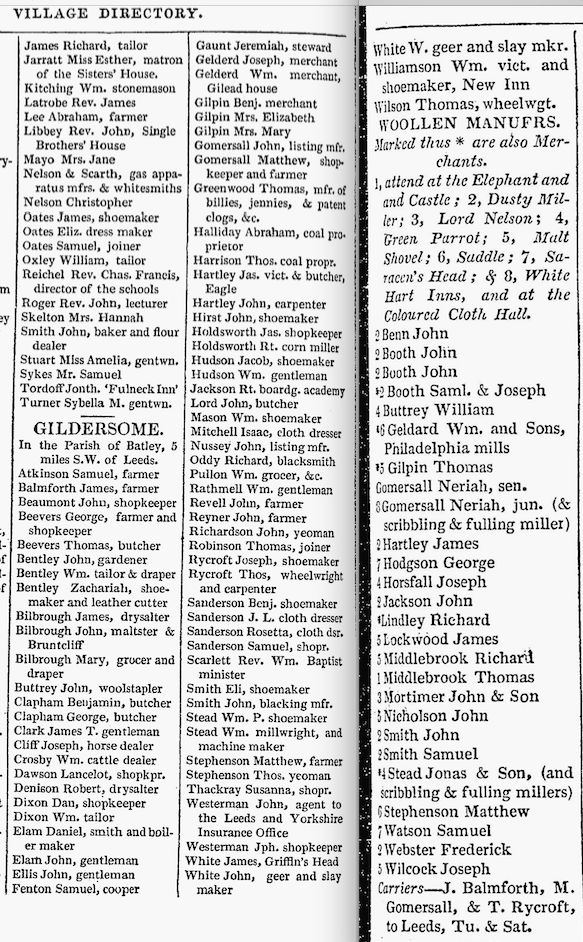
William's name appears in the 1826 General and Commercial Directory for the Borough of Leeds as one of the two tailors living in Gildersome, the other being William Dixon. In the 1830 Leeds and Clothing Directory he's listed as Wm. Bentley & Son, tailor (& draper). He probably had a shop front somewhere close to the Town Green, and would have sold fabric as well as making up clothing on commission and perhaps doing repairs. The first practical and commercially available sewing machine didn't appear until 1846, so he would have done everything by hand.

William died on 4 August 1831 at the relatively young age of 46. According to the Leeds Patriot and Advertiser on 20 August, he died "after a lingering illness". Ann, his wife, died in Gildersome in December 1849.

Image: By Frank Puterbaugh Bachman [Public domain], via Wikimedia Commons

Monday, February 6, 2017

Ben Bentley, Gentleman, part 2

Leeds Corn Exchange,
which Ben no doubt visited. Designed by
Cuthbert Brodrick and built in 1863.
Now home to a food emporium and boutique shops.
In my previous post about Ben Bentley I left the unfortunate gentleman languishing in Portland prison in Dorset, after he was arrested for embezzlement. So what became of him and his family?

Ben was released in December 1860, having shown "exemplary" behaviour while in prison. It seems that his time in penal servitude did not damage his reputation or his relationships irreparably. By the time of the census in April 1861 he was back with his family in Dewsbury in Yorkshire and was employed once more as a flour and corn agent (though perhaps not with the same employer). As time went on Ben became a corn dealer, and apparently did quite well for himself.

After the death of his wife Harriet in 1876, Ben married again, to a younger woman named Ann Dove (b 1835). He was still living in Dewsbury and working as a corn dealer in his seventies, but he seems to have retired after that. When he died in 1897 he left an estate of ₤474.11s.1d  (An adult male clerk could earn roughly ₤50 - ₤130 per annum according to newspaper advertisements at the time.) He was buried in the Friends burial ground in Wooldale, near Holmfirth in Yorkshire.

Ben and Harriet's children


Ben might have been pleased that all his sons went into white collar work or skilled trades. But his children had mixed fortunes when it came to money and marriage.

Typesetting using a traditional composing stick.
William, the eldest son (b 1840) became a letter press printer and worked on a weekly newspaper. He married Sarah Ellen Oates in the summer of 1864. By November 1865, according to an item in the Leeds Mercury, he was bankrupt. In 1874 he filed for divorce from Sarah on the grounds of adultery, after she had an affair with a neighbour. He remarried in 1877 to a Mrs Eliza Ann Leonard, but she died only two years later.

Ben and Harriet's eldest daughter Martha Ann (b 1844) died at the age of 16  in June 1861, less than six months after Ben's release from prison.

Ben's second son John Henry (b 1847) followed his brother William to the Friends (Quaker) school at Low Green in Rawdon. As I mentioned previously, the school was unusual for the time in being co-educational. He  became a solicitor's clerk in Huddersfield and married one of his classmates, Hannah Waddington, in 1868.

By the mid 1880's he had risen from being a solicitors' managing clerk to being a solicitor and he and his family were living in Cliffe House in Wooldale (which is possibly why Ben, his father, was buried there). In 1890 John was badly shaken and his left eye was damaged when the mail train in which he was travelling towards London collided with a goods train at Retford. He successfully sued the Great Northern Railway company the following year and was awarded  ₤1800 in damages. Despite this success, his life seemed to go from bad to worse from that point.

In 1898 he was declared bankrupt. In June 1900, in a case that was publicised all over the country,  he was struck off the roll as a solicitor for misappropriating clients' funds. Part of his defence was that he had been suffering from "mental derangement". By 1901 he was back to being a managing clerk in a solicitor's office.

I've already told the story of Ben and Harriet's third son,  Alfred Pearson Bentley (b 1849) in an earlier post. In the light of his childhood experiences and his family background, perhaps his later behaviour seems a little less incomprehensible. At another level it's difficult to understand how he could have abandoned his wife and children as he did, having experienced his own father's disappearance during his early childhood.

Ben and Harriet's younger daughter Harriet (b 1851) was no more fortunate in marriage than her brothers. Her first husband was a foundry worker named Barrett Butler. They married in 1871. Barrett died in 1884, leaving Harriet with four children.

In 1888 Harriet married John Inman, a widowed mechanic and labourer. They were together in Holbeck, near Leeds, in the 1891 census, but by the time the 1901 census was taken, Harriet had separated from Inman and was calling herself Harriet Butler again. She also claimed to be a widow, though Inman was still alive and living in the Holbeck Union workhouse.

The youngest son in Ben and Harriet's family, Walter Smith Bentley, seems to have been the most stable and unremarkable of the four sons (or at least he managed to keep his name out of the newspapers).  Walter was born in 1863, after Ben's release from prison. Like John Henry, he became a solicitor's clerk, but remained in that role for the rest of his life.

In 1887 he married Martha Gosnay at the Friends Meeting House in Dewsbury. They moved south, settling eventually in Stone in Staffordshire. After Martha's death in 1899 he married Ann Childs and they moved to Norfolk.  When he died in 1939 he was living near Shaftesbury in Dorset, not very far from Portland where his father had been in prison. It would be fascinating to know whether he was aware of his father's past connection with Dorset.


Image credits:
1. Leeds Corn Exchange © Copyright Chris Allen and licensed for reuse under
this Creative Commons Licence
2. Typesetting Image by Wilhei (Own work) [CC-BY-3.0 (http://creativecommons.org/licenses/by/3.0)], 
via Wikimedia Commons


Friday, September 16, 2016

The life of a laundress


Several years ago we visited a 'living museum', a house set up and furnished just as it would have been in the early 1900's. The couple who owned and occupied the house tried, as far as possible, to live as the occupants would have lived in that era. The one concession they had made to modern life was the washing machine sitting in a corner of the laundry. They admitted that washing their clothes and bedding the old fashioned way was just too much work, and they couldn't bear to wear their clothes over and over again, as people once did.

Their comments came to mind when I began looking at what the life of a laundress in the 19th century involved. My great great grandmother, Susan Whybrew (nee Mason) described herself as a laundress in the 1891 census, and several newspaper items about her make reference indirectly to this role.

It's likely, for instance, that the bundle Susan was carrying along the street when she slipped and sprained her ankle in 1899 was laundry being returned to a customer (The Essex County Standard West Suffolk Gazette, and Eastern Counties Advertiser (Colchester, England), Saturday, June 03, 1899; pg. 7).

When we see how much work was involved in being a laundress we can also perhaps understand why Susan thought her 20 year old daughter Harriet should have paid her for washing her collar and cuffs (Essex Standard, 20 October 1888, p 8) . Delicate lace collars and cuffs were usually made removable so that they could be washed, dried and starched separately, but this all added to the work load.

'Twas on a Monday morning...


Until the invention of the electric-powered washing machine in the early 1900's, washing clothes was a long, laborious task. Before the turn of the century many homes had no running water on tap, particularly in working class areas, so the water had first to be carried from a pump or well. This was likely to be at the bottom of a hill or down the street. A full wash required many gallons of water.

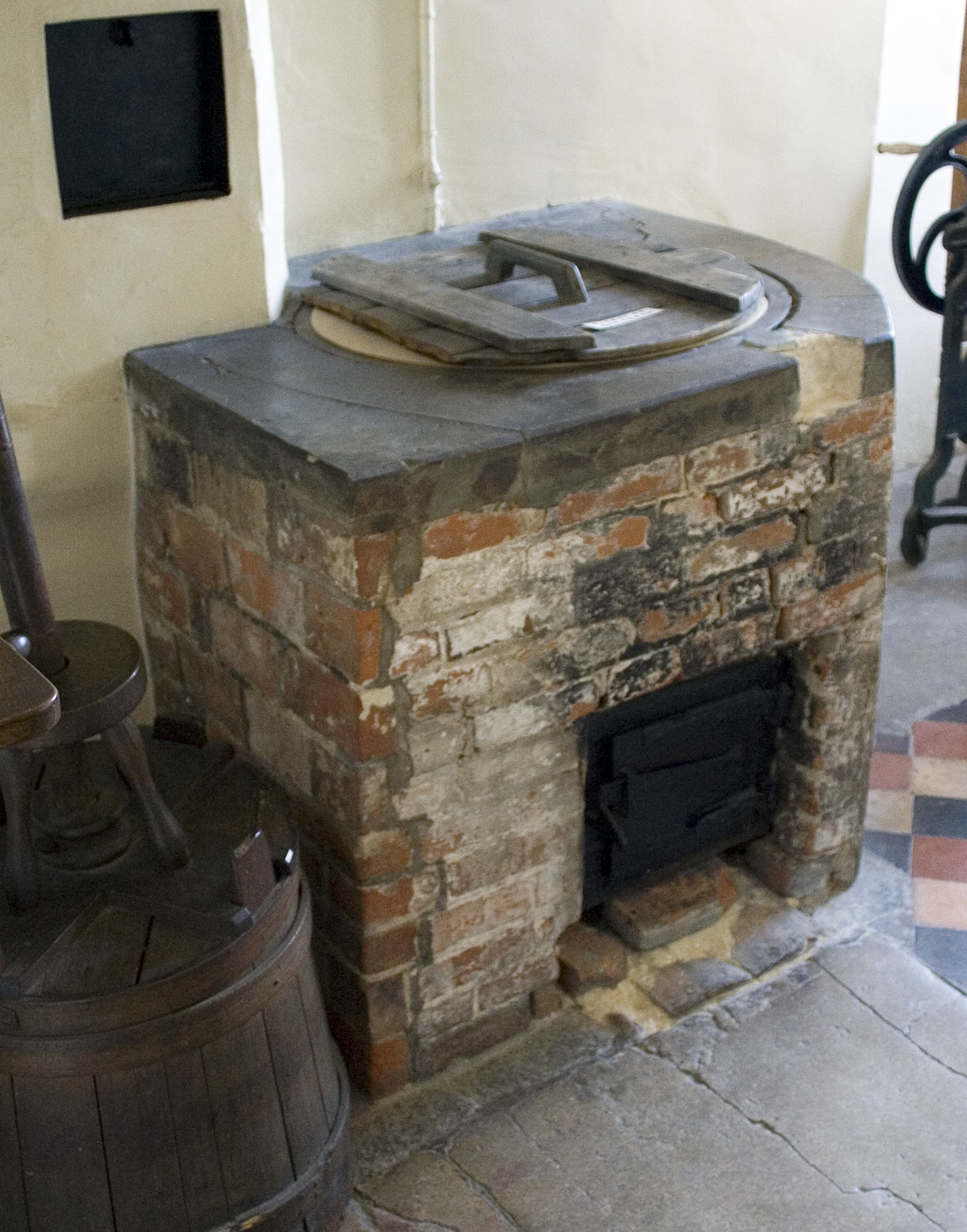
The water then had to  be heated in a copper, a large metal boiler set in a brick firebox in the corner of the kitchen or scullery, until it was hot enough to dissolve the soap and the grease on the clothes. The fire would be lit very early in the morning to have the water ready for the laundry after breakfast.

The clothes (which must often have been quite smelly) had to be sorted, soaked if necessary, treated for stains, then washed in a wooden tub or stone trough, using a bar of lye soap and a wooden 'dolly' to agitate and pound them. White clothes and sheets, as well as tougher, dirtier work clothes, were often boiled (separately) in the copper itself. After being put through a wringer, rinsed twice and starched, the wet clothes were wrung out and flattened using a mangle, and then hung to dry - outside in rural areas, but inside on racks in industrial areas where soot and other particles polluted the atmosphere.

Once the clothes were dry they were ironed using a heavy flat iron heated on the stove. Often several irons would be used, so that one could be in use while the others were re-heating. The whole process of soaking, washing, drying and ironing took several days, so the laundry was usually started on a Monday in order to have it done by Saturday afternoon.

Families saved up their laundry for as long as possible so that it could all be done at once, typically every few weeks if they had enough clothes to last that long. Nothing was put in the wash that could be spot-cleaned, and even underwear was worn several times before being washed. If they could afford to pay someone else to do their laundry, they did.

An unladylike occupation

Being a laundress, working independently or in a commercial laundry in one of the bigger cities, was one of the few occupations open to married women and widows. It could mean the difference between making ends meet and destitution for those without a husband's income or for women whose husbands had seasonal jobs, or who were poorly paid, as was the case for common soldiers such as David Whybrew.

Being a laundress allowed mothers to work at home and keep their children with them, though they were occupied with washing and ironing from early in the morning to late at night. The children were often used as unpaid labour to help with tasks such as carrying water, turning the mangle and hanging clothes. They also had to live with the steamy atmosphere, lines of wet washing, and the smell of damp clothes and laundry soap.

Because laundresses were often poorly educated, physically strong, independent women, who effectively ran their own businesses, they were considered 'unladylike' and lacking in social respectability. As a soldier's wife, Susan Whybrew was already pretty close to the bottom of the social heap. Being a laundress simply added another layer to her outsider status. Nevertheless, her labours helped to keep her family afloat.

References:

http://www.vintageconnection.net/VictorianLaundry.htm

http://www.avictorian.com/servants_laundry.html

https://washergenes.wordpress.com/2006/06/15/english-laundresses-a-social-history-1850-1930/

http://fet.uwe.ac.uk/conweb/house_ages/services/print.htm

___________________

You can find out more about Susan and David Whybrew and their family, in my book Susan: convict's daughter, soldier's wife, nobody's fool.
It's available on Amazon and other online books stores


Monday, April 4, 2016

Disturbing the peace - the Salvation Army

As I've mentioned before, William Beales and his family were dedicated members of the Salvation Army in Colchester. Recently I've been reading more about the history of the Salvation Army. It's not only fascinating in its own right, but also includes some intriguing links with our family history, both in Australia and England.

Catherine and William Booth
William Booth, a Methodist minister, began what was to become the Salvation Army as a mission in the slums of the east end of London in 1865. His focus was on bringing the gospel to the vast numbers of working class and underprivileged people who had no connection with the established churches. His unconventional methods, which included allowing women to preach and holding open air meetings with bands playing catchy tunes, created controversy but proved very effective.

The Christian Revival Ministry, as it was then known, soon extended its work of gospel preaching and started providing education, food relief and "penny banks" for the poor and destitute. The name was changed to the Christian Mission and then in 1878 it became known as the Salvation Army. It adopted an army-style uniform for its workers and began using military terminology for many of it's activities. Ordained ministers became "officers", it's local congregations "corps", and its buildings "citadels" or "barracks". William Booth remained the General. His wife Catherine was actively involved in both ministering and preaching.

The organisation soon spread beyond London to other parts of what William Booth referred to as "Darkest England". The first meeting in Colchester was held towards the end of 1881 in the Assembly Rooms in Queen St. When the local skating rink was put up for sale in 1882 it was purchased by an agent on behalf of General Booth and soon became the local  meeting place. General Booth himself visited Colchester and preached to large audiences on several occasions.

Initially the Salvation Army faced a lot of opposition in Colchester as elsewhere. The uneducated heckled and threw rocks and bottles, while the better educated tossed off letters to the editor such as this one to the Essex Standard in July 1882:
Sir, -- A short space in your columns, if you please, for a few valueless remarks of a simpleton.
We have in Colchester sixteen Churches, besides a Roman Catholic Chapel, and Meeting Houses, I don't know how many; and I suppose to these buildings are attached between thirty and forty Clergymen and other Gospel ministers; nor am I the one to say, or even think, that any individual member of that staff is negligent or his duties toward either God or man. Each, I hope, is serving his Master and his fellow-men to the best of his ability. So that to me it seems, there was no need whatever for a Salvation Army to march into this town with trumpet and drum, and flying colours, as if we were destitute of religious instructors, and it lead me to think, sir, that if General Booth, who I take to be commander in chief of these quasi-military forces, had ordered his obedient regiment into such as town, for instance, as Northampton, where it seems the Gospel preachers much have been utterly neglectful of their duties, where infidelity and atheism is riding paramount, they would have been doing much more real service in the great cause which they profess to support, than by disturbing the peaceable inhabitant of this town by their disorderly, and certainly most irreverent behaviour.
Perhaps the residents of Northampton had a different view. In any case, the Salvation Army's right to hold meetings both at the rink and outdoors was upheld by the local mayor and magistrates.

The Salvation Army in South Australia 


Individual members of the Salvation Army soon began to arrive in Australia as immigrants. Two early converts, John Gore and Edward Saunders, established the first official Corp in South Australia in September 1880, leading their first meeting from the back of a cart in the Botanic Gardens. The following week they held an open air meeting in Light Square, notorious for being the gathering place of prostititutes and larrikins, and this became a regular occurrence.

Members of the Salvation Army band
in Adelaide, c 1890
When the first officers, Captain Thomas Sutherland and his wife, arrived in Adelaide in February 1881 they were met by 68 people associated with the Corp. Within 3 years there were 32 officers and 12 Corps in South Australia. Meetings were held every night in a building in Morphett Street off Light Square, attended by hundreds of people. Though most saw the benefits of the Salvation Army's methods, not all were impressed. On July 30, 1881, the South Australian Register carried this report from the City Police Court:
Thomas Sutherland, "Captain" of the Salvation Army, was charged, on the information of Denis Sullivan, Inspector of Police, that in a certain place situated in the City of Adelaide — to wit, King William street — he did unlawfully disturb the peace, contrary to the statute in such cases made and provided.
The defendant, who appeared in a species of dark uniform with a silver S on the collar, pleaded not guilty. Mr. Pater opened the case by stating that the defendant was the so-called captain of the Salvation Army, a religious body who were in the habit of parading the streets in the evening, singing, screaming, and shrieking. On the occasion in question they had seriously frightened the horses on the cabstand and in the street, besides crowding passengers off the footpath by reason of the throng... 
...John Piper, commercial traveller, of Adelaide, gave evidence as to hearing very indecent language used in the crowd with the army on the night in question, on Sunday, July 24, and that the mob nearly jostled him off his feet. The army was singing 'Will you go,' each one trying to shout louder than the other. By the defendant— Saw the leaders of the army sawing up and down in the air with their arms. Did not know they were keeping time. Considered it a disgraceful exhibition.
Sutherland was fined one shilling, which he refused on principle to pay, and he was sentenced to being imprisoned "until the rising of this court".

A "Special" reporter for The Adelaide Evening Journal provided a more sympathetic if slightly bemused description of one of the Salvation Army meetings in May 1883, too long to include here, but worth reading.

The Salvation Army in Adelaide, as elsewhere, had a strong ministry to women and girls involved in prostitution, and those at risk of falling into it. In England the Salvation Army were at the forefront of a campaign to raise the age of consent from 13 to 18. In South Australia they opened several homes for "rescued girls", providing accommodation and assisting them to return to their family where appropriate. It's not outside the realms of possibility that they had some involvement in Harriet Whybrew's return to her parents in England, though I have no evidence of this.

Meanwhile, in 1882 the newly married Captain James Barker and wife Alice left Colchester and arrived at Port Adelaide to join the work in South Australia. But due to a labour strike on the docks, they had to keep going to Melbourne. They decided on arriving and looking around that they would establish their ministry there instead. The Salvation Army expanded its work rapidly, not just in Victoria but throughout Australia, as a result of the Barkers' pioneering activities.

My grandmother, Rosina,
in her Salvation Army uniform
The Barker family eventually returned to England in 1890. Their daughter Evalina, born in Victoria in 1884, became a Captain and in 1909 she married Albert William Thomas Orsborn.  Orsborn later became the 6th General of the Salvation Army, as well as the author of many of the songs in the Salvation Army song book.

Albert and Evalina employed William and Eliza Beales' daughter Rosina as a servant at their home in Ipswich during her teens. This photograph of Rosina in her Salvation Army uniform, must have been taken about this time.

Once again I'm struck by how different her life must have been after she married and moved to Lancashire, leaving behind not just her family and Essex but the Salvation Army background of her childhood.


Monday, July 27, 2015

How Mary met William - Mary Lander (1831-1879)


Map showing location of Dorset
It's strange, and sometimes slightly spooky, to discover that you've visited many of the places where your ancestors once lived, without realising it at the time. I've mentioned elsewhere that one of our daughters was baptised in the same church as her paternal great grandfather, though we didn't know that until recently. Now I've discovered that many generations of my mother's family lived in a little village called Langton Matravers, near Corfe Castle in Dorset, which we visted with our children in 1991. Back then I had no idea that this was part of our heritage.

It's hardly surprising that I didn't associate this area with our family history. Langton Matravers, on the Dorset coast near Swanage, is about as far removed from Manchester and Salford as you could imagine, both geographically and socially. But it was here that Mary Lander, the future wife of William Hough (and my maternal great great grandmother) was born.

Coastal walk not far from Langton Matravers
At the time of her birth in about 1831-32 the village was home to only a few hundred people, most of whom, it seems, were related to each other in some way. The local area was famous for its stone quarries and infamous for its smuggling activities. Legend has it that in 1876 the ceiling space of the parish church of St George in Langton Matravers was so laden with contraband goods that the walls began to sag and it had to be demolished and rebuilt.

Mary's father John Lander (1795-1871) was a stonemason, like many of the men in Langton Matravers. Her mother, Elizabeth Cross (1797-1866) was the only daughter of another stonemason, Thomas Cross and his wife Ann (known as Nancy, nee Savage).

Mary was the sixth child born to John and Elizabeth, so far as I can tell, and was baptised at St George's church. One of her older brothers, George (born 1826) seems to have died in infancy but her other brothers John Cross Lander, (1820) Robert (1828) and Joseph (1829) along with her sister Ann (1824) all survived.

Sometime between Mary's birth and the birth of her younger brother James the whole family, including Elizabeth's parents Thomas and Nancy moved to Salford. James was baptised in Christ Church, Salford in 1836. Unfortunately he doesn't seem to have survived infancy, and neither he nor George appear on the 1841 census.

Blackfriars wooden bridge,  Manchester
c 1831-1834 by Agostino Aglio
The bridge connected Manchester to Salford 
Mary's grandmother Nancy died in Salford in 1840 at the age of 72. When she was buried at the Wesleyan Methodist Chapel in Irwell St, her address was recorded as Muslin Street.

The family were still living in Muslin Street, off Hope Lane, at the time of the 1841 census. Mary's grandfather, Thomas Cross, lived with them or next door to them (it's not clear on the census).

What made them decide to make such a life-changing move? Economics is the most likely answer. While Dorset today might seem an ideal place for a quiet holiday, in the 1830's life was hard for most people. In the early 1830's riots broke out across southern England in protest against the use of mechanised farm machinery, which was putting labourers out of a job. While the Lander family were probably not directly affected, they would no doubt have suffered from the general stress and economic hardship.

Manchester Free Trade Hall (now a hotel)
built in 1853-56
Photo by David Dixon, used under a CC license
Meanwhile Manchester and Salford were growing rapidly. Alongside the many brick-built buildings that kept the Hough family occupied, large public buildings with impressive stone facades were being erected all over the city. Stonemasons would have been in great demand. John Lander and Thomas Cross were certainly not the only stonemasons from Dorset who moved to Lancashire.

It's not difficult to imagine how Mary might have met William Hough. Brickmakers and stonemasons must surely have worked alongside each other and got to know each other's families. They were married in Manchester cathedral on Christmas Eve, 1849. According to the marriage record, she was 19 and he was 18 years old. This must have been a rough estimate, since she claimed to be 18 years old at the time of the 1851 census. They remained in Salford for the rest of their lives.


Sunday, January 18, 2015

Fustian cutters

Samuel St Ledger (1821-1882) was a fustian cutter all his life, and so were his sons Ralph, Samuel, William and David. In her younger days his wife, Alice Dodd, was also a fustian cutter. But what did a fustian cutter do?

Corduroy: This modern diagram shows the warp (3) 
and the long (red-4) and short (green-5) weft threads; 
traditionally the knife (1) and the guide (2) 
are attached and the cutting motion is upwards.
"Cordsamt 6" by Ryj - Digitalkamera FinePix A 201. 
Licensed under Public Domain 
via Wikimedia Commons

Fustian refers to several types of heavy cotton cloth such as corduroy, velveteen and moleskin, which were once used mainly to make work clothes. It had ridges running along its length formed by loops of thread woven into the weft. For corduroy and velveteen these loops had to be cut to give the cloth a soft, thick surface.

The fustian cutter (sometimes called a cord cutter) used a tool rather like a modern-day stitch cutter (or button-hole cutter) on a long handle. This was run carefully along each ridge, cutting the loops.

At 7 ridges per inch, a bolt of corduroy cloth 31 inches (~ 80cm) wide would have been over 200 ridges across. Each bolt was many metres long, so cutting every one of these ridges was a laborious and skilled job.

The material was stretched across a long table and the fustian cutter would walk along the length of it, cutting one ridge, then back to cut the next one. Some fustian cutters were able to use two knives simultaneously. Once one length had been cut, the fabric was advanced. After the whole bolt had been cut, the material would be processed further to clean and brush it and then it was dyed.

Since each fustian cutter held their knife at a particular angle, it was important that only one person work on a bolt of cloth, otherwise it would be obvious where one stopped cutting and the other started. In a 60 hour week, a good fustian cutter could cut 500 yards (457 metres) of cloth. For this they might be paid 15 shillings.

Hebden Bridge in Yorkshire was particularly well known for its fustian manufacturing, and it was sometimes referred to as Fustianopolis. Foster Lane, where the St Ledgers lived, was the centre of fustian production. Some of the moleskin cloth produced here was exported to Australia, where it was used to make the iconic moleskin trousers worn by stockmen and other bush workers.

The first part of this video demonstrates what was involved.


Fustian cutting from Alternative Technology Centre on Vimeo.