Showing posts with label Leicestershire. Show all posts

Tuesday, September 24, 2019

Husbands Bosworth

Husbands Bosworth in Leicestershire is one of those places that I’ve never visited, though I would certainly like to see it one day. So what follows is what I can glean from the Internet. For several generations it was home to the Orton family, ancestors of my maternal grandfather, Albert Edwin Orton

Farmland north west of Husbands Bosworth (1)
It’s thought that the name was originally “Baresworde’, which is the Saxon word for Bar’s farm or settlement. The village, on gently rolling, fertile land close to the Avon river and the Grand Union Canal, was given the prefix “Husbands” to distinguish from the nearby Market Bosworth. “Husbandsmen” is another name for farmers.

In 1086, when the Domesday Book was written, Husbands Bosworth had a population of seventy one households, and was in the possession of five Norman lords. In the middle ages the village was established enough to build a church. Much of All Saints church has since been rebuilt, but the tower dates back to the fourteenth century.

The village gained some fame (or notoriety) in 1616 when 15 women were arrested as witches, and nine of them were tried and hanged on the same day. The other six were reprieved by the king, James I, after he happened to be passing through the area. One had already died in prison.

Several versions of the story appear online, but the gist of it is that the women were called to cure John Smith, the young grandson of the local land owner, Erasmus Smith, when he began having epileptic fits. When they failed to cure him by exorcism, they were accused of witchcraft. (One version says that the boy himself accused them, then later admitted that he’d made it up).

Unfortunately there seems to be no record of the names of the fifteen women accused of witchcraft, so I'll never know if any of them were among my ancestors. The name Orton is common in Leicestershire and the neighbouring counties, in fact there is a town in Leicestershire with that name. The first Orton in my family line that I’ve found living in Husbands Bosworth was John Orton, born about 1774. He and his wife, Mary Steans, were married in the parish church there in November 1804.

Husbands Bosworth (2)
Mary was born in Husbands Bosworth, as was her mother, Elizabeth Illiff, so it seems her family had probably been in the village for several generations. I haven’t been able to discover where John came from, though it’s likely to have been somewhere nearby. Nor do I know what John did for a living. But given that his sons were carpenters and wheelwrights, he probably had a similar occupation. They would have provided a service to the local farmers and villagers, who relied on wooden carts for transporting people and produce, and wooden farming implements.

John and Mary had at least four sons, one of whom, John (born 1807) died at the age of four. As was common in those days, the next son born after his death was given the same name, John. The two remaining sons, Thomas and Richard, both died in their twenties. A child baptised under the name Mary Ann Horton in Husbands Bosworth in 1815 may be John and Mary's daughter.

The younger John seems to have been a bit of a larrikin, as I’ve described in a previous post. He married Mary Ann Brown from nearby North Kilworth, in August 1841, though their marriage took place in Birmingham. John could have been working there, or possibly there was some objection to the marriage. Mary Ann was pregnant with their first child, Thomas Brown Orton, at the time.

The Cherry Tree, c1908, now demolished (3)
John and Mary Ann lived in Husbands Bosworth for the rest of their married lives and had six more children. John was self-employed as a carpenter, when he wasn't in court or in prison. After his death in 1880, Mary Ann became a publican, running the Cherry Tree in High Street, Husbands Bosworth, for several years. She retired to Leicester to live with her daughter Lucy.

The village reached its peak population of 934 in 1871 and then began to decline, as people in rural areas moved to cities and towns looking for work. By the 1891 census most of the Orton family had left Husbands Bosworth. Thomas Brown Orton, my mother's great grandfather, moved with his family to Manchester. It must have been quite strange moving from a small rural settlement to a place as large and overcrowded as Manchester.

Images:
1.Stephen McKay, Farmland north west of Husbands Bosworth - geograph.org.uk - 172870CC BY-SA 2.0
2. Mat Fascione, Husbands Bosworth 1CC BY-SA 2.0
3.Cherry Tree. Image from the Bosworth Bugle, issue 249

Friday, August 23, 2019

Manchester

Bee mosaic in Manchester Town Hall
Image from wikipedia.
Everywhere you go in Manchester, you’ll find bees - carved into buildings, decorating bollards and fountains, printed on flags, bumper stickers and tee-shirts, even tattooed on people’s arms.

Originally the worker bee symbolised the hard-working and productive labourers in the factories, those hives of activity during the industrial revolution. It was officially adopted into Manchester’s coat of arms in 1842.

More recently it has become a symbol of the unity and co-operation of Manchester’s population following the terrorist bombing of Manchester Arena in 2017.

Back when I began researching my family history, it certainly seemed as though Manchester was once a honey pot drawing families in. On almost every branch of the family tree, I discovered at least one family that migrated to Manchester, or the adjacent Salford, during the nineteenth century. On  my father’s side of the family, Thomas Ward's widow, Frances, left Walton le Dale and went to live there when she re-married, along with two of her daughters. Several of her grandchildren also went there to work.

On my mother’s side, Thomas Brown Orton and his family moved to Manchester from Leicestershire, the Bentleys from Yorkshire, the Landers from Dorset, the St Legers and the Hardmans from Ireland, the Holts and the Houghs from Cheshire.

So while my previous posts on "places" have been about towns and villages where one family lived, perhaps for several generations, this post covers many families. They often moved back and forth between Manchester and Salford addresses. Salford has its own distinct history, but in this post I'll consider it as part of Manchester.

Manchester's early history


The city gets its name from Mamucium, the name of a Roman fort built on a small hill in 79 AD to keep out the Celtic Brigantes. It was located close to the River Irwell, which meandered across an otherwise flat plain. After the Romans left in 407 AD, the little town around the fort stagnated until the thirteenth century.

In 1227 it was granted a charter for an annual fair, a sign of its increasing prosperity. By the 14th century a textile industry had grown up under the influence of Flemish weavers. Despite some setbacks due to outbreaks of plague and the English Civil War, the market town and its weaving industry gradually expanded.

Shambles Square, in the medieval quarter
Image from wikipedia


By 1720 Manchester was the most important town in Lancashire, with a grammar school, a collegiate church, a free public library and its own newspaper. The population of about 10,000 people had a single representative in the First Protectorate Parliament under Oliver Cromwell. This seat in Parliament was lost after the restoration of King Charles in 1660.

Manchester and the Industrial Revolution


Beginning in the late 18th century, the industrial revolution brought street-lighting, piped water, and a network of canals to transport coal and other goods. Britain’s first railway station was built in Manchester when the Manchester to Liverpool line opened in 1830.

The station built in 1830

An unprecedented influx of people arrived, drawn by the prospect of work in the building trades, the cloth manufacturing industries or the associated transport and service industries. By 1801 the population had reached 75,000 and thirty years later it had almost doubled again to 142,000. Despite this, the city had no representative in Parliament and most working people had no vote anyway.

Some people made their fortunes in the booming conditions, and used them to build impressive private and public buildings. For others, overcrowding and lack of planning led to poverty and hardship. Outbreaks of infectious diseases such as cholera were able to spread rapidly in the squalid conditions in which many people lived. High taxes and trade restrictions during and after the Napoleonic wars led to a recession and high unemployment. In 1812 food riots occurred in parts of the city.

On 16 August 1819, thousands of protesters gathered in a newly-cleared area known as St Peter’s Field to listen to the radical orator Henry Hunt and express their demand for parliamentary reform. The local magistrates sent the Manchester and Salford Yeomanry to arrest Hunt. They succeeded in capturing him, but in the process a child was killed and a woman was injured.

Map of St Peter's field and surrounds
Image by Jhamez84


The 15th Hussars were then sent to disperse the crowd. They went in on horseback with drawn swords, while other regiments blocked the exits to the square. In the panic and mayhem that followed, up to 18 people were killed and hundreds injured. The event became known as the Peterloo Massacre. It would be another thirteen years before the Reform Act of 1832 gave Manchester two representatives in Parliament, elected by eligible males.

Manchester continued to grow, absorbing the surrounding towns into its municipal borough and connecting to places further afield by rail, road and canal links. It was a place of exciting scientific discoveries, technical innovation, impressive engineering feats, and grandiose buildings, alongside social upheaval and radical political movements. Friedrich Engels and Karl Marx developed some of their political theories after visiting Manchester in the 1840s.

My family in Manchester


John Fielding is the earliest of my ancestors to have lived in Manchester. He was born there in 1778, and it may be that his family had lived there for several generations. Perhaps he was the same John Fielding whose name is on the list of those arrested at the Peterloo demonstration. In 1802 he married Jane Hughes, from Wrexham in Wales. Their daughter Harriet (born 1811) married William Holt, who was born in Cheshire.

Harriet and William’s son  John married Elizabeth Hardman, who had migrated from Ireland with her parents as a small child. And so it goes on. John and Elizabeth’s daughter Hannah and her husband William Hough were both born in Salford, as was William’s father John Hough, but his paternal grandfather was from Cheshire and his mother, Mary Lander, was from Dorset. The brick-making Houghs and the stone-cutting Landers no doubt helped to build parts of Manchester.

In the 1860s the Lancashire cotton famine caused a lot of hardship. But by the 1870’s, when the Orton family moved to Manchester from Leicestershire, conditions had improved, with less severe overcrowding and poverty and a better life-expectancy. Manchester had a reputation for social innovation, with some of the world’s first free public parks and libraries, and early branches of the Co-operative movement, the Trades Union Council and the women’s suffrage movement.

The city fostered both the arts and education and it was not uncommon for working people to be self-educated through their use of libraries and newspapers. Friedrich Engels left Manchester and moved to London in 1870.
Cotton-milling machinery in the
Science and Industry, Museum, Manchester

Manchester reached its height of industrial activity with the opening of the Manchester Ship Canal in 1894. This allowed ocean-going vessels to carry goods right into and out of the heart of the city. The world’s first industrial estate was built on its banks at Trafford Park. By now the population of the city and its suburban area had reached over 500,000.

Manchester in the twentieth century


Even as late as 1913, 65% of all the world’s cotton moved through Manchester. The city’s name was (and still is) synonymous with cotton goods such as sheets and towels. But cotton milling and other textile industries gradually gave way to machinery exports, chemical industries and financial businesses.

The First World War interrupted trade and the Great Depression that followed led to a decline in Manchester’s economy. Its population peaked around 760,000 in the early 1930s, but people had already started to move away.

During the second world war, Manchester and Salford were heavily bombed in what was known as “the blitz”. Children were hastily evacuated to safer areas by the government, with little preparation. My mother and her sisters, after experiencing the trauma of spending their nights in bomb-shelters and seeing their neighbourhood destroyed, were sent away from their parents to Blackpool, on the coast. After some time, the family were re-united when they moved to Crawshawbooth in Rossendale, 20 miles (32 km) from Manchester. They never went back.

Much of Manchester was rebuilt after the war, and it remained the most important city in the region, but it continued to decline economically. When I was growing up in semi-rural Rossendale, Manchester was the place to go to watch a pantomime, to see Father Christmas in one of the department stores or shop for special-occasion clothes, but I never thought of it as a place to live. Even when I returned there as an adult in the 1980s it still seemed a rather grimy, utilitarian place.

Manchester today


In 1996 the centre of the city was bombed by the IRA. Hundreds of people were injured and many retailers went out of business in the aftermath. But the redevelopment associated with the rebuilding, coupled with the Commonwealth Games held in Manchester in 2002, led to a revitalisation of the city. Slums have been cleared, old factories and warehouses re-purposed and public transport modernised.

Manchester's Christmas Markets, a popular annual event


Manchester now advertises itself as a tourist destination, something that would have been considered a joke when I was a child. I was impressed with how much had changed when I returned to Manchester in 2013, and even more so when I revisited it in 2018.

I haven't followed my family tree far enough into the twentieth century to see how many descendants of those original 'immigrants' are still living there. If you recognise any of your own ancestors names here, I'd love to hear from you.


General references used:
Manchester: wikipedia https://en.wikipedia.org/wiki/Manchester
A brief history of Manchester http://www.localhistories.org/manchester.html

Thursday, November 15, 2018

Was the convict James Orton related to John Orton?

Back in 2014, I described how I'd found records for a man in Australia with the same name as my Leicestershire-born great great grandfather, Thomas Brown Orton. My curiosity was piqued and I looked into this younger man's story a little. I soon realised that it was probably co-incidental that the two men were both named Thomas Brown. My great great grandfather (born 1842) was named after his mother, Mary Ann Brown, while the Australian (born 1880) was named after his maternal grandmother, Ruth Moore Brown. (I previously said he was named after his grandfather, but this wasn't correct.)

Along the way I discovered that the Australian Thomas was descended from a convict named James Orton from Leicestershire. I kept digging, hoping that he might still be related in some way to the Ortons in my family tree. He would be from the same generation as my ggg grandfather, John Orton, born in Husbands Bosworth in about 1813. But I couldn't find a link and eventually gave up.

The Australian Thomas Brown Orton came to mind again this week with the centenary of the Armistice at the end of World War One. I recalled that he enlisted in 1915. Sadly he died of war wounds in Belgium in September 1917, a terrible blow to his widowed mother in Victoria. I decided to look again at his story to see if I could find any new information to link his Orton family and mine.

His grandfather, James Orton, was sentenced on 31 December 1838 at the Leicester Assizes for his part in stealing a large quantity of wool from a hosier in Leicester. His sentence of 14 years transportation was much more severe than that of his companion, Thomas Tomkins, because he had a prior conviction for stealing. (Leicester Chronicle 5 January 1839, p4). He was transported to New South Wales in 1839 aboard the Barossa, at the age of 18.

In 1844, while still serving his sentence, he successfully applied for permission to marry Jane Waddell, a single woman from Glasgow who had arrived as a free settler aboard the Trinidad in 1841. They went on to have at least five children - Allison (1846), Anne (1847), Hannah (1849) James (c 1851) and George (1853).

James Orton received a conditional pardon on 10 June 1850. It seems he and his family moved to Sofala, near Bendigo in Victoria. On 22 March 1856 this advertisement appeared in the Sydney Morning Herald:


(JAMES ORTON left his wife and four children about the middle of February 1855, and has not since been heard of. Should this meet the eye of any person who has seen the above James Orton, will please communicate with his wife.JANE ORTON, Sofala.)
Whether poor Jane ever managed to locate James is unknown. Possibly he was the James Orton imprisoned in Darlinghurst Gaol in 1862 for being "of unsound mind". There were many James Ortons in New South Wales and Victoria at the time and the prison record contains few details, so it's impossible to be sure.

Jane died suddenly of heart disease in 1872. I haven't been able to find a definite date for James' death. Their son James married May Fulton Eaglesim and became the father of Thomas Brown Orton. He died in 1912.

So, was the convict James Orton related to 'my' Orton family from Leicestershire or not? Until I discover who his parents were, I won't know. I still haven't been able to track him down prior to his appearances in court in Leicester. Several James Ortons were born in Leicestershire around the right time (1820). Some of these I've excluded because they were still living in Leicestershire after 1839. None of the others have clear links to my Orton family.

If there is a connection, it may be much further back than I've been able to go so far. I know that 'my' Thomas Brown Orton's grandparents were John Orton and Mary Steans. (Not to be confused with his parents, John Orton and Mary Brown, though it certainly is confusing!) Mary was baptised in Husbands Bosworth in 1784, and she and John Orton were married there in 1804, but John's origins are still a mystery. Another of those mysteries yet to be solved.

Summary

The "English" Thomas Brown Orton
b 1842, Husbands Bosworth, Leicestershire
m Sarah Gregory, 1865, Leicester
d 1918, Ashton, Lancashire

Parents:

John Orton
b about 1813, Husbands Bosworth
m 1841, Birmingham
d 1880, Husbands Bosworth


Mary Ann Brown (daughter of Joseph Brown and Mary Berry)
b 1819, North Kilworth, Leicestershire
d 1901, Leicester, Leicestershire


Grandparents:

John Orton
b ? 1780, location unknown
m 1804, Husbands Bosworth
d October 1840, Husbands Bosworth


Mary Steans (daughter of Thomas Steans and Elizabeth Illiff)
b 1784, Husbands Bosworth
d July 1863, Husbands Bosworth


The "Australian" Thomas Brown Orton
b 1880, Eaglehawk, Victoria
d 1917 Hell Fire Corner, Belgium

Parents 
James Orton b about 1851, 
m 8 March 1873, the Manse, Eaglehawk
d 1912, Victoria

May Fulton Eaglesim (daughter of William Eaglesim and Ruth Moore Brown)
b March 1853, Eaglehawk, Victoria
d 1926, California Gully, Bendigo, Victoria

Grandparents:
James Orton
b about 1820, Leicestershire. Transported 1839
m 1844, Port MacQuarie, NSW
d ??

Jane Waddell
b about 1821, Glasgow, Scotland
d October 1872, Bendigo, Victoria


Sunday, August 31, 2014

Mary Ann Brown (1819 - 1901) - wife of John Orton

Farmland near North Kilworth
(image by Stephen McKay, geograph.org.uk)
Mary Ann was the eldest daughter of Joseph Brown, a farmer of North Kilworth in Leicestershire, not far from Husbands Bosworth. According to "The Modern Doomsday Book" printed in the Leicester Chronicle and Leicestershire Mercury 11 March 1876, Joseph owned just over 35 acres of land, worth  £97.15s.  He seems to have been an active member of his community, serving on a Grand Jury in 1842, supporting the Liberal candidate for parliament in 1868, and being listed as a partner in the Leicestershire Banking Company in 1870.

It's easy to imagine, then, that Mary Ann's marriage to the hot-headed John Orton in 1841 may not have met with great approval from Joseph and Mary. Mary Ann must have had quite a tough life being married to John.

Their first son, Thomas Brown Orton, was born early in 1842 a few months after their marriage. Over the next 20 years at least 6 other children were born to Mary Ann - William John, Lucy Ann, Alfred, Fanny, Mary Jane and Agnes. As mentioned before, they seem to have been baptised in two batches, one in 1845 after the birth of Lucy Ann, and the second in 1862 after the birth of the youngest child, Agnes, all in Husbands Bosworth.

Two of Mary Ann's married sisters, Catherine Dent and Maria Latham, were visiting her on the night of the 1851 census, along with Maria's infant daughter Isabella. Maria had married a man from London, John Latham. Sadly she died of tuberculosis at her parents' home in 1856, an event noted by the Leicester Chronicle.

At the time of the 1871 census Mary Ann and 15 year old daughter Mary Jane were staying with the eldest of the Orton's daughters, Lucy Ann. Lucy Ann's husband John Thomas Pulford was a "beer house keeper" at the New Royal Arms, St Margaret in Leicestershire. The Pulfords had a one year old daughter Liza and a one month old, Ann, so perhaps Mary Ann and Mary Jane were there to help. Strangely, Mary Ann is described as "farmer's wife", though there is no record of John ever being a farmer.

The early 1880's were a time of change and sadness for Mary Ann. Her husband John died in the middle of 1880. Not long afterwards, in early 1881, Agnes died at the age of 19. William was an inmate of the Leicestershire and Rutland Lunatic Asylum when the census was taken in 1881, and seems to have died not long afterwards. Fanny was working as a school mistress in the workhouse at Great Bowden. Alfred and his wife Henrietta had moved to West Derby, near Liverpool, and Thomas and wife Sarah had moved to Manchester. In the census of 1881 only Mary Jane was still at home with Mary Ann.

But Mary Ann still had many years of life in her. She was listed in the 1881 census as the publican of the Cherry Tree Inn in Husbands Bosworth, probably the same Cherry Tree mentioned in John's defence in his trial in 1861. Mary Jane was a waitress, and six year old grandson Oliver Pulford was staying with them, along with a boarder, a groom named Joseph Bacon.

In September 1886, according to the Leicester Chronicle, Mary Ann was charged with keeping her licensed premises open on a Sunday (8 August) and with allowing gaming to occur there. A zealous policeman had noticed that the back door of the inn was open, and had gone in to see what was going on. Mary Ann and her lawyer successfully argued that what the policeman witnessed was a private party in honour of her granddaughter's birthday. The case was dismissed, although the judge commended the policeman for rigorously carrying out his duties.

By 1891 Mary Ann had retired to Knighton in the Blaby district of Leicestershire and was living alone "on her own means". She went to live with Lucy Ann in Leicester some time before 1901, and died there in the second quarter of that year, at the good age of 82.


Monday, August 11, 2014

John Orton (1813-1880) - a reckless driver

In October 1861 John Orton of Husbands Bosworth was charged with 'over-driving a horse'. A witness claimed that his pony cart had been going "at a furious pace" near Lubenham (about 4 miles from Husbands Bosworth), maybe as much as 10 miles per hour, with John thrashing the poor pony relentlessly.

The witness, a gentleman by the name of Captain George Ashby Ashby Esq (sic), having failed to stop the driver or obtain his name, went to the police in Husbands Bosworth, where the pony cart was headed. The policeman, hearing the story, said 'he thought he knew who it was'. They both proceeded to follow John Orton, still thrashing his horse, to his house where Captain Ashby identified him. 

The Cherry Tree, Little Bowden (near Market Harborough)
image by Mat Fascione
In court, PC Farmer claimed that John was drunk, "his hat being to one side and nearly off". John called to his defence the proprietor of the Cherry Tree Inn in Market Harborough, who said that John had been perfectly sober when he left there at half past six. John Shirves, who had seen John Orton at the Crown Inn in Theddingworth, said he had been perfectly sober when he left there at 8 o'clock. And Esther Fox, who was charing at the Crown Inn, agreed that John Orton had left there 'perfectly sober'.

The judge decided he could give no opinion on the charge of drunkeness "since if the defendent was drunk it was at Bosworth and if riotous it was at Lubbenham." He ordered John be fined 10 shillings and 14 shillings costs on the first charge of over-driving his horse.

John Orton, born in 1813, was a colourful character. We've seen already that in 1841 he and Mary Ann Brown were married in Birmingham, although John was from Husbands Bosworth and Mary Ann from the nearby North Kilworth. Whether this was because he was working in Birmingham, or because they experienced some opposition to the marriage we'll never know. Thomas Brown Orton, their first child, was born early in 1842.

19th century tool bench
John followed his father (also called John) into carpentry. He seems to have have been successful enough at his trade to employ others, but not always without friction. In December 1842, a young apprentice named William Rose complained to the Court of Petty Sessions that John Orton had beaten him, refused to pay him for five weeks' work and kept his clothing when he dismissed him. John's defence was that he had only given a 'gentle clout or two' to the lad's head when he misbehaved. The court determined that Rose should pay for his board, and that John Orton should return the clothing he'd seized and pay the expenses. A week later a warrant was issued against John Orton for not complying with the Magistrate's decision, but the outcome isn't recorded.

In March 1843 a John Orton, aged 29, of Husbands Bosworth, was charged with another man named George Glover of the more serious offence of assaulting a police officer. They had apparently been drunk at the time that the policeman, Thomas Bailey, called at the house in Husbands Bosworth to investigate the noise they were making. If the newspaper is to be believed, the policeman was close to death for a few days from the injuries he received. Both men were sentenced to eighteen months imprisonment. 

At this point Mary Ann would probably have been pregnant with William John (born about 1844). Their first three children (Thomas, William and Lucy Ann) were all baptised on the same day in 1845, presumably after John returned home.

A one-line item in the Leicester Chronicle records that John was back in court in 1846 charged with non-payment of wages. He was ordered to pay. Perhaps he became quieter for a while - the only record of him between then and his reckless driving charge in 1861 was when he served on a jury in Husbands Bosworth in 1849.

The Leicester Chronicle mentions John once more in 1869 when he was in dispute with a William Gimson, a timber dealer of Leicester, over a load of hay which John had sold to him to offset the cost of some timber. The hay, it seems, was of poor quality and not worth anything like the 5 pounds per ton that John had claimed. 

John appears listed as a carpenter and wheelwright in various directories of Leicestershire and Rutland in the 1860s and 1870's. In the newspaper article in 1869 and in the 1871 census he is described as a builder. He died in 1880, at the age of 67. No probate is recorded.

It is worth noting that John had several namesakes in Leicestershire. One of these was born in 1791 and lived in Husbands Bosworth in 1841. He was married to Sophia and is described on the census as an "F. W Knitter W". He and Sophia had moved to Blaby by 1851. 

Another John Orton, born about 1817 in South Kilworth, was a carpenter and his first wife was called Mary, which is obviously a possible source of confusion. However he remained in South Kilworth all his life. He is mentioned in a couple of newspaper articles as John Orton of South Kilworth. All the articles I have used above specifically refer to John Orton of Husbands Bosworth.


Sunday, July 27, 2014

Sarah Harvey

Sarah Harvey's life left very little trace in the public records. We know that she married Robert Gregory in 1826 in Diseworth, Leicestershire, and from the census records in 1841 and 1851 we know that they had at least 6 children - Mary, Jane, John, Robert, Sarah and Ellen. Everything else has to be deduced from other sources.

It seems that Sarah was probably the sister of Joseph Harvey, a grocer with a shop in Market Place in Leicester. In the 1851 census Joseph had a nephew living with him, Robert Gregory, whose age corresponds with Sarah's son Robert (born 1835). He also had an employee, Thomas Brown Orton, who later married Sarah and Robert's daughter Sarah Gregory. And Joseph seems to have provided a character reference to Robert Gregory when he was tried for receiving stolen goods in 1838.

A newspaper item in the Leicester Chronicle, Saturday, November 27, 1841, notes the death "on 12th inst, Mrs Harvey, aged 74, mother of John and Joseph Harvey, grocers, Market-place". The only recorded death for that date which fits the description of Mrs Harvey is that of a Mary Harvey. And the only Mary I can find who married  a Harvey in Leicestershire in the period which would fit with Joseph's age is Mary Jarrom, who married Robert Harvey in April 1796. (This tallies with several online family trees which have Mary Jarrom and Robert Harvey as the parents of Joseph).

Long Whatton Baptist Chapel, built 1793
photo from Matt Fascione
Unfortunately I can't find any record of Joseph's birth, which would have been in about 1808 based on his age on the census and his age at death. But four children of a Robert and Mary Harvey were baptised in the Long Whatton Baptist church, Belton (the place where Joseph was born) according to the Non Conformist and Parochial registers - Peter (1799), John (1801), Sarah (1803) and Jane (1805).

The presence of John and Sarah in the list is interesting, especially since Sarah's date of birth would fit with Sarah Gregory nee Harvey. Joseph's absence from the same records could be explained by the fact that Robert Harvey died in 1808 (according to one on-line family tree which says the date is recorded in the Diseworth church). Possibly the crisis in the family somehow prevented him being baptised in the same church.

If Sarah was Joseph and John's sister, she seems to have had a much less successful life than her brothers, in worldly terms at least. Joseph married Selina Tyers in 1846, an event which was deemed important enough to be noted in the Leicester chronicle. Joseph's grocery business did well enough for him to employ several other people as shop assistants and servants, and when he died at the age of 73 he left an estate of nearly £600. Robert Gregory left no estate when he died at the age of 38.

Sarah herself seems to have died in Whetstone, near Blaby in Leicestershire, in May 1851. A brief notice in the Leicester Chronicle notes that "Mrs Gregory, sister of Mr J Harvey, grocer, died at Whetstone after a few days illness." She was 46. Her two youngest children, Sarah (11) and Ellen (10) were still living with her at home when the census was taken earlier in 1851. What became of them is a mystery. The young Sarah reappears when she married Thomas Orton in 1865, but I haven't been able to trace Ellen.


Sarah Harvey c 1805-1851(?)

Individual Summary27 July 2014

Name:Sarah HARVEY
Sex:Female
   
Individual Facts
Birthca 1805Leicester, Leicestershire, England
Census1841 (circa age 36)Leicester, Leicestershire, England1
Census1851 (circa age 46)Whetston Leicestershire, England2
Deathposs 1851 (possibly age 46)Blaby, Leicestershire, England3
   
Marriages/Children
1. Robert GREGORY (1805-1843)
ChildrenSarah GREGORY (1840-1923)
 Mary GREGORY (1828-    )
 Jane GREGORY (1829-    )
 Robert GREGORY (1835-    )
 John GREGORY (1831-    )
 Ellen GREGORY (1841-    )
1. 1841, England, , ; digital image, Ancestry.com. 1841 England Census [database on-line]. Provo, UT, USA: Ancestry.com Operations, Inc, 2010, ancestry.com.au (ancestry.com.au : online 27 July 2014).
2. 1851 census, England, , ; digital image, Ancestry.com. 1851 England Census [database on-line]. Provo, UT, USA: Ancestry.com Operations Inc, 2005, ancestry.co.uk (www.ancestry.co.uk : internet 26 July 2014).
 3. "FreeBMD. England & Wales, FreeBMD Birth Index, 1837-1915 [database on-line]," database, Provo, UT, USA: Ancestry.com Operations Inc, 2006, ancestry.co.uk (www.ancestry.co.uk: online 26 July 2014), ; citing General Register Office. England and Wales Civil Registration Indexes. London, England: General Register Office.

Robert Gregory c1805-1843

Individual Summary27 July 2014

Name:Robert GREGORY
Sex:Male
Individual Facts
Birthca 1805Leicester, Leicestershire, England
Misc15 Oct 1838 (circa age 33)Tried for larceny?; Leicester, Leicestershire, England1
Death1843 (circa age 38)Leicestershire, England2
Marriages/Children
1. Sarah HARVEY (1805-1851)
ChildrenSarah GREGORY (1840-1923)
Mary GREGORY (1828-    )
Jane GREGORY (1829-    )
Robert GREGORY (1835-    )
John GREGORY (1831-    )
Ellen GREGORY (1841-    )
  1. "England & Wales, Criminal Registers, 1791-1892," database, Ancestry.co.uk (ancestry.co.uk: internet 20 June 2014)    2. Trustees of FreeBMD, "FreeBMD," database, FreeBMD (http://www2.freebmd.org.uk/: internet 26 July 2014), 

More about Robert Gregory:

Sarah Gregory 1840-1923

Individual Summary27 July 2014
Name:Sarah GREGORY
Sex:Female
Father:Robert GREGORY (1805-1843)
Mother:Sarah HARVEY (1805-1851)
Individual Facts
Birth1840Leicester, Leicestershire, England1
Census1841 (about age 1)Leicester, Leicestershire, England
Census1851 (about age 11)Whetstone, Leicestershire, England
Census1881 (about age 41)47 Wynford Street, Pendlebury, Salford, Lancashire
Census1901 (about age 61)Droylsden, Lancashire, England
Census1911 (about age 71)25 Medlock St, Droylsden, Lancashire, England
Death1923 (about age 83)Ashton, Lancashire, England1
Marriages/Children
1. Thomas Brown ORTON (1842-1918) married 7 March 1865
ChildrenPercy Gregory ORTON (1865- 1891  )
Albert Edwin ORTON (1867-1919   )
Ernest Frank ORTON (1869-    )
John Sidney ORTON (1870-    )
Augusta Eleanor ORTON (1873-    )
Charles Walter ORTON (1875-    )
Bertha Annie ORTON (1876-    )

1. "FreeBMD. England & Wales, FreeBMD Birth Index, 1837-1915 [database on-line]," database, Provo, UT, USA: Ancestry.com Operations Inc, 2006, ancestry.co.uk (www.ancestry.co.uk: accessed ), ; citing General Register Office. England and Wales Civil Registration Indexes. London, England: General Register Office.

More about Sarah Gregory
A romance in a grocers' shop?


Thursday, July 17, 2014

Robert Gregory - a lucky escape

While looking for information about Sarah Gregory's father, Robert Gregory (born c 1806), I came across these interesting snippets of news.

The first comes from "The Leicester Chronicle: or, Commercial and Agricultural Advertiser", February 16, 1833, Issue 1169

"Robert Gregory, ostler, was charged by his master with embezzling 8s. The prisoner said he would repay the money if the complainant would take him on again. "I doubt you'd take him in again" said Mr Ald. Lovell. Remanded."
Eight shillings was quite a large sum in those days. Happily for Robert Gregory, his employer seems to have been more lenient than most. The same newspaper reported a week later, Saturday February 23, 1833:

"Robert Gregory (remanded last week) was discharged, his late employer, Mr Buckley Ward, declining to proceed further against him."

The Market Place, Leicester
photo from Djiin 76 on Flickr
Whether this was the same Robert Gregory who later became Sarah's father I have no way of knowing. However, this next piece of news contains a clue which suggests that this time it was quite likely to be Sarah's father Robert:

From the Leicester Chronicle, Saturday, September 29, 1838, Issue 1454

"Robert and William Gregory, of Waterloo St., brothers, were charged with having the following articles in their possession under suspicious circumstances:- A brass kettle holding about five pints; a hand saw; a damask table cloth, 3 3/4 yards long by 2 2/3 yards; one calico sheet, 2 yards long by 1 7/8 yards' one ditto, about two yards square; part of ditto, 2 yards long by 1 1/4 yards; one clean cotton pillow case, and one ditto dirty.
The plea that the prisoners made was their mother had sent the goods from Birmingham to William at Leicester and he had given them to Robert Gregory. Mr Harvey, Market Place, said the latter had lived with him two years and was punctual, sober and honest. - Remanded."

Entrance to Market Place, Leicester, c 1904
Photo from Djinn 76 on Flickr
Later on the same page is the note:

"Robert Gregory, who was brought before the bench on Friday, was discharged. - William Gregory, Rachel Freer and William Gannon were remanded for further examination."

It seems quite probable that this is 'our' Robert Gregory. He married Sarah Harvey in 1826, and so Mr Harvey of Market Place was almost certainly his brother in law, Joseph Harvey.


Apparently it wasn't long before Robert needed Mr Harvey's good services again:

From the Leicester Chronicle, Saturday October 20, 1838, Issue 1457

"Robert Gregory was charged with receiving a quantity of articles of dress belonging to Miss Alice Fox of Castle Donington, knowing them to be stolen. The prisoner, in his defence, maintained the account he gave to the magistrate - that his brother had brought the property for him to sell, telling him that it belonged to their mother who wished it to be sold. Mr Harvey, grocer, Market-place, gave him a good character. Mr Sheen said that during the time Gregory had been in the service of Mr John Ellis, at the Railway Station, both he and Mr Ellis found him to be a steady, honest industrious man. The Jury found him guilty and he was sentenced to two months hard labour - two weeks solitary confinement: the Chairman ... that the punishment was slight on account of his good character."

Two months of hard labour may not seem a 'slight' punishment. But given the crimes with which he was charged, Robert was very fortunate not to have been transported, as the following story illustrates. In 1843, the year that Robert died, two brothers named William and Thomas Gregory appeared in court in Worcester:

From The Leicester Chronicle, Saturday January 14, 1843, issue 1676

"Caution to shopmen: At the Worcester City Sessions on Monday week, two young men, named Thos. and William Gregory, drapers assistants, formerly residents of Leicester, were placed at the bar, the former charged upon three indictments of purloining silk goods to a considerable amount, the property of his employers, Messrs Hill and Turley, and the latter with feloniously receiving some pieces of silk from his brother. To each of the indictments the prisoners pleaded guilty. The Recorder, in passing sentence, observed, that the course they had adopted in pleading guilty was a very wise one, as this most serious charge, as far as he was able to judge from the depositions, was exceedingly clear against them: and it was the more serious with regard to Thomas Gregory inasmuch as he had violated the trust reposed in him as servant of the prosecutors. He then sentenced Thomas Gregory to a fortnight's solitary confinement for each of the first two indictments, and, in conjunction with William Gregory, to be afterwards transported for seven years."

Whether this is the same William Gregory as in the earlier stories is impossible to tell. Perhaps not, as his convict transportation records show that he and Thomas were in their early twenties at the time. They were sent to Van Diemens Land (Tasmania) and from there to Geelong in Victoria. The last trace I've found of them is in 1846 when they absconded from their employer while still convicts.

Sunday, June 8, 2014

A romance in a grocer's shop?

I always think it would be fascinating to know how couples on the family tree met and married, but usually it's a question that can't be answered from the historical records. However, in the case of Thomas Brown Orton and Sarah Gregory, the records do provide a clue.

Midland Railway Station, Leicester
opened in 1840, the year of Sarah's birth.
Robert, her father, possibly worked here.
We know from the later census records that Sarah was born in Leicestershire in the early 1840's. In all except the 1901 census (when Husbands Bosworth is indicated by 'ditto' marks under Thomas' place of birth) her birthplace is given specifically as Leicester.

Although there are several Sarah Gregory's whose births are registered in Leicestershire between 1840 and 1843, the only birth recorded in Leicester itself about this time occurred in the first quarter of 1840.

This Sarah appears in the 1841 census as a 1 year old child. She was living with her parents, Robert and Sarah Gregory in West Leicester, along with her older siblings Mary (aged 13), Jane (12), John (10) and Robert (6) and a younger sister Ellen, who was only 3 months old.

Two years later, in 1843, Robert Gregory died at the age of 38. How he died, or how his widow Sarah survived and raised her children alone isn't clear. She seems to have been employed at the time of the next census in 1851, when only Sarah (11) and Ellen (10) remained with their mother in a household in Whetstone, near Leicester.

In the same census, young Sarah's 16 year old brother Robert was living and working with a grocer, Joseph Harvey and his wife Selena, in Loughborough, north of Leicester. This was the same grocer who employed Thomas Brown Orton a few years later. On the census Robert is described as a nephew. In fact Robert's mother was Sarah Harvey before she married the older Robert Gregory.

So it seems that Thomas Orton married his employer's niece. Their marriage certificate (viewed online) confirms that Sarah was the daughter of Robert Gregory, engine driver, deceased. Thomas was said to be living in Husbands Bosworth at the time of the marriage, so he may no longer have been employed by Joseph Harvey.

It also seems that Sarah was not completely truthful about her age when she married, since the certificate records that she was 23 year old. This would put her date of birth at 1842. Or perhaps she simply didn't know her age. In the later censuses she always underestimated her age by a year or two.

Friday, May 30, 2014

Thomas Brown Orton


Name:Thomas Brown ORTON
Sex:Male
Father:John ORTON (1813-1880)
Mother:Mary Ann BROWN (1819-    )

Individual Facts
BirthJan 1842–Mar 1842Husbands Bosworth, Leicestershire, England1
Baptism18 May 1845 (about age 3)Husbands Bosworth, Leicestershire, England2
Census1851 (about age 9)Husbands Bosworth, Leicestershire, England3
Census1861 (about age 19)Market Place, Leicester, Leicestershire, England4
Census1911 (about age 69)24 Medlock St, Droylsden, Lancashire, England5
Death1918 (about age 76)Droylsden, Lancashire, England6

Marriages/Children

1. Sarah GREGORY (1840-1923)

ChildrenPercy Gregory ORTON (1865-    )
Albert Edwin ORTON (1867-    )
Ernest Frank ORTON (1869-    )
John Sidney ORTON (1870-    )
Augusta Eleanor ORTON (1873-    )
Charles Walter ORTON (1875-    )
Bertha Annie ORTON (1876-    )
More about Thomas Brown Orton:

Thomas Brown Orton 1842-1918
A romance in a grocer's shop?


1. "FreeBMD. England & Wales, FreeBMD Birth Index, 1837-1915 [database on-line]," database, Provo, UT, USA: Ancestry.com Operations Inc, 2006, ancestry.co.uk (www.ancestry.co.uk: online 25 May 2014), ; citing General Register Office. England and Wales Civil Registration Indexes. London, England: General Register Office.
 2. "England, Select Births and Christenings," database, ancestry.com, ancestry.com.au (ancestry.com.au : online ), .
 3. 1851 census, England, , ; digital image, Ancestry.com. 1851 England Census [database on-line]. Provo, UT, USA: Ancestry.com Operations Inc, 2005, ancestry.co.uk (www.ancestry.co.uk : online May 2014).
 4. 1861 England and Wales Census, England, , ; digital image, Ancestry.com. 1861 England Census [database on-line]. Provo, UT, USA, ancestry.com.au (ancestry.com.au : accessed ).
 5. 1911 census, England,  digital image, Ancestry.com. 1911 England Census [database on-line]. Provo, UT, USA: Ancestry.com Operations, Inc., 2011, ancestry.com.au (ancestry.com.au : accessed ).
 6ancestry.co.uk, .

Thursday, May 29, 2014

Another Thomas Brown Orton

While I was looking for details about Thomas Brown Orton from Husbands Bosworth in Leicestershire, I came across another Thomas Brown Orton, this one born in Eaglehawk, Victoria, Australia in 1880. I was intrigued, since the name is not a common one, and it would be fun to discover some more Australian relatives. So I decided to find out a little more about him, to see if there was any distant connection between the two.

The Australian Thomas Brown was the son of James Orton and May Fulton Eaglesim. May's father's name was Thomas Brown Eaglesim, which probably explains where the middle name came from. (Correction - May's father was William Eaglesim, her mother was Ruth Moore Brown.)

This Thomas Brown Orton was the grandson of James Orton (born about 1817), who was transported to Australia for 14 years on the Barossa in 1839. James was tried and convicted (for what crime I don't know) in 1838 in Leicester. In 1844 James married a Jane Waddell who arrived on the ship Trinidad as a free settler.

It's tempting to think that perhaps James was somehow related to the Ortons of Husbands Bosworth, but I haven't been able to make any connection. He would be a contemporary of John Orton, but I don't have a firm date or place of birth for either of them.

York and Oriental Hotels,
 Kalgoorlie ca. 1900

image via wikipedia
The Australian Thomas Brown Orton lived in the Western Australian mining town of Kalgoorlie for a while. By a strange co-incidence he seems to have been a grocer, like the English Thomas Brown Orton. Unfortunately he died in Belgium in 1917 while fighting in the war.

If anyone can tell me more about the elder James Orton and his origins, or if you would like more details about where I found the information in this post, please contact me, either through the comments section or by email. (stella DOT budrikis AT gmail DOT com)


Monday, May 26, 2014

Thomas Brown Orton 1842-1918

By a strange quirk of fate, my paternal great grandfather John Ward and my maternal great great grandfather, Thomas Brown Orton, were both born within weeks of each other in early 1842, the one in Walton le Dale in Lancashire, the other in Husbands Bosworth in Leicestershire. The disparity in the "greats" comes about because John Ward's youngest son, my grandfather Thomas Henry Ward, married relatively late in life.

Thomas Brown Orton was the first son of John Orton and Mary Ann Brown, arriving 6 months after their marriage in August 1841. John Orton was a carpenter, and it's likely that he travelled here and there, wherever work was available. At the time of their marriage he and Mary Ann were living in Great Hampton Row in Birmingham, so possibly John had found work on the nearby building of St Chad's Cathedral, which was begun in 1839 and completed in 1841.

Husbands Bosworth
(image from Wikimedia
Thomas' birth was registered in Market Harborough in Leicestershire, but from later census information it seems he was actually born in Husbands Bosworth, Leicestershire, a small town right in the centre of England. (In case you are wondering, the strange name came about because there was a need to distinguish the town from the nearby Market Bosworth. Husbands Bosworth was the place of husbandry, ie it was a farming community.)

Thomas and his younger siblings William (born 1843) and Lucy Ann Brown (born 1845) were all baptised at All Saints Church in Husbands Bosworth on the same day, 18 May 1845, another clue that perhaps John led a fairly mobile existence. There was another batch of christenings of John and Mary Ann's children in March 1862, when Alfred (1850) Fanny (1853) Mary Jane (1854) and Agnes (1862) were baptised.

Leicestershire, England 
The Orton family were in Husbands Bosworth at the time of the 1851 census, with two of Mary Ann's sisters and a niece present as visitors on census night. At the 1861 census the 18 year old Thomas was living with the family of Joseph Harvey in Leicester and working for Joseph as a grocer's assistant.

Thomas married Sarah Gregory, a girl from Leicester, early in 1865. They seem to have carried on the family tradition of marrying in haste and giving their first son his mother's maiden name as a middle name. Percy Gregory Orton was born in the second quarter of 1865. Albert Edwin followed in 1867, then Ernest Frank in 1869 and John Sydney in 1870.

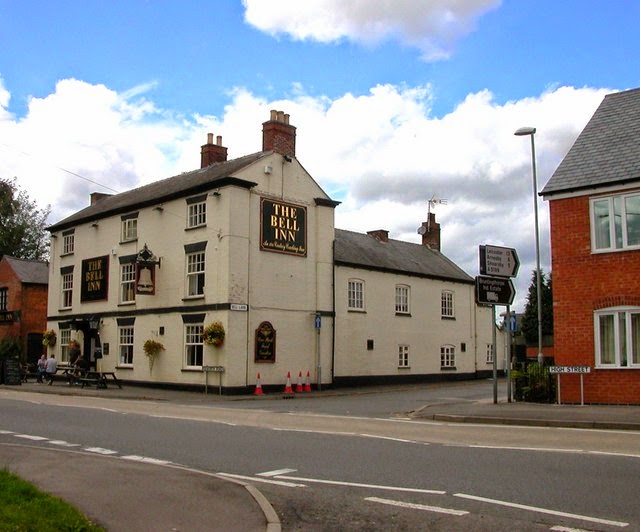
The Bell Inn, High St, Husbands Bosworth
image: Ian Rob
The 1871 census shows Thomas employed as a police constable in Leicester. Another young police constable, Henry Muddimer was lodging with the family in Great Holme Street.

More children came along in the years that followed - Augusta Eleanor in 1873, Charles Walter in 1875 and Bertha Annie in 1876. Thomas' father John Orton died in 1880.


The Ortons move to Lancashire

Sometime between the birth of Bertha in 1876 and the census in 1881 the family moved from Leicester to Wynford St, Pendlebury, in Salford, Lancashire. On the census record, Thomas was looking for work as a grocer but was unemployed. However, Percy was now working as a hairdresser.

This move must have been a major event for the family. The Ortons had lived in Leicestershire for several generations. Perhaps Thomas and Sarah were following a general trend, looking for work in the cities as rural areas declined. The population of Husbands Bosworth had decreased from 1002 in 1851 to 831 in 1881.

The Ortons moved again before the next census in 1891 to Hyde Rd in Ardwick, Manchester. By now Percy had married and left home and Thomas was working again as a shop keeper. Another grocer, a local named William Robinson, was with the family on census night, along with Frank Beesley, an enameller and future son in law. Many of the residents of Hyde Rd were shopkeepers or tradespeople of various kinds.

Market St, Droylsden
Photo: Gene Hunt
By 1901 Thomas, now 59 years old, was working as a warehouseman. He and Sarah had moved to Medlock Street in Droylsden, a few miles east of Manchester city centre. Here their neighbours were predominantly mill workers, and other labourers. None of the children were still at home, although all were still living except for Percy, who had died in 1891.

Thomas continued working into his old age and was employed as a general labourer in a foundry in 1911. Three cotton mill workers, William Haydock and his two sons, were boarding with the Ortons in the house in Droylsden, and a cousin, Gladys Sharp, was recorded as a visitor on the census. Their house had 4 rooms including the kitchen, so it must have been fairly crowded.

In 1918, at the age of 76, Thomas died. Sarah continued on until 1923, when she died at the age of 82. Their lives seem fairly typical of many of their generation. Perhaps their most remarkable achievement was in raising 7 children to adulthood, and a marriage spanning more than 50 years.