Showing posts with label Ward. Show all posts

Friday, August 23, 2019

Manchester

Bee mosaic in Manchester Town Hall
Image from wikipedia.
Everywhere you go in Manchester, you’ll find bees - carved into buildings, decorating bollards and fountains, printed on flags, bumper stickers and tee-shirts, even tattooed on people’s arms.

Originally the worker bee symbolised the hard-working and productive labourers in the factories, those hives of activity during the industrial revolution. It was officially adopted into Manchester’s coat of arms in 1842.

More recently it has become a symbol of the unity and co-operation of Manchester’s population following the terrorist bombing of Manchester Arena in 2017.

Back when I began researching my family history, it certainly seemed as though Manchester was once a honey pot drawing families in. On almost every branch of the family tree, I discovered at least one family that migrated to Manchester, or the adjacent Salford, during the nineteenth century. On  my father’s side of the family, Thomas Ward's widow, Frances, left Walton le Dale and went to live there when she re-married, along with two of her daughters. Several of her grandchildren also went there to work.

On my mother’s side, Thomas Brown Orton and his family moved to Manchester from Leicestershire, the Bentleys from Yorkshire, the Landers from Dorset, the St Legers and the Hardmans from Ireland, the Holts and the Houghs from Cheshire.

So while my previous posts on "places" have been about towns and villages where one family lived, perhaps for several generations, this post covers many families. They often moved back and forth between Manchester and Salford addresses. Salford has its own distinct history, but in this post I'll consider it as part of Manchester.

Manchester's early history


The city gets its name from Mamucium, the name of a Roman fort built on a small hill in 79 AD to keep out the Celtic Brigantes. It was located close to the River Irwell, which meandered across an otherwise flat plain. After the Romans left in 407 AD, the little town around the fort stagnated until the thirteenth century.

In 1227 it was granted a charter for an annual fair, a sign of its increasing prosperity. By the 14th century a textile industry had grown up under the influence of Flemish weavers. Despite some setbacks due to outbreaks of plague and the English Civil War, the market town and its weaving industry gradually expanded.

Shambles Square, in the medieval quarter
Image from wikipedia


By 1720 Manchester was the most important town in Lancashire, with a grammar school, a collegiate church, a free public library and its own newspaper. The population of about 10,000 people had a single representative in the First Protectorate Parliament under Oliver Cromwell. This seat in Parliament was lost after the restoration of King Charles in 1660.

Manchester and the Industrial Revolution


Beginning in the late 18th century, the industrial revolution brought street-lighting, piped water, and a network of canals to transport coal and other goods. Britain’s first railway station was built in Manchester when the Manchester to Liverpool line opened in 1830.

The station built in 1830

An unprecedented influx of people arrived, drawn by the prospect of work in the building trades, the cloth manufacturing industries or the associated transport and service industries. By 1801 the population had reached 75,000 and thirty years later it had almost doubled again to 142,000. Despite this, the city had no representative in Parliament and most working people had no vote anyway.

Some people made their fortunes in the booming conditions, and used them to build impressive private and public buildings. For others, overcrowding and lack of planning led to poverty and hardship. Outbreaks of infectious diseases such as cholera were able to spread rapidly in the squalid conditions in which many people lived. High taxes and trade restrictions during and after the Napoleonic wars led to a recession and high unemployment. In 1812 food riots occurred in parts of the city.

On 16 August 1819, thousands of protesters gathered in a newly-cleared area known as St Peter’s Field to listen to the radical orator Henry Hunt and express their demand for parliamentary reform. The local magistrates sent the Manchester and Salford Yeomanry to arrest Hunt. They succeeded in capturing him, but in the process a child was killed and a woman was injured.

Map of St Peter's field and surrounds
Image by Jhamez84


The 15th Hussars were then sent to disperse the crowd. They went in on horseback with drawn swords, while other regiments blocked the exits to the square. In the panic and mayhem that followed, up to 18 people were killed and hundreds injured. The event became known as the Peterloo Massacre. It would be another thirteen years before the Reform Act of 1832 gave Manchester two representatives in Parliament, elected by eligible males.

Manchester continued to grow, absorbing the surrounding towns into its municipal borough and connecting to places further afield by rail, road and canal links. It was a place of exciting scientific discoveries, technical innovation, impressive engineering feats, and grandiose buildings, alongside social upheaval and radical political movements. Friedrich Engels and Karl Marx developed some of their political theories after visiting Manchester in the 1840s.

My family in Manchester


John Fielding is the earliest of my ancestors to have lived in Manchester. He was born there in 1778, and it may be that his family had lived there for several generations. Perhaps he was the same John Fielding whose name is on the list of those arrested at the Peterloo demonstration. In 1802 he married Jane Hughes, from Wrexham in Wales. Their daughter Harriet (born 1811) married William Holt, who was born in Cheshire.

Harriet and William’s son  John married Elizabeth Hardman, who had migrated from Ireland with her parents as a small child. And so it goes on. John and Elizabeth’s daughter Hannah and her husband William Hough were both born in Salford, as was William’s father John Hough, but his paternal grandfather was from Cheshire and his mother, Mary Lander, was from Dorset. The brick-making Houghs and the stone-cutting Landers no doubt helped to build parts of Manchester.

In the 1860s the Lancashire cotton famine caused a lot of hardship. But by the 1870’s, when the Orton family moved to Manchester from Leicestershire, conditions had improved, with less severe overcrowding and poverty and a better life-expectancy. Manchester had a reputation for social innovation, with some of the world’s first free public parks and libraries, and early branches of the Co-operative movement, the Trades Union Council and the women’s suffrage movement.

The city fostered both the arts and education and it was not uncommon for working people to be self-educated through their use of libraries and newspapers. Friedrich Engels left Manchester and moved to London in 1870.
Cotton-milling machinery in the
Science and Industry, Museum, Manchester

Manchester reached its height of industrial activity with the opening of the Manchester Ship Canal in 1894. This allowed ocean-going vessels to carry goods right into and out of the heart of the city. The world’s first industrial estate was built on its banks at Trafford Park. By now the population of the city and its suburban area had reached over 500,000.

Manchester in the twentieth century


Even as late as 1913, 65% of all the world’s cotton moved through Manchester. The city’s name was (and still is) synonymous with cotton goods such as sheets and towels. But cotton milling and other textile industries gradually gave way to machinery exports, chemical industries and financial businesses.

The First World War interrupted trade and the Great Depression that followed led to a decline in Manchester’s economy. Its population peaked around 760,000 in the early 1930s, but people had already started to move away.

During the second world war, Manchester and Salford were heavily bombed in what was known as “the blitz”. Children were hastily evacuated to safer areas by the government, with little preparation. My mother and her sisters, after experiencing the trauma of spending their nights in bomb-shelters and seeing their neighbourhood destroyed, were sent away from their parents to Blackpool, on the coast. After some time, the family were re-united when they moved to Crawshawbooth in Rossendale, 20 miles (32 km) from Manchester. They never went back.

Much of Manchester was rebuilt after the war, and it remained the most important city in the region, but it continued to decline economically. When I was growing up in semi-rural Rossendale, Manchester was the place to go to watch a pantomime, to see Father Christmas in one of the department stores or shop for special-occasion clothes, but I never thought of it as a place to live. Even when I returned there as an adult in the 1980s it still seemed a rather grimy, utilitarian place.

Manchester today


In 1996 the centre of the city was bombed by the IRA. Hundreds of people were injured and many retailers went out of business in the aftermath. But the redevelopment associated with the rebuilding, coupled with the Commonwealth Games held in Manchester in 2002, led to a revitalisation of the city. Slums have been cleared, old factories and warehouses re-purposed and public transport modernised.

Manchester's Christmas Markets, a popular annual event


Manchester now advertises itself as a tourist destination, something that would have been considered a joke when I was a child. I was impressed with how much had changed when I returned to Manchester in 2013, and even more so when I revisited it in 2018.

I haven't followed my family tree far enough into the twentieth century to see how many descendants of those original 'immigrants' are still living there. If you recognise any of your own ancestors names here, I'd love to hear from you.


General references used:
Manchester: wikipedia https://en.wikipedia.org/wiki/Manchester
A brief history of Manchester http://www.localhistories.org/manchester.html

Sunday, March 31, 2019

Milnrow

John Ward and his family left Rastrick in Yorkshire, sometime before 1901, and returned to Lancashire. They settled in Milnrow, not far from Littleborough, where they'd been living before they went to Yorkshire.

Handloom weaver working in a cottage
Cottage handloom weaver at work.
(Image from Wikimedia.org)
Milnrow, located in a valley on the River Beal, was similar to Littleborough in many ways. It had once been a quiet sheep-farming village, nestled in the foothills of the Pennines. Until the 19th century, local people produced woollen cloth in their own homes and sold it to the traders in Yorkshire. (Have a look at this video to see what was involved.)

Over time, fellmongering (processing sheep skins and hides) became an important industry and Milnrow was home to what was, reputedly, the largest fellmongering yard in England, owned by William Clegg Company. Tens of thousands of hides were brought in each week for processing.

Cotton milling, along with factory-based woollen milling, came to Milnrow in the early 19th century. The damp climate and ready access to coal to run the engines that powered the mills made this region ideal for cotton milling. Multi-storied brick edifices with tall chimneys dotted the landscape. Long rows of new houses went up, many of them built by the mill owners, to accommodate the workers. The railway line arrived in Milnrow in 1863. Originally part of the Butterworth township in the Rochdale parish, Milnrow gained its own Urban District Council in 1894. By 1901 the population had grown to about 10,000 people.

Tram car, Dale St, Milnrow, old photo (c 1910?)
Tram car in Dale Street, maybe c1910,
with one of the mills in the background*
John and Mary Ann Ward must have arrived during the 1890s, since they were there for the 1901 census. Were they simply born-and-bred Lancashire people yearning to be back in their own home county? Or did they have some other reason for moving to Milnrow? As is so often the case, I don't know the answer to that.

Their son Matthew, who had married in Rastrick in 1890, was already living in Milnrow when his wife Elizabeth gave birth to their second child, Annie, in June 1892. So it's possible that Matthew and Elizabeth moved to Milnrow first, and John, Mary Ann and the rest of the family followed.

The 1901 census suggests there were just as many cloggers and shoe makers in Milnrow as there had been in Littleborough, when John lived there in the 1880s. Despite this, he and his son Thomas (my grandfather) set up shop as cloggers in the main street, at 2 Dale Street. John's name appears at that address in the 1905 Kelly's Trade Directory. They apparently found enough work to keep the family settled in Milnrow. Various members of the family lived in the same house at 17 Clifton Street for at least four decades.
Corner of Dale Street, Milnrow, old photo
Dale St, Milnrow. This photo is from a later date,
but the Ward's shop must have been on this corner*.


St James parish church, Milnrow, old photo
St James parish church,
Milnrow*
When John died in 1905, Mary Ann and Thomas continued running the business, although they turned to repairing shoes and boots, as clog-wearing became less common. Despite some family disagreements, all of John and Mary Ann's children remained in Milnrow or its vicinity as adults. Many of their graves can be found in the graveyard around St James Church, including that of John, and Mary Ann, who died in 1916.

During World War 1, many men from Milnrow enlisted. The local war memorial shows that 144 of them never returned. John and Mary Ann's two older sons, John Willie and Matthew, were too old to join up. The youngest, Thomas, already in his thirties, probably thought he too would be overlooked. But he was enlisted, and sent to Mesopotamia as a member of the Royal Army Ordnance Corp. He did his training in Colchester, in Essex, which is where he met his future wife. That is where we will go to next in this series.

And since we are now leaving the clog-making Ward family of Lancashire, I thought I'd share this poem (in dialect) about clogs.
IT DIDN’T SEEM REET - Anon. 
Wen a fella cum walkin’ deawn eawr road,
‘Is clogs went "er—clatt, er—clatt."
An’ it struck mi, as Ah’d never knowed
A pair o’clogs t’seawnd like that.
Soo Ah waited wile ‘ee getten close,
Fer t’see wot wer th’matter,
Clogs doant "er—clatt, er—clatt" tha knows
Thi should guh "clatt—er, clatt—er!"
Ah thowt, "Just wen ‘as passes mi
Ah’ll ‘ev a looka’t’greawnd,
Cause Ah wer fair reet wonderin’
O’er th’reason feryon seawnd.
Sos wen ‘ee sad, "Nah then theer,"
Wen ‘ee passed mii’ th’ street,
Ah looked, an’ does ta know
Booath ‘is clogs wero’t’wrong feet.

*My thanks to Steve, owner of the wonderful Old Milnrow Pinterest board, for allowing me to use these photos.


Saturday, March 9, 2019

Littleborough in Lancashire

The so-called Roman Road on Blackstone Edge near Littleborough.
Photo by Humphrey Bolton

Let's follow John and Mary Ward, as they leave Walton le Dale in the 1870s and move to Littleborough, close to the Lancashire border with West Yorkshire. How different they must have found this village in the hilly, sheep-grazing moorlands of the Pennines, to the flat farmland and market gardens around Walton le Dale, where they had both spent most of their lives.

Like Walton le Dale, Littleborough had been a quiet village until the 19th century. It was on a trade route that crossed the Pennines into Yorkshire, with the remains of an ancient road (once thought to be from Roman times) still visible in places on the moorland of Blackstone Edge. The main industry in the 18th century was woollen milling and weaving. Wool "pieces", woven on handlooms in people's homes in Littleborough and the nearby hamlets of Calderbrook, Smithybridge, and Summit, would be carried over the hills to the Piece Hall in Halifax, in Yorkshire, for sale.

Map of Littleborough and surrounds
from Vision of Britain 
Littleborough remained an important link in several trade routes as the industrial revolution got underway. In the early 1800s,  the Rochdale Canal, linking Sowerby Bridge in Yorkshire with Manchester in Lancashire, was completed. Littleborough became the site of one of the locks along the canal. A large reservoir, Hollingworth Lake, was constructed nearby to feed water into the canal, and this became something of a tourist attraction over time.


Hollingworth Lake
Own photo

In 1839 the first section of the new Manchester to Leeds railway was built as far as Littleborough. It was extended to Leeds by 1841. Soon the home-based woollen weavers were replaced by steam-powered mills and factories. By the late 1870s, when my great grandparents John and Mary Ann Ward moved to Littleborough, there were numerous cotton and woollen mills in the area, along with associated industries such as bleaching and dyeing, and the population was growing. By 1879 there were nine schools, many of them denominational, with over 1000 students between them.

I still have no clear idea why John and Mary Ann decided to move their family from Walton le Dale sometime between the birth of their fifth child, Edward, in 1874 and their sixth, Mary Ann, in 1877. Was it something to do with the depression in the cotton industry around Preston in the mid 1870's, the result of disputes between the employers and the operatives? Perhaps Littleborough was faring better economically.

Or could they have been trying to remove their family from the smallpox epidemic which struck Preston and surrounding areas in 1876? When she was three years old, Mary Ann had lost two older brothers in the same week, during what was probably an epidemic. She may have been keen to move her young family to a healthier place. Sadly, if that was their reason for moving, it was in vain. Their infant daughter Mary Ann and their seven-year-old son Richard died within days of each other in April 1879, probably from some type of infectious illness. They were buried in the graveyard near the church of St James, Calderbrook, just north of Littleborough.

This was close to where John and Mary Ann and their family were living. In the 1879 MacDonald's Directory, John was listed as a clogger, living in Caldermoor.  The 1881 census records their address as Crabtree Street (no longer in existence). John was just one of at least fifteen cloggers and bootmakers listed in the MacDonalds Directory who were living in the Littleborough area at the time.

Moving on again

John and Mary Ann had three further children born to them in Littleborough, after the deaths of Richard and baby Mary Ann - Fanny (1879), Thomas Henry (my grandfather, in 1882) and Henrietta in 1886. But Littleborough wouldn't remain their home for decades, as Walton le Dale had been for previous generations of the Wards. Sometime after Henrietta's birth they moved to Rastrick in Yorkshire, where they stayed only a short time, then settled in Milnrow, on the other side of Hollingworth Lake.

Again, there's nothing to indicate why they moved. John's widowed brother, Richard, married Elizabeth Clarkson, one of John and Mary's neighbours from Crabtree Street, in 1886. John was one of the witnesses at the wedding, so it seems unlikely this caused any sort of family conflict. Perhaps there simply wasn't enough work in Littleborough for so many cloggers. John and Mary's eldest son, John Willy, had most likely become a clogger and bootmaker by this time, since that was his profession in 1891.
Old mill by the Rochdale Canal, Littleborough
Photo by Tim Green from Bradford

By a series of co-incidences, my husband and I lived just outside Littleborough for a while in the 1980s, By then, the mills were no longer operating and many stood derelict, but it was still a thriving small town. We had no idea then that my father's family had ever lived there, although I was aware of their association with Milnrow.

As I've described before, one of our daughters was baptised in the same church as her great grandfather, Thomas Henry, even though we didn't realise it at the time. Hollingworth Lake was one of our favourite spots for Sunday afternoon walks, and the tow-path along the canal was the easiest and most pleasant way to push a pram to the shops.


Monday, February 18, 2019

Walton le Dale

The sun was shining, but the air had a bitterly cold bite to it, when we left the station in Preston, Lancashire, and made our way south in December last year. We were planning to walk to Walton le Dale via the London Road (the A6), over the stone arched bridge which is famous as the site where Oliver Cromwell fought a battle with the Royalists in 1648.


Instead we came to a footbridge, which took us across the broad Ribble river and along a footpath to Walton Green. This pretty lane is the site of one of the oldest houses in Walton le Dale, The Cottage, built in 1675.


We had come to see the village where at least four generations of my father's family, the Wards, lived between 1785 and 1875. The name Walton is said to come from wahl tun, meaning a settlement or farmstead of the Britons. There's another Walton (Walton-on-the Hill) near Liverpool.

Map from Google Maps


The first thing that surprised me was how flat the farmland was along the river. I grew up in Lancashire, but in the hilly country closer to the Pennines. The whole plain looked as though it could easily flood. And in fact there have been many times when the area has flooded, most notably in 1866.

Walton le Dale village itself is built on a rise between the Ribble (which makes almost a right angle bend near the bridge) and the Darwen river which flows into it. Its position, on what is effectively a peninsula, makes it an easy spot to defend. The Romans once built a fort here.


The Ward family arrive

Although at least two Ward families were already resident in Walton le Dale in the early 1700s, the first of my own line seems to have been Cuthbert Ward and his wife Ellen (nee Catterall) who arrived in the mid 1780s, with their children Thomas, Ellen and Sarah. They came from Kirkham, a small town in the Fylde district to the east of Preston. After settling in Walton le Dale, Cuthbert and Ellen had another five children (Betty, Nancy, Robert, Margaret and Cuthbert).

It's not clear what prompted Cuthbert, a carpenter, to uproot his family, although it probably had something to do with finding work. As far as I can discover, there were no major building projects going on in Walton le Dale itself at this time. The industrial revolution was already underway by the 1780s, and a calico printing factory operated in Walton le Dale, run by Livesy and Hargreaves. It went bankrupt in 1788. But the first cotton mill in Walton le Dale, Moons' Mill, didn't  begin operations until 1793. Perhaps Cuthbert found work building houses for the people migrating to Preston from the surrounding villages.

By the 1790s, there would have been plenty of work for a carpenter.  New cotton milling machinery was being installed at Moons Mill and the old water-powered corn mill at Higher Walton. By the early 1800s a cotton mill was being built on Calvert's Flats near the Ribble river. In the early years, cotton was spun in the mills, but often was still passed on to handloom weavers who produced woven cloth in their homes.


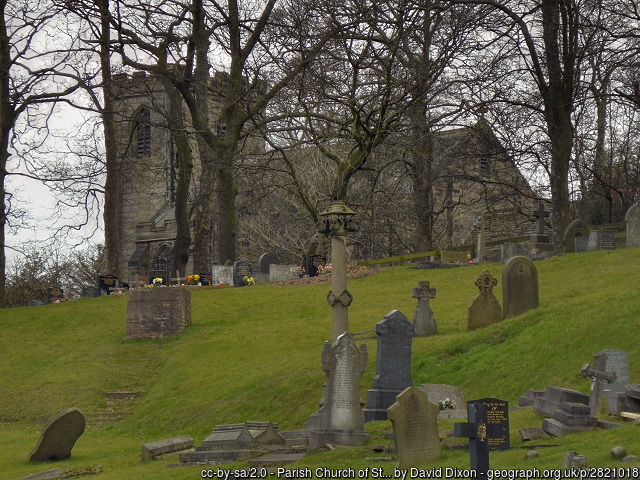
Work also began in 1795 to replace the nave, or main body, of the Parish Church of St Leonard. The church, in a prominent position on the tree-covered hillside, was established in the 12th century. Parts of the building date back to the 16th century, including, I understand, the tower. The circular font is also said to be many centuries old. I haven't found out whether the church was still used for Sunday services, weddings and baptisms while it was being rebuilt.

The font, mentioned in
British History Online's
account of Walton le Dale
Until the 19th century both Protestants and Catholics were interred in the graveyard which tumbles down the hillside around the church. Records show that many of the Ward family were buried there, though unfortunately, when we visited, we had no way of knowing where. In any case, the family may not have been able to afford to mark the graves with gravestones.

Cuthbert Ward died in 1799. His son Thomas, who was also a carpenter, married Frances Dickinson from nearby Chorley in 1802. By 1813, when Thomas died at the early age of thirty four, there were four mills and an iron foundry, and the population of Walton le Dale was beginning to boom. It had increased to 5,740 by 1821, with nearly 2000 new inhabitants added between 1809 and 1829.* By the 1840's a large proportion of the population in Walton le Dale was employed in the cotton industry.

The 1840s and 1850s

Thomas Ward's widow Frances, and three of their four children eventually left Walton Le Dale. The eldest son John, another carpenter, moved to Liverpool, while the rest moved to Manchester. Only the youngest son, Richard, remained in Walton le Dale.

The 1841 census shows that he was one of at least ten shoemakers, bootmakers, cloggers and 'cordwainers'  living in the village itself, and there were others in the surrounding area. People working in factories needed hard-wearing shoes, and they needed someone to repair them when the soles wore out. Their leather work-clogs, boots and shoes were all locally made.

Walton le Dale was not often in the news, but in 1847 two tragic murders occurred within weeks of each other, both of which were reported in the national and colonial newspapers.


In February, the married daughter of a local businessman and retired cotton mill owner, James Livesey, poisoned her five children, before drowning herself in the river Ribble. Fortunately, with medical treatment, four of the children survived but the fifth, Fanny, died.

Late in May, the body of a young baby was found in a stream near Walton le Dale by two boys. People remembered seeing an Irish woman with a baby pass through the village a few days earlier, and then the same woman travelling the other way, without the child. This was during the time of the Great Famine in Ireland, which resulted in a rapid influx of destitute Irish people into Lancashire.

But even the local people had their struggles. While conditions for the working class were usually not as dire in places like Walton le Dale as they were in larger centres such as Manchester, they were by no means easy during the 1840s. An economic depression in the early 1840s, which resulted in workers' wages being cut, bolstered demands by the working class for better conditions and the right to vote.

In August 1842, workers in Preston, just across the river from Walton le Dale, went on strike, in what is known as the Plug Plot riots. Three men were killed and several others injured when troops opened fire on a crowd who were moving from factory to factory, urging workers to strike. No doubt both the workers and the mill owners in Walton le Dale were keenly interested in these events.

It would be a long time before the workers finally did get to vote. In 1859 Walton le Dale was listed as one of many places in Lancashire with a population of over 5,000 that had no representation in Parliament.


In the 1850's, it seems, Richard Ward was no longer able to support his family as a shoemaker. At the time of the 1851 census he was working instead as a gardener. His wife Mary died in 1852, leaving him with six children. The two older boys were both employed as apprentices, while Ann, the eldest daughter, was working in one of the cotton mills.

The 1860s

As in the previous generation, most of the Ward family children moved away from Walton le Dale as adults. In early 1861, only Ann (who was married) and the youngest son, John, were still living there. Richard Ward, the father, had returned to shoemaking, and John was working as a clogger's apprentice. They were living in Mansleys Row, an address that no longer exists, but presumably was one of several "rows" of houses built to house the influx of people during the previous decades.

Lancashire suffered another great economic depression in the early 1860s, as a result of the so-called cotton famine. Overproduction of cotton fabrics, coupled with stockpiles of raw materials in the late 1850s, led to a drastic fall in prices. This was followed by a shortage of raw cotton when British shipping was blockaded during the American civil war. Many mills ceased production and there was mass unemployment. People from as far away as South Australia contributed to a relief fund, from which Walton le Dale received £100 (pounds) in December 1862.


Industry picked up again after 1865. In 1869, Walton le Dale was mentioned during a Parliamentary commission into river pollution. The river Ribble was said to be badly polluted as it flowed past the village, resulting in a dreadful stink, and dead fish. Despite this, Dr Ashton, who said he had lived and practised in Walton le Dale for twenty years, thought it was a healthy place. The death rate was 22 per 1000.  (The death rate in the UK in 2017 was 9.4 per 1000.)

He was asked about an outbreak of fever among workers at Calvert's Mill the previous year. He denied that it was due to typhoid, saying that, in his opinion, it was caused by overheating and sunstroke. He also denied that water from many of the privies (toilets) in the village drained into the wells from which people drew drinking water, or that polluted river water could reach the wells. He did disclose that many houses shared a privy. (My impression reading this account is that Dr Ashton was keen to protect the reputation of the owners of Calvert's Mill.)

But life in the village was not always dull or dangerous. Many of the mill owners organised annual outings to the seaside by train for their workers^. Events such as the Floral and Horticultural Show, and the St Leonard's Church School field day provided innocent but enjoyable entertainment.

The White Bull, Walton-le-Dale.
Photo by Alexander P Kapp 

For those whose tastes ran to something less refined, there were numerous drinking places - the Unicorn, the Queen's Arms, the Black Horse, Sir Robert Peel, the Black Bull, Grey Horse, Gardener's Arms, Yew Tree, Bridge Inn, White Bull, Ring O'Bells, the Beef tub (or Beefsteak) and the Red Lion. (Many of these no longer exist.) Perhaps it was no co-incidence that Walton le Dale also produced one of the stalwart campaigners of the Temperance movement, Joseph Livesey, and even a Temperance poet, Henry Anderton.

In 1864 Richard Ward's son John (my great grandfather) married the girl next door, Mary Ann Cragg. Their first five children were born in Walton le Dale and baptised at St Leonards. At the 1871 census, John was a clogger and Mary Ann worked in one of the cotton mills. And then, about 1875, they moved to Whitelees, between Littleborough and Calderbrook, near the Lancashire-Yorkshire border.

Why they moved is still a mystery. John's father, Richard, had remarried in 1861, and he and his second wife, Betsy, had a son, Robert, in 1866. Richard continued to live in Walton le Dale until his death in 1881. Was there not enough work for John in Walton le Dale? Did some family dispute lead to the move? Perhaps we'll never know.


I said when I began my series on "Places" that I wanted to see how the places where people lived influenced their lives, and vice versa. Visiting Walton le Dale, and reading more about it, made me realise how much the river played a part in the life of the villagers, both as a source of life and death, and as a barrier between Walton le Dale and the much larger Preston. Even now, I'm told, it is not a good idea to suggest to a local that Walton le Dale is a suburb of Preston!

Despite the industrialisation that happened in the 19th century, the place has maintained the feel of being a village. As such, it apparently didn't offer enough opportunities for everyone in the Ward family to stay, but it provided stability for the four generations of the Ward family who did remain there.

The Wards left no obvious mark on Walton le Dale or its history, as is to be expected of a working-class family. But as carpenters and cloggers, mill workers and parents, they no doubt contributed to the smooth running of village life.


*According to Pigot and Co.'s National Commercial Directory for 1828-9, p 436. This seems to have included the population in nearby Bamber Bridge.
^"LOCAL INTELLIGENCE." Preston Guardian etc [Preston, England] 4 Sept. 1861: n.p. British Library Newspapers.

All images are taken by me, (and are copyright), unless otherwise labelled.

Sunday, July 1, 2018

Why did Matthew spurn his family?

Equitable Street, Milnrow. Matthew and his family
 lived at number 33 in 1911.
Most of the unsolved mysteries from my family tree involve "what" "when" or "who" questions. What was the relationship between James Beales and William Beales? When was Richard Ward born? Who brought up Harriet Whybrew? They're questions that, at least in theory, could be answered by finding the right records (if they exist).

But sometimes the question behind a mystery is "Why?" Why did someone suddenly move across the country, or across the world? Why did a child named James apparently take the name of his dead brother William as an adult?

Most of the time, these questions are unanswerable. I can make a guess, based on learning more about a person's background, the social conditions, and local customs at the time. But I can never really be certain. The people who could tell me the answers are long gone.

One such unanswerable "why?" involves my father's Uncle Matthew (born November 1867). Matthew was born in Walton le Dale in Lancashire, but in the late 1870's his parents John and Mary Ward moved with their family to Littleborough. Then for a short while in the early 1890s they lived in Rastrick in Yorkshire. By the late 1890s the whole family had settled in the village of Milnrow in Lancashire, where John was a bootmaker and clogger. Most of the children remained there after they married and had families of their own.

For most of his adult life Matthew was employed as a fellmonger. Fellmongering is a process in which the wool is chemically separated from sheep hides, and was an industry for which Milnrow was noted. The wool was used by the woollen mills for weaving flannel, while the hides were tanned for leather.

Matthew met and married his wife, Elizabeth Ann Brown, while the Ward family were living in  Rastrick. They had six daughters, the first born in Rastrick and the other five in Milnrow. The youngest, Edith, a twin to Esther, died in her first year of life. The rest of the family all lived to a great age. Matthew and Elizabeth themselves, along with their two married daughters, Doris and Esther, all lived past eighty. Their unmarried daughters, Maud, Annie and Clara, all lived beyond ninety. Perhaps that in itself is a bit of a mystery, but not the one I'm coming to.

My father recounts that when he was about eight or nine years old, Matthew and his family suddenly stopped all interaction with the rest of the family. The rift was apparently never healed. For the rest of his life, Matthew's family had no contact with the rest of the family, even though they continued to live in the same small village. Or so my Dad remembers it. He was too young at the time to know what caused this disruption, though he thinks it involved some sort of argument.

I can't find anything in the records to suggest why Matthew and his family would have suddenly cut themselves off from the rest of the family at this time (around the end of the 1930's). Could there have been an argument over property? Or was it something more personal?

At the time of the 1939 Register (which is now online on both Ancestry and FindMyPast) Matthew had retired from work. The three unmarried daughters, Maud, Annie and Clara, all in their forties, were living with Matthew and Elizabeth in a house at 17 Buckley Hill Lane, which was practically "shouting distance" from other members of the family. They had been living there for at least eighteen years according to the electoral rolls.

Matthew's wife Elizabeth died in 1946 and Matthew himself died in March 1949, in Milnrow. He left his property to his daughters, who eventually all moved to Morecombe on the coast. None of them appears to have had any children. Unless something unexpected turns up, it seems unlikely that we'll ever find out what caused the family to separate from the wider family as they did.


Monday, January 22, 2018

Richard Ward - born twice?


Church door, St Leonard's
Walton le Dale
One of the most long-standing mysteries in my family history research is the date of birth of Richard Ward, my paternal great great grandfather. I know from several sources that he was the son of Thomas and Frances Ward, and that he was born in Walton le Dale, in Lancashire.

The problem with determining his date of birth is that two baptism records exist for Richard Ward in the Walton le Dale registers. Both say Richard's parents were Thomas and Frances (or Fanny) Ward. But one says he was born in 1809, and the other gives a date of 1813.

The most obvious solution would be that Thomas and Fanny had a son named Richard in 1809, who died in infancy. They then used the same name when they baptised another son in 1813. That was a common practice at the time. But I can't find any record of a burial for a child name Richard Ward between 1809 and 1813.

Besides that, most of the census records for Richard suggest that he was born in 1809 or 1810. Only in the 1851 census does his recorded age suggest a later date. At his death in December 1881 he was said to be 72 years old, which again gives a date of birth around 1809.

Images of the originals of the two baptism records are available online on the Ancestry website, so it's not a case of a transcription error causing confusion. The first record comes from the Parish Registers of Walton le Dale from 1698 to 1812. Among the christenings for 1809 is this one:
"Richard, son of Thomas and Frances Ward. Born Aug 17, baptised Oct 1." 
The names and dates are quite clear.

The same details appear in the Bishop's Transcripts, the local bishop's copy of the records for all the parishes in his diocese.

The second baptism record is from the Parish register of the Parochial Chapel of Walton le Dale, 1813-1887. Again the record is quite clear and unambiguous.
"Richard, son of Thomas and Fanny Ward" . His date of birth is recorded as 27 April, and his baptism 20 June 1813.

Another Thomas and Fanny

One possible explanation of the two baptism records is that the Richard born in 1813 belonged to another couple named Thomas and Fanny, and the minister at the time, E.S. Radcliffe, has recorded the wrong surname for some reason.

Only one other child-bearing couple named Thomas and Fanny lived in Walton le Dale at this time. Thomas Marsden married Fanny Bushby (or possibly Buskey) in 1805. They had three children baptised in Walton le Dale - Elizabeth in July 1808, John in April 1810 and Sarah in September 1811. Sadly all three, plus an older child named Mary, died in infancy and were buried in Walton le Dale.

The graveyard at St Leonard's Parish Church
Walton le Dale.
Their mother, Fanny Marsden, died in 1813 at the age of 30, and was buried on 25 April*. Is it too far fetched to suggest that she might have died giving birth to the Richard who was said to have been born on 27 April 1813? Obviously there is an awkward discrepancy of a couple of days between her burial and his reported date of birth. But given that the child wasn't baptised until two months later, perhaps the date of birth could be in error by a few days. It's easy to imagine a grieving husband mixing up the dates.

To give this theory a bit more weight, a Richard Marsden, born about 1812 in Walton le Dale, appears in the 1851 and 1861 census in Leyland, Lancashire. In the 1841 census his place of birth isn't recorded, but he was living in Leyland with a Thomas Marsden, with no other relatives listed. That would be consistent with Thomas being widowed and Richard being the only surviving child.

Since he was born in Walton le Dale, we might expect that Richard would have been baptised there, but I can't find any record of a baptism for a Richard Marsden in the Walton le Dale registers within 10 years of 1812. Could that be because his baptism in 1813 was recorded as Richard Ward?

Against this theory is the fact that the 1813 baptism record describes Thomas Ward's occupation as "joiner" (ie a carpenter). This was, in fact, his occupation according to other records. Thomas Marsden's occupation was a "cotton operative" when his wife was buried, and an agricultural labourer in 1841. For my theory to hold water, I'd have to explain why the minister not only wrote "Ward" instead of "Marsden", but also inscribed the occupation of Thomas Ward rather than Thomas Marsden. Any suggestions?

In the meantime, I'm leaning towards the earlier date of birth being the correct one for Richard Ward, though I'll keep the other one recorded as an alternative.


(*Burials, Parish register for 1813-1819, p 8, entry 58. Reference Number: Pr 2948/1/17)

Sunday, January 15, 2017

New Year's resolutions

Happy New Year! It's a while since I've written any posts. The living members of my family obviously take precedence over those long since departed when it comes to how I spend my time, and the past couple of months have been filled with family events, visits, traumas and travels. But Christmas is over, the visitors have all gone home, the walking wounded are showing signs of getting better, and at last I have an afternoon free.

A couple of years ago I decided that I would alternate each year between writing about my father's side of the family and my mother's. Last year I focused on the Ward and Beales side, which fitted in well with the work I was doing on a book about Susan Mason. The book isn't finished, but it has reached the stage where it's mainly the format rather than the content that needs attention. Writing up the endnotes and references has been a much bigger undertaking than I anticipated, due partly to problems with the software I was using. But now even the references are at the editing stage and I can turn my mind to other research.

So, with the start of a new year it's time to get back to the Ortons and Bentleys. Perhaps I'll start with Ben Bentley, corn dealer, of Yorkshire, who when he died in 1897 was described in the probate records as "gentleman". We don't have many of those in our family history! More about him as soon as I've refreshed my memory for that side of the family.

Tuesday, January 27, 2015

Comings and goings

Australia's first boat people
Yesterday was Australia Day, the day when Australians remember the arrival in Port Jackson (in 1788) of a fleet of British convict ships. From these ships staggered several hundred disgruntled prisoners and their guards, while the local Aboriginal people looked on in disbelief.

The day got me thinking about the people in our own family history who left the land of their birth to migrate, willingly or otherwise, to another country.

Irish migrants to Manchester

On the maternal (Orton and Bentley) side, most of the migration seems to have been from Ireland to Manchester in England. I've mentioned previously that it seems likely that Samuel St Ledger and Alice Dodd both had Irish parents.

One of my grandmother's great grandmothers, Elizabeth Hardman, the child of Patrick and Margaret Hardman, was also born in Ireland, in Galway. Her family migrated to Manchester around 1840 when she was a young child. She  married John Holt in 1853.

The most notorious 'migrant' on the Bentley side of the family was Alfred Pearson Bentley, who in 1879 left his wife and 4 children in Salford and sailed to Massachusetts. There he married (bigamously) and had another son. He and his new family eventually returned to England and lived not many miles away from his first family. More of him in a later post.

One of Samuel and Alice St Ledger's grandsons, Frederick Helliwell, migrated to New South Wales in Australia some time after his marriage to Frances Beatrice Farmer in 1903. Frederick died in Redfern in NSW in 1933 and Frances in 1968. As far as I'm aware they had no children.

To Australia and back

On the Beales side of my father's family, we have John Mason, who was probably an Irishman, and quite possibly a convict. He arrived in Sydney quite early on, sometime before 1841, and married Catherine Murphy, another immigrant. They moved to Adelaide in 1845, and remained there for the rest of their lives.

One of their 8 daughters, Susan (born 1849) married an English soldier, David Whybrew, who was stationed in South Australia for a while. Susan returned to England with David after the birth of their second child, Eliza, (who became my paternal great grandmother). Their first daughter, Harriet, born in South Australia, was left behind and didn't join them in England until her late teens.

Susan's younger sister, Eliza (born 1850), also married a British soldier, Jeremiah Murphy. They moved with the army to England and then to Scotland. The rest of the Mason's daughter seem to have stayed in Australia.

David Whybrew's older half-brother, Jeremiah, migrated to Canada with his employers in 1850. He married and had a family and died there in 1878.

Two of David and Susan Whybrew's daughters, Alice and Rose, migrated via Canada to Cook County in Illinois in the early 1900's. Unfortunately neither of them seem to have had happy experiences there. Alice died not long after she arrived, leaving a husband and young daughter, while Rose lost her only son when he was six.

The Ward side of my paternal family all seem to have remained staunchly in Lancashire, except for an occasional foray into the wilds of Yorkshire. The only migrant I've discovered is Henry Heaps (born 1832), a nephew of Matthew Cragg, who migrated to Utah, USA in 1869.

And then, of course, there are the members of my own childhood family, who came to Australia unaware that we had forbears and distant relatives here.

Does anyone know of any other migrants in the family?

Thursday, September 18, 2014

James or William? - James Ward (1837- maybe 1882)

A few weeks ago I was looking again at the Ward side of the family tree and noticed that I had the dates of death for all the children of Richard and Mary Ward (nee Baines) except for James, born in about 1837.

Being a bit obsessive, I decided to tidy things up by finding his date of death. Not a good idea! After many hours of searching over several days I'd managed to add quite a few details to his life story, but I still don't know his date of death for certain.

Previously I had only his baptismal record from St Leonard's church in Walton le Dale, and his presence with his parents in the 1841 and 1851 censuses. James was the fourth child of Richard and Mary and was baptised in June 1837. His next older brother, William, died in 1838, a fact that seems to have some relevance to James' later story. After 1851 James seemed to disappear.

I'd managed to find a James Ward, born in Walton le Dale, in the 1881 census before. He was a house painter, married to Alice, with children named Enoch (22) and Mary Alice (19). They were living in Salford. But I couldn't find any of them in the 1861 and 1871 censuses, despite Enoch's unusual name. Nor could I find a marriage to Alice that would fit in with the ages of the children (both born in Bury, Lancashire, according to the 1881 census). This was the point where I'd given up on James before.

"Hundred of Salford" by John Speed - John Speed's Map of Lancashire (1610)
The town of Salford ("Sauford") is just north of Manchester (near the bottom of the map).
Heywood ("Hawood") lies between Rochdale and Bury.
Preston and Walton le Dale are off to the north west of this map.
Licensed under Public domain via Wikimedia Commons 

This time I decided to widen my search, so I looked in the 1861 census for a house painter named Ward (leaving the first name blank) born Walton le Dale in a 20 year period around 1837. What came up, apart from all of James brothers and sisters, was a William Ward, a house painter living in Bury. He was a lodger in a house with a woman named Susan Harwood. She had a baby daughter, Mary A.

It seemed a long shot, but I did a bit of research on Susan and her daughter. It seemed that Susan, nee Barlow, was the (ex?)wife of Enoch Harwood, who was still living. They had a son named Enoch who was living with relatives at the time of the census. I couldn't find a Mary A Harwood born in Bury, but I did find a Mary Alice Ward, born in Bury in 1860, whose mother's maiden name, according to the lancashirebmd.org.uk site was Barlow. That seemed promising.

The problem was, why would James be calling himself William? Perhaps he adopted his dead brother's name because he was living with a married woman? Or maybe I was just joining too many dots together, and this wasn't really James at all.

Next I looked for Susan in the 1871 census - and found her living in Heap (near Heywood) with a lodger named  James Ward, a house painter born in Preston. Preston is a large town close to the village of Walton le Dale. This time Mary A was gone (I still haven't found her in this census) but Susan had a daughter, Amelia Ann Harwood, aged 10, living with her. I couldn't find a birth for Amelia Harwood that fitted, but an Amelia A Ward was registered in Castleton, Rochdale in 1862.

Again it seemed intriguing, but I was worried that I was joining too many dots. So next I looked for Susan Harwood and Amelia in 1881. They were still living in Heap, but their lodger had disappeared.

To Salford, perhaps? If James was married to Alice in the 1881 census, they must have married between 1871 and 1881. One marriage that fit those dates was James William Ward's marriage to Alice Iddon (nee Alice Kirkham Hill) in Preston in 1876. The groom was a house painter, and his father, Richard Ward, was a gardener, which fit the facts from the 1871 census. Not only was Alice a widow, but James William claimed to be a widower too.

So it seems quite likely that at the time of the 1881 census James was living with his wife Alice, his stepson Enoch Harwood and his daughter Mary Alice.

By 1901 Alice Kirkham Ward was a widow again, living in Walton le Dale. I haven't been able to find her for sure in the 1891 census, so I don't know when she became a widow. It seems most likely that it was in 1882, when a James William Ward died in Salford. But I have no way to be certain of that.

Amelia Ann Harwood married Charles Frederick Falshaw Lupton in 1885. On the marriage record her father is named as "William Harwood, painter, deceased." Her mother, Susan Harwood, was living with the Lupton family in Oldham in 1891, along with Amelia and Charles' two sons, John and Enoch. Susan died in 1893.

Laid out like this, it all seems fairly straight forward. What took me hours of research was weeding out all the other possible James and William Wards born about the right time in Lancashire, many of whom also had fathers called Richard. One had a wife called Alice. I also needed to make sure that there wasn't a house painter named William Ward born in Walton le Dale in any other census. (I didn't find one.)

In the end, James William is just a side branch on my family tree. But tracking down his records has given me some insights into how tricky it can be to trace people who were trying not to be easily traced. It has also given me hope that I might one day be able to tie up some other loose ends that so far have been impossible to unravel.


As usual, I haven't given detailed references to the census records etc in order to keep things easy to read. But if you would like more detailed references to the records that I've mentioned please contact me (stella(dot)budrikis(at)gmail.com and I'll be happy to pass them on.


Sunday, January 12, 2014

On this day in 1914

This year I thought it would be good to write some posts about the other side of my family tree, the Ortons and the Bentleys. Not that I've said everything there is to say about the Wards and the Beales, and I will keep adding posts about them, but my original intention was to cover the history of all four of my grandparent's families.

So as a sort of segue from one side of the family to the other, I thought it would be interesting to imagine what each of my four grandparents might have been doing 100 years ago today, on 12 January, 1914. It was a Monday and bitterly cold. (I like to think it was cold - we're having a heatwave here at the moment.)

Model T Ford c 1910
The first commercial airline flight had just taken place in the USA, and Henry Ford was about to open the first assembly line for Model T Fords. In England the Liberals were in power and George V was on the throne. Trouble was brewing in the far-away Balkans, the Suffragettes were becoming more and more militant, and there was industrial unrest. But the war that some were predicting was still 6 months away and unimaginable to most people.

Annie Kenney and
Christabel Pankhurst
The oldest of my grandparents, Thomas Henry Ward, would have been 31 years old. He was living with his widowed mother and his sister Fanny in the village of Milnrow, Lancashire. Perhaps his mother still owned the shoe retailing business in which he worked as a boot repairer, although by now she was over 70 years old. Thomas Henry's brothers and sisters were all married now apart from Fanny, and all were still living in and around Milnrow.

The 18 year old Rose Beales was probably working as a domestic servant with the Orsborn family in Ipswich, as she had been when the census was taken in 1911. Work as a domestic servant was the most common occupation for unmarried women at the time. Like her parents, the Orsborns were members of the Salvation Army. Their first daughter, Maria Evelina, was born in Colchester in 1910 so the two families no doubt knew each other. According to my father, Rosina was very much appreciated by her employers.

For the 10 year old Albert Edwin Orton in Pendleton, near Manchester, it would likely have been a school day. His father would have been at work at his gentleman's hairdressing shop, his older sister Edith May was working in a cotton mill and his brother Harold, 15, had probably also started work. His mother Sarah Jane may have been at home, or she too might have been working.

Gazette du Bon Ton
fashion plate 1914
Meanwhile the youngest of my four grandparents, the 9 year old (Margaret) Annie Bentley, was probably also at school. Home for her must have been a crowded, bustling place. According to the 1911 census, the family lived in a 3 room house. Along with her father, Walter Bentley, lived his three brothers-in-law, Albert, James and John Hough, his sister-in-law Lily Elizabeth Hough, Annie's brothers Walter (14) and Albert Bentley (5), and her sisters Alice (11) and Harriet (5). Annie's mother had died in 1909 and Lily acted as mother to the younger children.

While some were predicting war ahead, no-one could have forseen how drastically the coming years would change the lives of these individuals and the society in which they lived.