Showing posts with label Salford. Show all posts

Sunday, February 22, 2026

The sad finale of Alfred Pearson Bentley

Back in 2015, I told the story of Alfred Pearson Bentley, my maternal great great grandfather. Alfred left his wife Annie (nee Reed) and four young children in Salford, Lancashire in about 1878, and sailed to America. Ostensibly he planned to establish himself in the States before bringing his family to join him. But in 1879, having settled in Boston, he bigamously married another English migrant, Annie Jane Smith. 

The first Annie was left in financial hardship to raise her family alone. Family lore has it that she was led to believe that Alfred had died in America. It's unclear whether or not deliberate deception was involved, but having listed herself as 'married' on the census of 1881, she declared herself a widow on the 1891 census. She died in 1899, apparently still believing that Alfred was dead.

Alfred and the second Annie returned to England some time in the 1880s with their Boston-born son, John Alfred (who shared his name with one of Alfred's other children). They settled in Annie's home county of Cheshire, only 33 miles from Salford, and there Alfred continued his career as an engraver. John, who worked as a clerk in an insurance office after leaving school, remained living with his father after his mother's death in 1914. 

I noted in my previous post that Alfred was baptised into the Church of England in 1890 at the age of 41. He died in September 1922, aged 73. My cousin records on his family tree that his death was said to be due to 'senile debility and cardiac failure'. 

The next record I had of John Alfred appeared in the 1939 England and Wales register, when he was an inmate of the County Mental Hospital in Cheshire. The last sad trace I could find of John was his death in a Cheshire mental hospital in September 1971. He left a considerable estate of over 12,000 pounds, presumably inherited from his parents. As far as I could tell, he remained unmarried and had no descendents. 

A new twist in the story

That was as far as the story went when I wrote about it ten years ago. But recently I've come across newspaper accounts and court records from 1922 that give a dramatic twist to the life of John Alfred and the death of Alfred Pearson Bentley.

On 12 November 1921, John Alfred Bentley, described as a 38 year old insurance clerk, was arrested for 'attempting to procure the commission of an act of gross indencency with males.' (Homosexual activity, even in private between consenting adults, was a criminal offence in England until 1967.) After appearing in the Birkenhead County Court on 24 November 1921, he was committed for trial three months later. His father, named in newspaper reports as Alfred Pearson Bentley, put up bail of 200 pounds. But rather than going home with Alfred, John disappeared.

A bench warrant for John's arrest was issued when he failed to show up in court in Chester both on 28 February and on 1 March 1922. He again failed to appear on either 10 July or 14 July. By now the judges' patience had run out. Bail and surety was 'estreated' i.e. forfeited. 

The Halifax Evening Courier reported on 15 July that the judge called John's elderly father, Alfred Pearson Bentley, to the witness box to explain why his son had not appeared. Alfred said he had made every endeavour to trace his son and to persuade him to turn up at his trial. 

'I am sorry that any act of mine should be done to defeat justice. When I went bail for my son, it was solely with the idea that he would be more comfortable at home than in confinement,' he said. 'He was always a very good son, considerate, generous and helpful; in fact all that a son could possibly be...He deceived me as he evidently had not the courage to come and face his trial... '

The judge asked, 'Did you write the letter I told you to write? I gave you an address in Paris.' 

To which Alfred replied, 'I wrote on Monday.'

'And you have had no reply?' 

'No.'


It's unclear what this address in Paris was about, or whether Alfred's letter had any effect. It doesn't seem to have prompted John to return immediately. According to a report in the Belfast Telegraph of Saturday 9 September, John was eventually arrested at his father's home two months later, on Tuesday 5 September. Alfred is reported to have collapsed at home the same day and died in hospital the following day, Wednesday 6 September 1922.* 

Perhaps the shock of John's arrest had hastened his death. Or possibly John had returned home in response to hearing of his father's imminent demise. Either way, it seems certain that the strain, and disappointment of the recent months had a dreadful and tragic impact on Alfred's health. He literally died of a broken heart.

Today it's difficult to imagine the depth of embarrassment and concern a parent in the 1920s would feel if a son was publicly exposed for homosexual activity. Alfred claimed he put up bail so that his son could await trial in the comfort of home. But it's also likely he wanted to spare John the experience of spending time in prison. Men accused of 'gross indecency' did not fare well in the prison environment.

Then there was the worry that he might forfeit the money he had put up as bail. While he was quite well off, 200 pounds was still a considerable sum in 1922. And unless he was complicit in John's disappearance, he would surely have been concerned about his whereabouts and well-being.

Finally, another great anxiety for Alfred must have been the possibility that someone from his first family might see and recognise his name in the papers. The same story carried in the Halifax Evening Courier appeared in newspapers across the country.  'Alfred Bentley' was a common enough name, but 'Alfred Pearson Bentley' was unique. He faced the possibility that his previous deceptive life might be exposed.

It was a dreadful situation for Alfred. Yet it's difficult not to see the irony of his words in court, 'He deceived me as he evidently had not the courage to come and face his trial'. How might his first wife Annie, had she been alive, have responded to that? The betrayer had surely been betrayed.

An unclaimed fortune?

John, who probably knew nothing of his father's past life, finally came to trial on 24 October 1922, and was found guilty of 'attempting to procure acts of gross indecency'. He was sentenced to twelve months imprisonment. How this 'crime' and his imprisonment related to his mental health issues is one of those things that can be imagined but never be known. It seems he led a very lonely life. 

Nearly three years after John's death in 1971, Bell and Joynson, a company of solicitors, advertised in The People magazine of 12 May 1974 for relatives of John Alfred Bentley, 'no matter how distant', to contact them, as they 'may hear something to their advantage'. By 1974 all of Alfred's other children were long deceased. I wonder if anyone ever enjoyed the benefits of Alfred Pearson Bentley's fortune?

*According to the probate record, Alfred died on 9 September. But if the newspaper was already aware of his death on that date, it seems more likely that 6 September is correct.



Sunday, January 30, 2022

Mrs C J Hough (Cecil Jean MacVicar Shaw)

For the past couple of years my blog posts have focused on the Whybrew and Mason families, on the paternal side of my family. But with the recently published 1921 UK census offering never-before available information, I've decided that it's time to take another look at some of the other branches of my family tree.

'Mrs C. J. Hough'

One of the first mysteries that the 1921 census allowed me to solve was the identity of 'Mrs C. J . Hough' who was listed on the National Roll of the Great War at the same address as my maternal grandmother's uncles, John and James Hough. I'd guessed that she was probably the wife of John Hough, since I knew James' wife was called Elizabeth. But I couldn't find out any more about 'C.J.' or a record of their marriage.

Looking up the address given on the National Roll (18 Shuttleworth Street, Pendleton) in the 1921 census revealed that there were two households listed at this address. The first consisted of James and Elizabeth Hough, their son Albert, plus a number of other relatives, including my 17 year old grandmother, Margaret Annie Bentley. (More of that another time.)

The other household contained only two names, Cecil Jean Hough, aged 37, and her one-year old son Cecil John Hough. Cecil Jean was described as 'wife' of the head of the family. Strangely, John Hough is listed as the person who filled in the census, but his details aren't included. But at least I could now be fairly certain that 'Mrs C. J.  Hough' was Cecil Jean, John's wife. 

From her son's birth registration in 1920 I discovered her maiden name was Shaw, and the baby was born in Marylebone, in London. A note, 'nee Shaw' also appeared on her entry in the UK, World War I Service Medal and Award Rolls, where she was listed under her married name. It seems likely that she and John met as a result of their time in the armed services. 

I haven't found a definite record of their marriage, but a marriage registered towards the end of 1918 between John Hough and 'Cecil J Shand' in Wandsworth is possibly theirs.

An Indian childhood

On the 1921 census transcript, Cecil Jean is said to have been born in India. This might have been a misunderstanding on the part of John Hough when he filled in the census details. Cecil Jean MacVicar Shaw's birth was registered in Marylebone, London, in the second quarter of 1885. When she was baptised on 2 March 1885, her parents were living at 6 Harley Place, Marylebone. This was a mews off the more famous Harley Street. 

But it seems likely that Cecil (sometimes listed as Cecilia) did spend most of her childhood in India.The baptism record describes her father, Robert John MacVicar Shaw, as an Indian coffee planter. 

Robert Shaw and her mother, Florence Carew Hutchinson, were married in Jersey in 1876. Florence, who was born in India, seems to have died sometime before 1904. Robert married Marie Ombrey Leacock in Tamil Nadu, India, that year. 

Joining the army


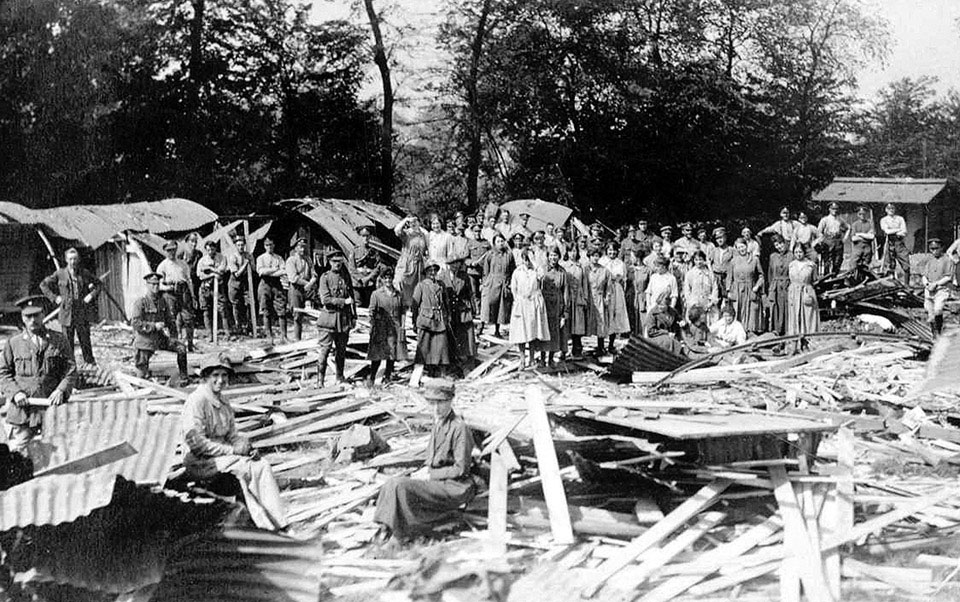
QMAAC clearing up after the air-raid at Abbeville

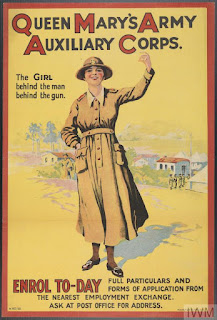
When the 1911 UK census was taken, Cecil was in Wales, working as a wardmaid at the Royal Alexandra Hospital in Rhyl. Her experience in that role would have made her a good candidate for the Queen Mary's Army Auxillary Corps. This began orginally in 1917 as the Women’s Army Auxiliary Corps (WAAC). It's purpose was to free up men from administrative and home service jobs for fighting on the front. 

On the National Roll her entry reads:

HOUGH, C. J. (Mrs.), Worker, Q.M.A.A.C. (Queen Mary's Army Auxiliary Corps)

Having joined in March 1918, she was sent to France, where she did excellent work as waitress in the Officers' mess at Abbeville, and was wounded during an air raid on that place. She remained in this area until June 1919, when she returned home and was demobilised, holding the General Service and Victory Medals.  18, Shuttleworth Street, Pendleton."

Cecil Jean was fortunate to survive the air raid on Abbeville, on the Somme. Nine women died in the raid. This film clip shows the damage done to the women's camp.

John Hough was a corporal in the 8th Lancashire Fusilliers and also spent time in France. His entry in the National Roll reads:

Volunteering in August 1914, in the following month he was sent to Egypt, and served there until drafted to the Dardanelles, where he took part in numerous engagements until the Evacuation, and was wounded. He then returned to Egypt, and in March 1917 proceeded to France, where he fought on the Ancre, at Ypres, and in the Retreat. After the Armistice he was sent to Ireland and served there until, owing to ill-health, he was invalided home and discharged in November 1920, holding the Star, and the General Service and Victory Medals. 18, Shuttleworth Street, Pendleton

John and Cecil had (at least) three children - Cecil John in 1920, Peter in 1922 and Margaret in 1926. Peter died in infancy, and possibly also Margaret. Cecil Jean herself died in 1927 and was buried in what seems to be a shared grave with several unrelated people. I haven't been able to discover for certain when John died, although 1942 seems likely. I can't remember my grandmother ever mentioning Cecil or Cecilia when she spoke about her family.

Friday, August 23, 2019

Manchester

Bee mosaic in Manchester Town Hall
Image from wikipedia.
Everywhere you go in Manchester, you’ll find bees - carved into buildings, decorating bollards and fountains, printed on flags, bumper stickers and tee-shirts, even tattooed on people’s arms.

Originally the worker bee symbolised the hard-working and productive labourers in the factories, those hives of activity during the industrial revolution. It was officially adopted into Manchester’s coat of arms in 1842.

More recently it has become a symbol of the unity and co-operation of Manchester’s population following the terrorist bombing of Manchester Arena in 2017.

Back when I began researching my family history, it certainly seemed as though Manchester was once a honey pot drawing families in. On almost every branch of the family tree, I discovered at least one family that migrated to Manchester, or the adjacent Salford, during the nineteenth century. On  my father’s side of the family, Thomas Ward's widow, Frances, left Walton le Dale and went to live there when she re-married, along with two of her daughters. Several of her grandchildren also went there to work.

On my mother’s side, Thomas Brown Orton and his family moved to Manchester from Leicestershire, the Bentleys from Yorkshire, the Landers from Dorset, the St Legers and the Hardmans from Ireland, the Holts and the Houghs from Cheshire.

So while my previous posts on "places" have been about towns and villages where one family lived, perhaps for several generations, this post covers many families. They often moved back and forth between Manchester and Salford addresses. Salford has its own distinct history, but in this post I'll consider it as part of Manchester.

Manchester's early history


The city gets its name from Mamucium, the name of a Roman fort built on a small hill in 79 AD to keep out the Celtic Brigantes. It was located close to the River Irwell, which meandered across an otherwise flat plain. After the Romans left in 407 AD, the little town around the fort stagnated until the thirteenth century.

In 1227 it was granted a charter for an annual fair, a sign of its increasing prosperity. By the 14th century a textile industry had grown up under the influence of Flemish weavers. Despite some setbacks due to outbreaks of plague and the English Civil War, the market town and its weaving industry gradually expanded.

Shambles Square, in the medieval quarter
Image from wikipedia


By 1720 Manchester was the most important town in Lancashire, with a grammar school, a collegiate church, a free public library and its own newspaper. The population of about 10,000 people had a single representative in the First Protectorate Parliament under Oliver Cromwell. This seat in Parliament was lost after the restoration of King Charles in 1660.

Manchester and the Industrial Revolution


Beginning in the late 18th century, the industrial revolution brought street-lighting, piped water, and a network of canals to transport coal and other goods. Britain’s first railway station was built in Manchester when the Manchester to Liverpool line opened in 1830.

The station built in 1830

An unprecedented influx of people arrived, drawn by the prospect of work in the building trades, the cloth manufacturing industries or the associated transport and service industries. By 1801 the population had reached 75,000 and thirty years later it had almost doubled again to 142,000. Despite this, the city had no representative in Parliament and most working people had no vote anyway.

Some people made their fortunes in the booming conditions, and used them to build impressive private and public buildings. For others, overcrowding and lack of planning led to poverty and hardship. Outbreaks of infectious diseases such as cholera were able to spread rapidly in the squalid conditions in which many people lived. High taxes and trade restrictions during and after the Napoleonic wars led to a recession and high unemployment. In 1812 food riots occurred in parts of the city.

On 16 August 1819, thousands of protesters gathered in a newly-cleared area known as St Peter’s Field to listen to the radical orator Henry Hunt and express their demand for parliamentary reform. The local magistrates sent the Manchester and Salford Yeomanry to arrest Hunt. They succeeded in capturing him, but in the process a child was killed and a woman was injured.

Map of St Peter's field and surrounds
Image by Jhamez84


The 15th Hussars were then sent to disperse the crowd. They went in on horseback with drawn swords, while other regiments blocked the exits to the square. In the panic and mayhem that followed, up to 18 people were killed and hundreds injured. The event became known as the Peterloo Massacre. It would be another thirteen years before the Reform Act of 1832 gave Manchester two representatives in Parliament, elected by eligible males.

Manchester continued to grow, absorbing the surrounding towns into its municipal borough and connecting to places further afield by rail, road and canal links. It was a place of exciting scientific discoveries, technical innovation, impressive engineering feats, and grandiose buildings, alongside social upheaval and radical political movements. Friedrich Engels and Karl Marx developed some of their political theories after visiting Manchester in the 1840s.

My family in Manchester


John Fielding is the earliest of my ancestors to have lived in Manchester. He was born there in 1778, and it may be that his family had lived there for several generations. Perhaps he was the same John Fielding whose name is on the list of those arrested at the Peterloo demonstration. In 1802 he married Jane Hughes, from Wrexham in Wales. Their daughter Harriet (born 1811) married William Holt, who was born in Cheshire.

Harriet and William’s son  John married Elizabeth Hardman, who had migrated from Ireland with her parents as a small child. And so it goes on. John and Elizabeth’s daughter Hannah and her husband William Hough were both born in Salford, as was William’s father John Hough, but his paternal grandfather was from Cheshire and his mother, Mary Lander, was from Dorset. The brick-making Houghs and the stone-cutting Landers no doubt helped to build parts of Manchester.

In the 1860s the Lancashire cotton famine caused a lot of hardship. But by the 1870’s, when the Orton family moved to Manchester from Leicestershire, conditions had improved, with less severe overcrowding and poverty and a better life-expectancy. Manchester had a reputation for social innovation, with some of the world’s first free public parks and libraries, and early branches of the Co-operative movement, the Trades Union Council and the women’s suffrage movement.

The city fostered both the arts and education and it was not uncommon for working people to be self-educated through their use of libraries and newspapers. Friedrich Engels left Manchester and moved to London in 1870.
Cotton-milling machinery in the
Science and Industry, Museum, Manchester

Manchester reached its height of industrial activity with the opening of the Manchester Ship Canal in 1894. This allowed ocean-going vessels to carry goods right into and out of the heart of the city. The world’s first industrial estate was built on its banks at Trafford Park. By now the population of the city and its suburban area had reached over 500,000.

Manchester in the twentieth century


Even as late as 1913, 65% of all the world’s cotton moved through Manchester. The city’s name was (and still is) synonymous with cotton goods such as sheets and towels. But cotton milling and other textile industries gradually gave way to machinery exports, chemical industries and financial businesses.

The First World War interrupted trade and the Great Depression that followed led to a decline in Manchester’s economy. Its population peaked around 760,000 in the early 1930s, but people had already started to move away.

During the second world war, Manchester and Salford were heavily bombed in what was known as “the blitz”. Children were hastily evacuated to safer areas by the government, with little preparation. My mother and her sisters, after experiencing the trauma of spending their nights in bomb-shelters and seeing their neighbourhood destroyed, were sent away from their parents to Blackpool, on the coast. After some time, the family were re-united when they moved to Crawshawbooth in Rossendale, 20 miles (32 km) from Manchester. They never went back.

Much of Manchester was rebuilt after the war, and it remained the most important city in the region, but it continued to decline economically. When I was growing up in semi-rural Rossendale, Manchester was the place to go to watch a pantomime, to see Father Christmas in one of the department stores or shop for special-occasion clothes, but I never thought of it as a place to live. Even when I returned there as an adult in the 1980s it still seemed a rather grimy, utilitarian place.

Manchester today


In 1996 the centre of the city was bombed by the IRA. Hundreds of people were injured and many retailers went out of business in the aftermath. But the redevelopment associated with the rebuilding, coupled with the Commonwealth Games held in Manchester in 2002, led to a revitalisation of the city. Slums have been cleared, old factories and warehouses re-purposed and public transport modernised.

Manchester's Christmas Markets, a popular annual event


Manchester now advertises itself as a tourist destination, something that would have been considered a joke when I was a child. I was impressed with how much had changed when I returned to Manchester in 2013, and even more so when I revisited it in 2018.

I haven't followed my family tree far enough into the twentieth century to see how many descendants of those original 'immigrants' are still living there. If you recognise any of your own ancestors names here, I'd love to hear from you.


General references used:
Manchester: wikipedia https://en.wikipedia.org/wiki/Manchester
A brief history of Manchester http://www.localhistories.org/manchester.html

Friday, September 28, 2018

Albert and Hannah Hough's puzzling family life

The spire, all that remains of
Stowell Memorial church where
Albert and Hannah married in 1878
I've written a little about Albert Hough and Hannah Holt before. Their daughter Alice was my mother's maternal grandmother. But there are several gaps and puzzling details in their story that I've yet to resolve.

Albert Hough and Hannah Holt married in Salford, Lancashire, in August 1878. At the time Albert was working as a brickmaker like his father William.  When they married they both gave their address as 51 Jane Street in Salford. For some reason Albert’s name was recorded as ‘Alfred Hough’, although his name was registered as Albert both when he was born and when he was baptised. He was also listed as Albert on his children's baptism records.

Their first child, Alice, was born in 1879. But when the census was taken in 1881, Hannah and little Alice were living with Albert’s brother John Hough and his family in Lynton Street in Salford. Albert wasn’t with them. I thought I’d found Albert/Alfred boarding with another family in Ardwick Street, not too far away. Now I'm not so sure. This man was listed as Alfred, and was described as a dyer, which would be quite a leap from being a brick maker. Albert’s occupation was listed as ‘labourer’ when his children were baptised. So far I haven't found any trace of him in 1881.

So why were Albert and Hannah not living together? The obvious explanation would be that as a young working-class couple they couldn’t afford to rent a place for themselves, and found lodging where they could. Little Alice and her brother Albert (born 1882) weren’t baptised until 1885, another hint that the family might have been hard up. Although, as we'll see, there may have been other reasons for the delay in baptising them.

Other possibilities come to mind. Was Albert working somewhere away from home for long periods? Was he perhaps in prison, or the workhouse? None of these ideas have produced any results so far.

Still missing, or missing again?

By the time of the 1891 census Hannah had four living children (another died in infancy) and she and the children were all boarding with a family in Siever Street in Pendleton, Salford. She was working as a charwoman. Again Albert is nowhere to be found. That’s not to say he wasn’t living somewhere in Salford or Manchester, but I haven’t been able to find him.

It seems strange that the couple should still be living apart. They had obviously spent some time together in the previous ten years to produce five children! The census is only a snapshot on a single night, so perhaps they had been living together for most of the intervening ten years.

Still, it would be interesting to find Albert’s whereabouts in 1881 and 1891. By 1901 Hannah had died and the widowed Albert was living with his eldest daughter Alice, her husband, their son and four of his own younger children – nine people in a four-roomed house. He was employed as a labourer.

Some unexplained baptism records

The Lancashire Online Parish Clerks site offers another strange puzzle related to this family. Most of Albert and Hannah’s children were baptised at St Ambrose church in Pendleton. Until 1902 this was a mission church of the parish of St Thomas, an Anglican (C of E) church. But James, born 26 June 1889, appears to have been baptised on 20 November at the Catholic Mother of God and St James church. There’s no photo of the record available, but the transcription reads:

Baptism: 20 Nov 1889
Mother of God and St James, Pendleton, Lancashire, England
Joannes Jacobus Hough - filius Alberti Hough & Hannae (formerly Holt)
Born: 26 Jun 1889
Abode: 40 Dawson St.
Godparents: Julia Anna Donovan
Baptised by: P. J. Markey
Source: Salford Diocesan Archives

(Catholic churches at the time recorded baptismal names in Latin).

Even more strange, Albert and Hannah’s next son John, born on 16 October 1892, was also baptised in the Mother of God and St James church in Pendleton on 1 November 1892. But then on 2 November 1892 he was apparently baptised again, this time at the Anglican church of St Ambrose in Pendleton.

Baptism: 1 Nov 1892 Mother of God and St James, Pendleton, Lancashire, England
Joannes Hoff - filius Alberti Hoff & Annae Rosae (formerly Holt)
Born: 16 Oct 1892
Godparents: Helena Bower
Baptised by: Henrico Van Wtberghe
Source: Salford Diocesan Archives

Baptism: 2 Nov 1892 St Ambrose, Pendleton, Lancashire, England
John Hough - [Child] of Albert Hough & Hannah
Born: 16 Oct 1892
Abode: 24 Buckingham St.
Occupation: Labourer
Baptised by: G. Morgan
Register: Baptisms 1881 - 1894, Page 175, Entry 1393
Source: Parish Register

The names are spelled a little differently, but it certainly looks like the same child. But why would he be baptised twice? As far as I’m aware, the Catholic and Anglican churches have always recognised baptisms carried out in each others’ churches as valid, so there would be no reason to have a child “done” in both churches, even if the parents were of different denominations. I've heard of baptism records being accidentally duplicated in the same church register, but not across two different churches. Any suggestions would be most welcome.

Albert, the father, was baptised in St Phillip's Salford, an Anglican church. I haven’t found a baptism record for Hannah,  but her mother Elizabeth Hardman was Irish, so perhaps she was brought up Catholic. By the time Albert and Hannah's youngest child Elizabeth (a.k.a. Lily) was born they seem to have resolved the issue and she was baptised just once, at St Ambrose Anglican church.


Sunday, August 19, 2018

The hard-to-find Hardmans

Shop Street, Galway, Ireland
Photo by Peter Gorman*
After my success in discovering new information about the St Leger family, I decided to see if I could find out more about another Irish family in my mother's line, Patrick and Margaret Hardman or Hardiman (nee Jenkins.) The Hardmans apparently arrived in England between the birth of their daughter Elizabeth (my maternal grandmother's great grandmother) in 1835 and their son Thomas in 1840. They were in Salford, near Manchester, in time for the 1841 census.

Unlike migrants to North America, the names of Irish people travelling to England, Scotland or Wales were not recorded, since Ireland was part of the British Isles at the time. All we can say is that Patrick and Margaret left Ireland with Elizabeth before the great famine of 1845, probably as part of an on-going movement of people looking for work and a better life in the new industrial areas.

Old buildings, Chapel St, Salford
Photo by Alfred Brothers, 1878, courtesy of British Library
They settled first in Church Court off Style Street in Manchester. This was part of the rabbit-warren of decaying buildings around St Michael's Church yard known as Angel Meadow. Many of their neighbours were Irish. Samuel St Leger and Alice Dodd also lived in the area at one stage, though it would be several generations later that the two families were linked by marriage. Patrick found work as a labourer.

By 1851 he and Margaret had added Bridget (1843) John (1847) and Margaret (1850) to their family and had moved to number 10, Briercliffe Buildings in Chapel Street, Salford. Patrick was working as a brick layer's labourer both in 1851 and 1861. He died in 1868, in his mid fifties. Margaret lived on until 1888.  Before she died she was an inmate of the Manchester Work House in Crumpsall.

This much I already knew, but I had no information about the family before the 1841 census. According to all the census records, Patrick, Margaret and daughter Elizabeth were born in Galway, Ireland. Since no other location is listed, my guess is that Galway refers to the town, not just the county.

Unfortunately the Irish Genealogy site doesn't yet have many parish records for Galway. Nor can I find any trace of the family in Irish records on Ancestry or FindMyPast. At one point I thought I'd found Patrick in the Royal Hospital Chelsea Military records, but that Patrick Hardiman (born in Galway in about the right year, 1813) is said to have died in Manchester in 1853.

The names Hardman and Jenkins are not particularly common in Galway. From the internet I found several variants of both names (Hardiman, Harman, Hardogan etc, for Hardman, along with Jennings, Junkin, Johnson and even Shinkwinn for Jenkins). But using those in my search hasn't helped to discover anything.

I'm still quite a novice at researching Irish records, so perhaps if I keep learning more about it and searching, something will turn up. Just this week, Chris Goopy provided a link on her amazing blog That Moment In Time, to the Irish Genealogy Toolkit, which has lots of useful information about Irish research. Meanwhile I've been looking at pictures of Galway and thinking it would be great to do some on-the-ground research for the missing Hardmans!

*Photo used under a Creative Commons licence

Saturday, November 11, 2017

The story of two John Alfreds, part 1

Nine Elms British Cemetery, Belgium
As I've mentioned before, my great great grandfather Alfred Pearson Bentley (b 1849) had two sons named John Alfred, one born to his wife Annie Reed in Salford in 1873 and the other born, through a bigamous marriage to Annie Jane Smith, in Boston in 1884. Despite sharing the same name and the same father, the two John Alfreds led rather different lives. In this post I'll tell the story of the older of the two half-brothers.

The first John was only four or five years old when his father left for America. He and his four siblings grew up in Salford, surviving on what their mother could earn from taking in laundry and renting out a room. When he was old enough to leave school he found work as a bricklayer's labourer and added his earnings to the family income.

In March 1897 John married Elizabeth Ann Brown, a girl from Stalybridge, a few miles east of Manchester. They were married in the Registry office in Salford. Their first child, Thomas, was born in August that same year while they were living at 20 Arthur St in Seedley, Manchester. 

St Ambrose Church, Salford,
where most of John and Elizabeth's children
were baptised.
Two years later, in August 1899, a daughter, Annie, arrived. By this time the family had moved to 49 Mayor St in Pendleton, and they remained at this address for several years, adding John Alfred (1902) Ernest (1905) and Elizabeth (1908) to their family. Two of the children, John Alfred and Elizabeth, died in infancy.

When the census was taken in  1911 John and Elizabeth had moved with their family to 11 Hodgson St. It was a four roomed house, but besides their family they had two single men from Stalybridge, both labourers, and apparently brothers, boarding with them. John was working as a contractors labourer.

John and Elizabeth's eldest son Thomas was 17 years old when the war began in August 1914. Like many young men, he enlisted as soon as he could, joining the 2/7th battalion of the Lancashire Fusiliers. He was given regimental number  281894, and after a long period of training was sent to Le Havre in France early in 1917.

This must have caused his parents some concern, but worse was to come. On 12 March 1917 John Bentley received a letter from the Borough Engineers Office in Salford. It didn't even address him by name, but read:

Dear Sir,  
Road Service in France 
I enclose a form from the War Department which you are requested to present to the recruiting officer at the Town Hall, Broad St, Pendleton on an early day between the hours of 9.00 am and 5.30 pm on Saturday between 9.30 am and 2.00 pm. 
Yours truly 
Ernest B Martin.
At the age of 43 John Alfred was being conscripted to build roads across other men's fields in France. Conscription had been introduced in 1916 and anyone under the age of 51 who was not a widow with children or a Minister of Religion could be called up. In reality, many of those called were rejected as unfit, or claimed exemption on the grounds that they were doing work of national importance or their absence would cause domestic hardship. However, like Thomas Henry Ward, John Bentley received no exemption.

He was enlisted on March 16 in the Royal Engineers, 338 RC (Road Construction) company as a "pioneer", regimental number 25500. He was later transferred to the 303 RC company. The army doctor who examined him noted two tattoos, one on his right arm saying "E A Brown", and the other a pair of butterflies on his left. After spending time at Salamanca Barracks in Aldershot, John was sent to France. 

With both her husband and a son on the front line, and a ten year old child, Ernest, to care for alone at home, Elizabeth must have been beside herself with worry. Her fears were not unfounded.

Street corner, Poelcappelle, Belgium 1918
Twenty year old Thomas was injured, probably at the Battle of Poelcappelle in Flanders on 9 October, and died of his wounds on 12 October 1917. He was buried at the Nine Elms British Cemetery in West Vlaanderen, Belgium. The cross on his grave bears only his name and regimental details. 

In his brief will, written on 8 April 1917 on a standard issue form provided by the army, he left all his possessions to his mother "Mrs E. Bentley of 5 Swan St, Pendleton." He apparently was aware of his father's enlistment.

John Alfred was admitted to hospital on 12 April 1918, for reasons unknown. He was discharged on  the 19 April. He arrived "TTBD" on 26 April and was released from "TTBD" on 6 May 1918. (The most likely explanation I can find of this abbreviation is "Temporary Transfer Base Depot" but if you can improve on that, let me know.) He was officially demobbed in 1919 while on home leave.

He returned home to Elizabeth on 26 December 1918. They were still living at 5 Swan St when their daughter Annie married the following year. When he died at the age of 59, in March 1933, he left an estate of £278 4s to his widow Elizabeth.

My next post will cover what I know of the younger John Alfred.


Thursday, October 12, 2017

More on boatmen and baptisms

The Leeds Liverpool Canal at Wigan Pier
Never publish in haste! I wrote my last article based on research I'd done quite a while ago, but after digging into things a bit more, I find I now need to correct a couple of statements in my previous post about Hannah Holt and her family.

First, I said that her father John Holt was a boatman, and guessed that this meant he was a labourer on the docks. But after doing more research I've realised that it's more likely that he worked on the actual canal boats.

Even before the Manchester Ship Canal opened in 1894, there was an extensive network of canals all over England, which were used for transporting raw materials and goods. It was much more efficient to have a horse (or a man) pull a fully laden boat along a canal than it was to have the horse pull a cart along an unpaved road.

Some of the canals dated back as far as Roman times, but the canal system was greatly expanded during the industrial revolution. The port in Liverpool was linked to industry in Manchester and Yorkshire by the Leeds and Liverpool Canal and there was an extensive network of canals linked into this. Eventually the railways took over as the main means of transporting goods. But the canals still exist and it's apparently still possible to travel from London to Lancaster without setting foot on dry land.

Many boatmen lived on their boats, since the journey between the port and their destination could take several days. In some cases their families lived with them. But it seems from the census returns that John Holt and his father William had homes that they returned to regularly.

John and Elizabeth Holt's children

The second thing I need to correct is my statement that Mary Ann, the first child of John Holt and Elizabeth Hardman, appeared to have died in infancy. In fact I've now found her as a seven year old in the 1861 census, staying with her grandparents Patrick and Margaret Hardman in Eagle St, Pendleton. Whether she was there just for the night of the census or more permanently is unclear. I haven't been able to trace her in the 1871 census, but she would have been a teenager then and may well have been working away from home. In March 1876 she married Thomas Ogden in St John the Evangelist Church in Salford. She was still living in Salford, though widowed, in 1911.

While on the topic of John and Elizabeth Holt's children, I've recently discovered their baptism records on the Lancashire Online Parish Clerk site (which is where I also found Mary Ann's marriage). They were all baptised in the Catholic Cathedral Church of St John the Evangelist, in Salford, except for the youngest, John, who was baptised in Christ Church, Salford, which is an Anglican church.

Perhaps this was because his mother Elizabeth, an Irish Catholic, had a say in where the other children were baptised, but she had already died before John came for baptism. I haven't been able to find a burial record for Elizabeth but her death was registered in the first quarter of 1870 and John was born on 13 March 1870, so she probably died towards the end of March. When John was baptised on 6 April, his father, or his father's family, apparently chose to have him "done" in the Church of England.

I usually try to check my facts before posting, but if you come across any errors in any of my blog posts, do please let me know, either by posting a comment or messaging me.


Friday, September 29, 2017

Hannah Holt and her family


Salford Quays today would be unrecognisable
 to Hannah Holt and her family
When I wrote about Alice Hough, I mentioned that she was the child of Alfred (aka Albert) Hough and Hannah (or Anna) Holt. I've already described the Hough side of her family, who were brick makers in Salford. Now it's time to say something about the Holts. Unfortunately there's little to tell about them besides details of births, deaths and marriages, and even some of those are hard to find. They seem to have been one of the many families living in crowded, poor conditions in Salford during the late 19th century.

Hannah's background

Hannah's father John Holt was described in the various census returns as a boatman or waterman, which probably means he worked as a labourer on the docks in Salford (but see below).  He was born in Salford in about 1831. His father, William Holt, was also a boatman.

Hannah's birth registration indicates that her mother's maiden name was Hardman.* Elizabeth Hardman arrived in Manchester from Galway, Ireland with her parents, Patrick and Margaret Hardman (nee Jenkins), around 1840 when she was about 6 years old. Patrick was a labourer, so it's likely that John and Elizabeth began their married life in July 1853 with very little.

John and Elizabeth's first child, Mary Ann (born 1854) seems to have died in infancy, since she doesn't appear in the 1861 census (but see below). The next child, Harriet, was two years older than Hannah (born in 1858). In the 1861 census Hannah is listed as Anna, and the family were living in "Slater's building" which seems to have been some sort of tenement off Hampson St, not far from the docks.

Elizabeth gave  birth to five more children after Hannah, (James 1861, Sarah 1863, Samuel 1865, Elizabeth 1867 and John 1870) but it's not clear how many survived. I can't find the family in the 1871 census. Elizabeth herself died during or soon after giving birth to John in March 1870. Hannah would have been about 12 years old at the time.

In December 1870 Hannah's father remarried, to a woman named Margaret Gill who was 27 at the time. I haven't been able to find the family in the 1871 or 1881 census. Possibly a child, Mary Ellen, was born to Margaret in 1871, but I can't find any others, so John or Margaret may have died soon after that. (The name John Holt was common in Salford so it's difficult to know for certain which death registration is his.)

Marriage and children

Hannah Holt married Albert Hough, a brickmaker, at the Stowell Memorial church in Salford on 18 August, 1878. She was 20. When they married they both gave their address as 57 Jane St. This was in a typical Salford row of two storey brick houses built "back to back" on a cobbled street with flag-stone pavers.

When the census was taken three years later Hannah and her daughter Alice were living with her bother-in-law John Hough and his family in Lynton St, Salford. Albert was lodging with another family in Ardwick St. Was this for financial reasons, or had they separated? They had another child, Albert, the following year, and another five children after that, so perhaps it was for practical reasons.

By 1891 Hannah was boarding with another family, along with four of her children, and she was working as a charwoman, which suggests that she was in very difficult circumstances. Albert is nowhere to be seen on the census.

In 1899, at the age of just 41, Hannah died. Albert went to live with his daughter Alice and was with her family in 1901, but he seems to have died before 1911.

NOTE: I've updated and corrected some of the information in this post in my next post. See More on Boatmen and Baptisms

*(GRO Reference: 1858  S Quarter in SALFORD  Volume 08D  Page 77). 

Sunday, July 9, 2017

Annie Reed

Market place, Barnard Castle 
(cc-by-sa/2.0 - © Ben Gamble )
Now that I've traced back through Alfred Pearson Bentley's forebears, it's time to have a look at his wife Annie Reed. As I've mentioned before, Alfred and Annie were married in Dewsbury in Yorkshire in 1869, and moved to Salford in Lancashire before 1872. In 1879, soon after the birth of their fifth child, Alfred sailed to America, apparently promising to send for his family as soon as he was settled. Instead he entered into a bigamous marriage in Boston with another Annie (Anne Jane Smith from Cheshire in England) and poor Annie in Salford either believed, or made believe, that he had died in the USA.

The castle at Barnards Castle
photo by Francis Hannaway
via Wikimedia Commons
At first glance it's not clear how Alfred and Annie Reed could have met, since he was born in Hunslet, part of the city of Leeds in West Yorkshire and she grew up in Barnard Castle, a market town in Teesdale, County Durham. However, her father, Henry Reed (b 1804), a carpet weaver, originally came from Leeds, so perhaps Annie's childhood family maintained some connections with Henry's family in Yorkshire. Her older half-sister, Jane, also married in Dewsbury in Yorkshire in 1853 and went on to live there, providing another connection to that county.

Annie's childhood

Annie's mother, Margaret Waite, was Henry's second wife. His first wife, Elizabeth Stout, bore him at least six children, all girls, but only two, Sarah (b 1827) and Jane (1831), survived childhood. Elizabeth herself died soon after the birth of the last ill-fated child in 1834.

Annie was the youngest of Margaret's four children. Hannah (b 1838) and John (1841) were a part of her childhood, but Annis (1844) died soon after birth. Henry, Annie's father, died in 1859 when she was about 13 years old.

In the 1861 census she was the only child still living at home with Margaret. The financial hardship caused by the loss of Henry's income might have led to Annie being sent to her relatives in Yorkshire, or perhaps she found work as a servant there. Her mother continued to live in Barnards Castle until her death in 1875.

Marriage to Alfred Pearson Bentley

When Annie married Alfred at the age of 23, she most likely thought her chances of having a more comfortable life than her mother were fairly good. Living standards for the working class in England had been improving over the previous years, and Alfred's skills as an engraver gave him good prospects for employment. He may well have inherited his father Ben's ambitiousness.

Their first child, James Henry was born in Dewsbury in 1870, and they were still living there at the time of the 1871 census. By the time their second child, Margaret Ann, was born they had moved to Hollinwood St, in the Ordsell district of the city of Salford, Lancashire. Their neighbours in this area of booming population included a "gold beater" and a lithographic printer along with masons, bricklayers, shop keepers and mill hands.

Sadly little James died in 1873. The following year Annie gave birth to another son, John Alfred, then Walter Horatio in 1876 and Ernest Reed in 1878. It was then that Alfred senior decided to go to Boston.

"Widowed"

Perhaps he and Annie really believed that he was going to find a better life for his family in America and they would join him there, but then, somehow, he just got sidetracked from his plans after he arrived. Or perhaps the promise of a better life was just the story he told Annie, while secretly planning all along to meet up with Miss Annie Jane Smith in America. Or possibly his marriage with Annie had fallen apart and they tacitly agreed that, since they couldn't afford a divorce, he should conveniently disappear to America.

Whatever the case, Annie was still describing herself as 'married' on the 1881 census. By 1891 she had begun to call herself a widow. Whether she had received news that led her to believe this to be the case, or simply found it best to make this her story, she clearly didn't expect Alfred to return. Did she ever learn that he and his new wife and son had returned from America in the late 1880's and were living just across the county border in Cheshire? We'll probably never know.

Life must have been hard for Annie as a single mother with four children. In the 1881 census the family had an elderly woman, Jane Bastow, boarding with them, but she was on Parish relief, so she couldn't have provided much in the way of rent.

Arthur St, Pendleton (just north of Liverpool St)
from 1930 map of Manchester*
Click to enlarge.
By 1891 the family had moved to Arthur St in Pendleton, between Langworthy Park and the Salford cattle markets. Annie was taking in washing and ironing to make ends meet, and had another lodger staying with her. Any hope she might have had of her children having a better standard of living had gone west with Alfred. Nineteen year old Margaret had by now left home and was working as a servant, and the two older boys had jobs, John as a bricklayer's labourer and Walter as an office boy. A year later Margaret, still single, gave birth to a son, John Henry. She never married.

Annie died in 1899 at the age of 53. The doctor who wrote the death certificate gave "cirrhosis of the liver, ascites, syncope" as the cause of death. (Thanks to my cousin David for this information). It's impossible to know whether the cirrhosis and the associated ascites (fluid in the abdomen) were the result of alcohol abuse or some other cause, but her last few years must have been spent in very poor health. Neither the registrar nor the person providing the information were aware that Alfred was still alive and well. Annie was described on the death register as "widow of Alfred Pearson Bentley, an engraver journeyman".

*Map extracted from: 
http://www.artus-familyhistory.com/Manchester%201930/Main%20Map.html
The site has a wonderful collection of old maps from all over Britain.


Tuesday, November 10, 2015

Heroes and heroines of Salford

Every family has its villains and heroes. In my last post I looked at one of the apparent villains. Now seems an appropriate time to look at some of the more heroic members of the family, those who served in the 1914-18 war.

I've written previously about members of my father's side of the family who fought in the 'War to end all wars', including my grandfather Thomas H Ward, his brother-in-law William J Beales and the Whybrew brothers. Here are a few stories from my mother's side.


Ernest Reed Bentley (1878-1940)

Ernest was my grandmother's uncle, the youngest son of Alfred Pearson Bentley and Annie Reed. He was born in January 1878, shortly before Alfred disappeared to Boston. In 1902 he left his job as a labourer and joined the Royal Navy as a second class stoker.

His early years in the navy were not exactly glorious. In 1903 he deserted his first ship, the Duke of Wellington II, and after being 'recovered' he was given hard labour. His record shows numerous stints spent in the cells for disobedience, and his character was described as 'fair' or 'indifferent'. However by about 1910 he seems to have settled and was described as being of "very good character".

He remained in the navy when war broke out in 1914, serving on the Victory II, and his subsequent story is told in the National Roll of the Great War:
"(A)t the outbreak of war in August 1914 (he) was sent to Belgium with the Royal Naval Division, and was taken prisoner at Antwerp. During his captivity he suffered many hardships. After a short time in Doeberitz Camp he was forced to repair trenches on the German front in Russia, where he was often under heavy fire, worked at the docks at Libau on the Baltic Coast, and also down the coal mines in Saxony. He was repatriated and discharged in March 1919, and holds the 1914 Star, and the General Service and Victory Medals."
After the war he joined the RFR (Royal Fleet Reserve). He was discharged in 1921 to 34, Brunt Street, Rusholme, Manchester, the address of his sister, Margaret Bentley.

(For some reason his date of birth is recorded on his service papers as 1882, although his stated age of 22 when he joined makes a clerical error seem likely.)

John Henry Bentley (1892-1915)

John, my grandmother's cousin, was the grandson of Alfred Pearson Bentley and Margaret Bentley's only child. Born in 1892, he was 22 and still single when he enlisted in 1914 as a driver in the Royal Engineers Corp. 

Sadly his career in the army was brief. In 1915 he became unwell with TB and was allowed to go home. In February 1915 he died.

It seems the army wanted some evidence that he hadn't simply deserted. In a letter to his army officers, his grieving mother Margaret wrote:
Dear Sirs
In reply to your request, my son 52301 Driver, J. H. Bentley was buried in consecrated part Southern Cemetery, grave number 666 Q section, Manchester. He was buried on 23 February 1915.
I remain yours,
Mrs M. A Bentley.
34 Brunt St, Rusholme.
George Orton (1898-1916)

HMS Powerful
George, my grandfather's cousin, was the son of John Sidney and Julia (Annie) Orton. He joined the navy in 1914, when he was barely 16, in the rank of Boy Ist Class and served initially on HMS Powerful and then on the Defiance. On  31 May 1916 he was killed in action during the battle of Jutland. His body was never recovered.


Sidney Thomas Orton (1890-1916)

The main street of Longueval in 1916
Sidney was George Orton's older brother, born 1 Nov 1890. He married Edith Hulwe in 1912 and they had a child. In 1914 he joined the Rifle Brigade and then became a private in the Machine Gun Corp and was sent to France. On 18 August 1916, just a few months after his brother George's death, he too was killed in action. He was buried at Caterpillar Valley Cemetery, Longueval in France.


James Thomas Hough (1890 - 1937 ) and John Hough (1892 - )
The battle at Vimy Ridge


These brothers, my grandmother's maternal uncles, both enlisted in the Lancashire Fusiliers. My grandmother had a rosary, made of ivory or bone, which I believe one of them had brought back from their time in France. In the centre of the cross was a small lens, through which could be seen, as if by magic, scenes from some of the battles. 

Their military careers are described in the following entries in the National Roll of The Great War:

"HOUGH, J. T.. Private, Lancashire Fusiliers.
He joined in February 1916, and was shortly afterwards drafted to France, where fought at Vimy Ridge, the Somme, Arras, Ypres and Cambrai, He also took part the Retreat and Advance of 1918, and after the Armistice proceeded to Germany with the Army of Occupation, with which he served until invalided home owing to illness. He was eventually discharged in July 1919, holding the General Service and Victory Medals.
18, Shuttleworth Street, Pendleton."
(James and John's sisters Lily and Alice Hough both lived at 18 Shuttleworth Street, Pendleton when they married in the early 1920's.)
"HOUGH, J., Corpl., 8th Lancashire Fusiliers.
Volunteering in August 1914, in the following month he was sent to Egypt, and served there until drafted to the Dardanelles, where he took part in numerous engagements until the evacuation, and was wounded. He then returned to Egypt, and in March 1917 proceeded to France, where he fought on the Ancre at Ypres, and in the Retreat.

After the Armistice he was sent to Ireland and Served there until, owing to ill-health, he was invalided home and discharged in November 1920, holding the 1914-15 Star, and the General Service and Victory Medals.
18, Shuttleworth Street, Pendleton."
What is interesting is that directly above these two entries is this one:
"HOUGH, C. J. (Mrs.), Worker, Q.M.A.A.C. (Queen Mary's Army Auxiliary Corps)
Having joined in March 1918, she was sent to France, where she did excellent work as waitress in the Officers' mess at Abbeville, and was wounded during an air raid on that place. She remained in this area until June 1919, when she returned home and was demobilised, holding the General Service and Victory Medals.
18, Shuttleworth Street, Pendleton."
Members of the QMAAC in Rouen, France, 1918
The address is the same, but I haven't been able to trace any woman with the initials C. J. in our family. James' wife's name was Elizabeth, so perhaps C J  was John's wife. Or perhaps she was the wife of a C. J. Hough, but again there is no-one known in the family with those initials. 


These are just a few of the family members who served in World War 1. If you would  like to see others included, or have more information about those I've described, please email me, or leave a comment.

Saturday, October 17, 2015

To Boston and back - Alfred Pearson Bentley

The SS City of Richmond
Alfred may have arrived in America
in 1879 on this ship or one like it.
When Walter Bentley married Alice Hough in 1898, his father did not attend the wedding. Although his father's name, Alfred Pearson Bentley, was recorded on the register, it was followed by "deceased." But Alfred was far from deceased, in fact he was living less than 60 miles away in  Cheshire, with his second wife and son. Whether Walter or his mother Annie, Alfred's first and only legal wife, knew this is one of those intriguing mysteries.

According to family lore, Alfred, an engraver by trade, left England for America in the late 1870's, with a promise to send for his wife Annie (nee Reed) and their four children when he had established himself there. But, the story goes, he died in America, leaving the widowed Annie in Salford to fend for herself as best she could. Her youngest child, Ernest, was only a few months old, and the oldest, Margaret, was seven.

What the records show is that Alfred did indeed go to America. But he didn't die there. Soon after arriving in the US, Alfred married Annie Jane Smith, the daughter of John and Catherine Smith. Their wedding took place in Boston, Massachusetts on September 3, 1879. Both claimed that this was their first marriage - which was true at least for Annie Jane. Alfred's parent's names, Ben and Harriet, were noted on the marriage record, along with his occupation, 'dial writer' (a trade sometimes taken on by engravers).

North Grove St, Boston, 1888. Alfred and Annie Jane
were living at no. 11 in 1884.
The fire house, no. 16,  is circled in red.*
Alfred and Annie were still living in Boston at the time of the 1880 US census, and his occupation was then listed as 'engraver'. Their son, John Alfred, was born in Boston in 1884. While the child may have been named after Annie Jane's father and Alfred himself, it was a strangely insensitive name to give him, since Alfred already had a ten year old son named John Alfred back in England.

Sometime between 1884 and 1890 the family returned to England, to Cheshire, which was Annie Jane's home county. They remained there for the rest of their lives. John Alfred was their only child.

All sorts of questions spring to mind but seem unanswerable. Did the first wife, Annie Reed, know that her husband had gone through a bigamous marriage in America? Or did Alfred somehow arrange for false evidence of his death to be sent to her? In the 1881 census she was still listed as married, but she described herself as a widow on the 1891 census. Was that her belief, or a face-saving fib? Divorce was not an option because of the cost, and admitting that she had been betrayed and abandoned for another woman after ten years of marriage would have been hard.

While bigamy was illegal, it was not unusual among the working classes in England at a time when divorce was out of their reach. According to one researcher, it was considered tacitly acceptable only if the three parties involved were all aware and agreed to the arrangement, and the husband was willing to support both families. Annie Reed Bentley was taking in laundry to support herself and her family in 1891, so it doesn't appear that Alfred made any financial arrangements for her.

And what about Annie Jane Smith. How and where did she and Alfred meet? He was born in West Yorkshire but lived his early adult life in Salford in Lancashire. She was born and raised in Weston, on the Cheshire coast near Birkenhead. Her mother died some time in the 1860's, and Annie was no longer living with her father in 1871, but I haven't been able to trace her on the census of that year. Did they meet in England and travel to America in order to marry, or was it a chance encounter in Boston that led to their relationship? Did Annie Jane Smith know that Alfred had been married, in fact was still married, with a family back in England, or did he deceive her too?

All Saints' Church, Runcorn
(photo from Wikimedia)
Alfred's story takes another odd turn in  December 1890 when, at the age of 41, he was baptised into the Church of England at All Saints' church, Runcorn. Unlike his marriage, this was not double-dipping. His parents, Ben and Harriet, belonged to a non-conformist denomination and maybe for this reason Alfred had not been baptised as an infant. Was he simply seeking social conformity, or was he looking for peace from a troubled conscience? If he ever confessed his bigamy to the parish minister, it remained a secret.

Alfred outlived both of his wives and his son Walter. He died in September 1922 at the age of 73, leaving all his estate of over £1500 to his Boston-born son, John Alfred. His first wife, Annie Reed Bentley, died of cirrhosis in Salford in 1899 at the age of 55, leaving no will. We'll never know the full story, but perhaps my cousin David's description of him as "The Cad" is apt.

*Map from the Boston Fire Historical Society site.