Happy New Year! It's a while since I've written any posts. The living members of my family obviously take precedence over those long since departed when it comes to how I spend my time, and the past couple of months have been filled with family events, visits, traumas and travels. But Christmas is over, the visitors have all gone home, the walking wounded are showing signs of getting better, and at last I have an afternoon free.
A couple of years ago I decided that I would alternate each year between writing about my father's side of the family and my mother's. Last year I focused on the Ward and Beales side, which fitted in well with the work I was doing on a book about Susan Mason. The book isn't finished, but it has reached the stage where it's mainly the format rather than the content that needs attention. Writing up the endnotes and references has been a much bigger undertaking than I anticipated, due partly to problems with the software I was using. But now even the references are at the editing stage and I can turn my mind to other research.
So, with the start of a new year it's time to get back to the Ortons and Bentleys. Perhaps I'll start with Ben Bentley, corn dealer, of Yorkshire, who when he died in 1897 was described in the probate records as "gentleman". We don't have many of those in our family history! More about him as soon as I've refreshed my memory for that side of the family.
Sunday, January 15, 2017

Friday, November 25, 2016
Jeremiah Whybrew
 |
| Oro-Medonte in Ontario, Canada |
Jeremiah was David's full brother, sharing not only the same father, James Whybrew, but the same mother, Sarah Baldwin. He was born in Bures St Mary, Suffolk, in about 1830 and was baptised on 6 June 1830. On one genealogy site his name on the baptism record has been transcribed as "Jeremiah Whybread", causing confusion.
More confusion arises around his date of birth because his father James' first wife, Mary Webber, had a child named Jeremiah in 1823. This child almost certainly died in infancy. Though there is no record of his death, I suspect that a burial record for "Jemima Whybrew" aged 3 in Bures St Mary in 1826 is probably his.
The second Jeremiah appears in the 1841 UK census as an 11 year old with the rest of the family in Wormingford. In 1850, after the death of both his parents, he migrated to North America, leaving from Liverpool and arriving in New York on 21 May aboard the Forest Queen. He is described on the passenger list as a labourer. From New York he apparently moved to southern Ontario in Canada and settled in Oro, a small rural community in Simcoe County.
Also aboard the Forest Queen were two families from Essex named Leatherdale, possibly a father and his son with their respective wives and children. Whether Jeremiah knew the Leatherdales before he migrated, or whether he met them during the journey isn't clear. His name appears directly after theirs on the passenger list, and they also settled in Oro, so perhaps he travelled with them. Whatever the case, he married one of their daughters, Hannah, in 1853.
Jeremiah found work as a carpenter in Oro. He and Hannah had several children born to them there. Their first child, Jeremiah, died in infancy. The others (James, John Thomas, Charles D, George, Mary Ann and Emily) all seem to have reached adulthood.
Some online family trees include a son named William, but the only Canadian-born William that I can find in the records is the son of a Solomon Whybra and his wife Agnes. In the 1891 census a William Whybrow, born in 1873, lived in Simcoe County, but he was born in England. (While researching this I discovered that the Canadian Library and Archives site has census records dating back to 1825, which are free to search and view online.)
Hannah is said to have died in 1867, the year Emily was born. The information sent to me says that the family then broke up and was "bound out". Later records show that several of the children moved to Michigan, which despite being in the USA, is actually just west of Oro in Canada, due to the way the border weaves through the Great Lakes.
Sadly it seems that Jeremiah may have struggled after the death of Hannah. His death on 6 January 1878 in Simcoe was said by the doctor who wrote the death certificate to be due to "prostration following drink and exposure". It would be interesting to know if Jeremiah had kept contact with any of his family in England and whether or not David or any of his sisters heard of his death.
Image source: By P199 (Own work) [CC BY-SA 3.0 (http://creativecommons.org/licenses/by-sa/3.0) or GFDL (http://www.gnu.org/copyleft/fdl.html)], via Wikimedia Commons
_____________________
 You can find out more about David and Susan Whybrew and their family, in my book Susan: convict's daughter, soldier's wife, nobody's fool.
It's available on Amazon and other online books stores
Friday, September 16, 2016
The life of a laundress

Their comments came to mind when I began looking at what the life of a laundress in the 19th century involved. My great great grandmother, Susan Whybrew (nee Mason) described herself as a laundress in the 1891 census, and several newspaper items about her make reference indirectly to this role.
It's likely, for instance, that the bundle Susan was carrying along the street when she slipped and sprained her ankle in 1899 was laundry being returned to a customer (The Essex County Standard West Suffolk Gazette, and Eastern Counties Advertiser (Colchester, England), Saturday, June 03, 1899; pg. 7).
When we see how much work was involved in being a laundress we can also perhaps understand why Susan thought her 20 year old daughter Harriet should have paid her for washing her collar and cuffs (Essex Standard, 20 October 1888, p 8) . Delicate lace collars and cuffs were usually made removable so that they could be washed, dried and starched separately, but this all added to the work load.
'Twas on a Monday morning...
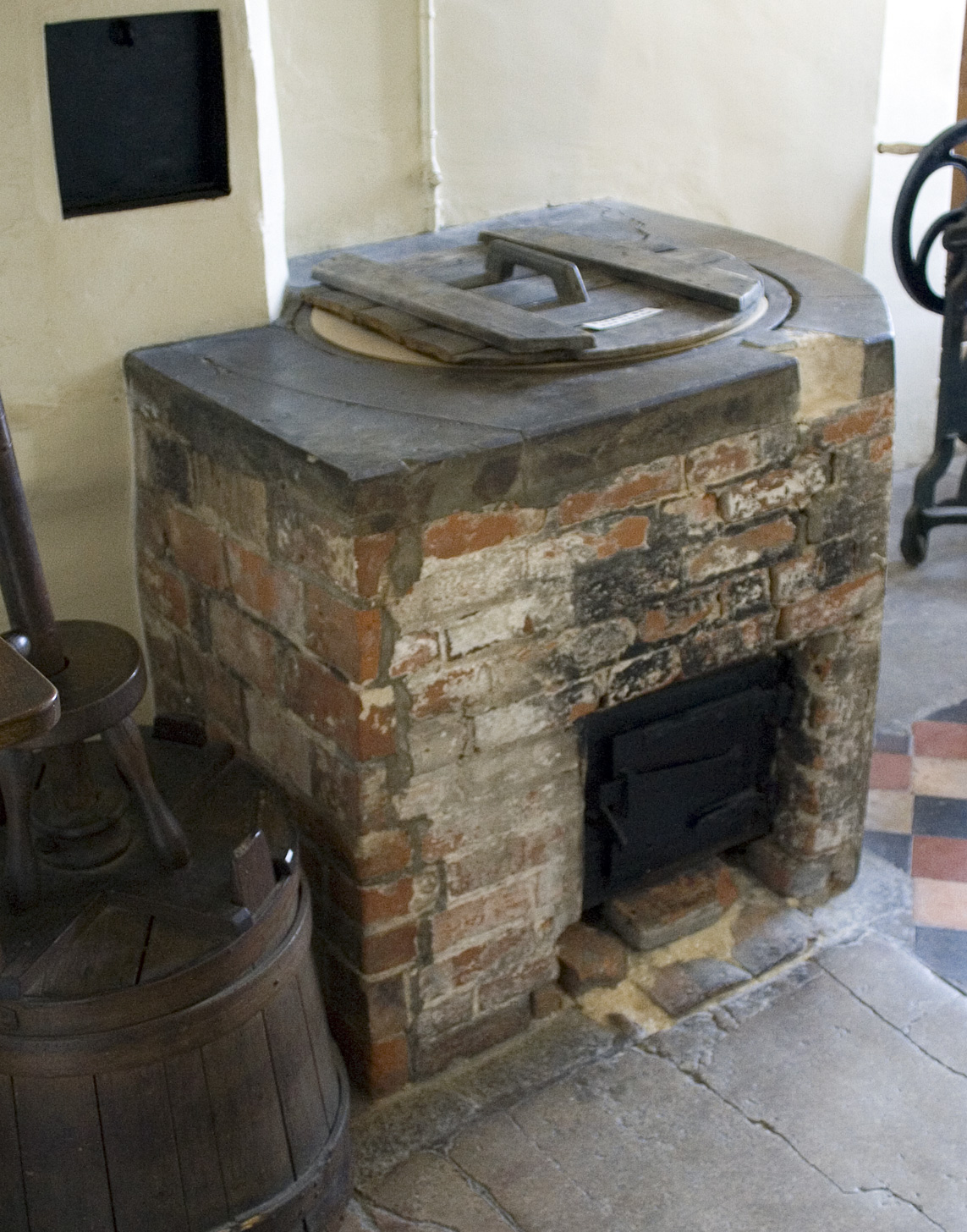
The water then had to be heated in a copper, a large metal boiler set in a brick firebox in the corner of the kitchen or scullery, until it was hot enough to dissolve the soap and the grease on the clothes. The fire would be lit very early in the morning to have the water ready for the laundry after breakfast.
The clothes (which must often have been quite smelly) had to be sorted, soaked if necessary, treated for stains, then washed in a wooden tub or stone trough, using a bar of lye soap and a wooden 'dolly' to agitate and pound them. White clothes and sheets, as well as tougher, dirtier work clothes, were often boiled (separately) in the copper itself. After being put through a wringer, rinsed twice and starched, the wet clothes were wrung out and flattened using a mangle, and then hung to dry - outside in rural areas, but inside on racks in industrial areas where soot and other particles polluted the atmosphere.

Families saved up their laundry for as long as possible so that it could all be done at once, typically every few weeks if they had enough clothes to last that long. Nothing was put in the wash that could be spot-cleaned, and even underwear was worn several times before being washed. If they could afford to pay someone else to do their laundry, they did.
An unladylike occupation
Being a laundress, working independently or in a commercial laundry in one of the bigger cities, was one of the few occupations open to married women and widows. It could mean the difference between making ends meet and destitution for those without a husband's income or for women whose husbands had seasonal jobs, or who were poorly paid, as was the case for common soldiers such as David Whybrew.
Being a laundress allowed mothers to work at home and keep their children with them, though they were occupied with washing and ironing from early in the morning to late at night. The children were often used as unpaid labour to help with tasks such as carrying water, turning the mangle and hanging clothes. They also had to live with the steamy atmosphere, lines of wet washing, and the smell of damp clothes and laundry soap.
Because laundresses were often poorly educated, physically strong, independent women, who effectively ran their own businesses, they were considered 'unladylike' and lacking in social respectability. As a soldier's wife, Susan Whybrew was already pretty close to the bottom of the social heap. Being a laundress simply added another layer to her outsider status. Nevertheless, her labours helped to keep her family afloat.
References:
http://www.vintageconnection.net/VictorianLaundry.htm
http://www.avictorian.com/servants_laundry.html
https://washergenes.wordpress.com/2006/06/15/english-laundresses-a-social-history-1850-1930/
http://fet.uwe.ac.uk/conweb/house_ages/services/print.htm
___________________
You can find out more about Susan and David Whybrew and their family, in my book Susan: convict's daughter, soldier's wife, nobody's fool.It's available on Amazon and other online books stores
Subscribe to:
Posts (Atom)