Showing posts with label Colchester. Show all posts

Tuesday, July 20, 2021

Alice Whybrew


Herbert & Alice Miller
with baby Alice c1901
(from a larger family photo)

Having tracked down the story of what happened to Rose Whybrew after she arrived in Chicago in the United States, I hoped I might find out more about her sister Alice, who also migrated to Chicago. Unfortunately, I haven't been able to find much to add to what I wrote about her in my post about the fourteen children of David and Susan Whybrew. But here's what's known.

Alice was born at Parsonstown in Ireland in September 1875, while her father David was stationed with the 50th Regiment in Kings County (now known as Co. Offaly). At the time of her birth her oldest sister, Harriet, was still in Australia, and two other siblings, David and Rosina, had already died. So she effectively became the second child in the family, with her sister Eliza nearly six years older. 

By the time her younger sister, Rose, was born in 1877, the family had moved back to England, to Canterbury. They eventually settled in Colchester. I can't find anything about Alice's childhood, other than what's known about the family generally. In the 1891 census, when she was 16, she was described as a tailoress.

In 1896 Alice married Herbert Arthur Miller, a carpenter from Colchester. He had enlisted in the army in 1889, but was discharged in 1891, apparently due to having flat feet. The couple went to live in Canterbury Road, Colchester.

A newspaper report in the Essex Standard in October 1899 suggests that their marriage was not going well. Herbert appeared in the Colchester police court charged with assaulting Alice. It was evident that this was not the first time that they had a violent argument. Alice wanted a separation order, but the judge would not allow it.

Perhaps things improved. A year later, in November 1900, Alice gave birth to their first child, Alice Frances. Three years later, in September 1903, Bessie Mary was born. She was named after Herbert's sister and was baptised at St Botolph's church in Colchester. I can't find a record of Alice Frances being baptised.

Moving to Chicago

In 1905, Herbert left England for Winnipeg in Canada aboard the Virginian, arriving in April. Alice followed with the two children on 10 August 1905, on the Tunisian. They all arrived safely in Canada. But the North West census for Canada in 1906 shows Alice and six year old daughter Alice living in what seems to be a boarding house in Winnipeg, with no sign of Herbert or little Bessie.

The census was taken in June. Possibly Herbert had already left for the USA. He crossed through Vermont into the United States with $30 to his name in June-July of 1906. (Most of this information comes from documents on familysearch.org)

It seems most likely that Bessie died while they were in Canada. She may be the 'Mary Miller' aged 2 whose death on 11 July 1906 is listed in the Manitoba Vital Statistics Agency database. It was a sad start to the family's new life in North America.

Eventually Alice and daughter Alice joined Herbert in Chicago. He found work as a bricklayer. When Alice's sister Rose and her husband George migrated in 1907, they gave Alice and Herbert's address, on 48th Avenue, Chicago, as their destination. Rose was still at this address in 1910.

By 7 December 1909, Alice was dead. I haven't discovered what caused her death. She was only thirty-four. There are no newspaper reports to suggest an accident. Her address when she died was recorded as 4742 W Ohio St. (See a photo of the house here.) She was buried at the Forest Home cemetery, 

Herbert remarried a few months later, to Alice M McKeon, an Irish immigrant who was a five years younger than Alice Whybrew. She is the Alice who appears with Herbert and his daughter Alice in the 1910 United States census, living as boarders with another family.


You can find out more about Susan and David Whybrew and their family, in my book Susan: convict's daughter, soldier's wife, nobody's fool.
It's available on Amazon and other online books stores


Monday, June 14, 2021

Benjamin John (Jack) Whybrew

I haven't written much about Benjamin John (Jack) Whybrew. For a long time there seemed little to add to what I said about him, when I wrote about the Whybrew's fourteen children. But recently I've come across some new information about his army career and his later life.

To recap, Benjamin John (usually known as John or Jack) was born in Canterbury in July 1879, while his father David Whybrew was a Staff Sergeant with the East Kent Militia. As the first boy in the family to survive infancy, he grew up with three older sisters. (Eliza, Alice and Rose. He was about ten years old when his eldest sister Harriet briefly re-joined the family.) 

Of the children born after Jack, two boys (David aka Henry and William) and two girls (Ellen and Ada) survived to adulthood. Jack was sixteen when Ada was born.

Cap badge of the York & Lancaster regiment


Like his younger brother, Henry, Jack joined the army in his late teens. He initially enlisted in the militia and then transferred to the York and Lancaster Regiment when he reached eighteen. But he was discharged unfit a couple of years later due to a perforated eardrum. The medical officer who diagnosed him was unsure of the cause, but seemed certain that it hadn't been caused or aggravated by his army service. 

His army records describe Jack as 5 feet 4 7/8 inches tall, with blue eyes, dark brown hair and a fresh complexion, which suggests he took after the Irish side of his family. On his discharge, his behaviour was described as 'fair' rather than 'good'. He'd faced a court martial and spent time in the lock-up on one occasion for breaking out of the barracks.

Marriage and family


In 1898, the year he left the army, he married Emily Licence, the daughter of a blacksmith from Suffolk. I have no clues as to how or where they met. At the time of the 1901 census they were living at 12 Charles Street in Colchester with Jack's sister Harriet, her husband Henry Malone and another married sister, Rose Anthony. Jack was employed as a general labourer and Emily was working as a 'tailoress'.

Their first and only child, Emily, was born in Colchester in 1902. That same year, Jack's brother Henry died from dysentery in South Africa while fighting during the Boer War. Jack must  have been acutely aware that he might well have had the same fate if he hadn't been discharged from the army.

Jack and Emily were living at 3 Smiths Yard in Colchester when the 1911 census was taken. Jack had work as a bricklayer's labourer and Emily was still tailoring. 

Two years later, in the summer of 1913, Emily died. She was only thirty-five. I've heard that their daughter, ten year old Emily, went to live with her paternal aunt and uncle, Eliza (Whybrew) and William Beales, but have no record of this.

Enlists again in WWI


Army Veterinary Corps staff treating a wounded horse, c1917 
(photo from National Army Museum)


When World War 1 began, Jack enlisted in the Royal Army Veterinary Corp, as a private, with the service number SE510. This was the same corp as his brother William.  The RAVC was responsible for looking after the many horses and other animals used by the army. Jack apparently served overseas from October 1914, but was discharged in February 1915, for reasons unrecorded. Perhaps his deafness became a problem again. 

He must have been devastated when William was killed in France just weeks before the war ended. Perhaps this contributed to the impression I have of him from distant family, of an unsettled, hard-living man. There are hints, too, that he didn't have a good relationship with his parents, but again, no record of this survives.

After the war


In 1920 he was awarded the Victory Medal and British War Medal, medals which were given to most returning soldiers. After that, tracing Jack becomes difficult. In 1927 his daughter Emily married George Sydney in London, but I don't know whether Jack attended the wedding. 

He appears next in the 1939 register, created by the British government just before the Second World War. Jack was living at 12 Childwell Alley with "Jessie Whybrew", born in 1878. A note against her name says 'Ward', suggesting that was her maiden name. 

But there's no record of them having married. In fact Jessie Ward was quite possibly still the wife of Edward Ward. At the time of the 1911 census, Jessie and Edward Ward were living at 4 Childwell Alley with their children. Edward was a hawker and a returned soldier.

The 1939 registered records that Jack, now aged sixty, was incapacitated, but gives no details. He died two years later in 1941. His daughter Emily and her husband George both lived on to a good age. They had three children. Whether Jack ever met his grandchildren is another unknown.


Monday, February 8, 2021

Memories of Susan and David Whybrew


John Street, Colchester
I'd like to share some of the fascinating information that was sent to me recently with the photo of Susan Mason. It was recorded from a conversation with Susan's granddaughter, Violet, late in life. Violet had never met her grandparents, Susan and David. Her memories were based on recollections of what  her mother, Ada, had told her, many years earlier. So the source is rather distant in time. 

Having said that, it gives a wonderful insight into the characters of both Susan and David Whybrew, and also answers some questions that were left unanswered in the book, Susan. 

I've edited the information I was provided a little, and reformatted it to make it flow. But I hope you can still hear Violet's voice in it.

Susan was born in Australia in 1848. Her parents were Irish. She married David Whybrew while his regiment was stationed in Australia. After travelling around the world with the regiment, they returned to England and the barracks in Colchester.

Nell (Ellen) and Ada were the youngest of many children, born in many different places, including Cambridge. Susan was nearly fifty when Ada was born. Only Nell and Ada were still at home when Susan used to go away to work as a midwife. (This explains why Susan described herself as a nurse on the 1911 census, despite having no training as far as I could tell. Midwives then didn't need any qualifications.) 

In those days, midwives used to live in with the family in confinement. Susan used to go away for six weeks; three weeks before the birth and three weeks after the birth. Families used to send their pony and trap for her when she was needed. One particular family she used to attend to had lots of children and they always used to send for Susan.

Susan often used to be paid in kind. On one occasion she had been paid with sausages. As she was walking along, all the sausages were trailing along behind her!

Her husband, David, loved her dearly. He described her as 'the belle of the ball' and said that he loved every hair on her head.

David used to sing to Sue:

Sue, Sue, I’m very much in love with you, 

When your pretty little eyes of blue are smiling,

Few, few, few little girls are as nice as you,

There’s a lovely (lonely?) little part, in the middle of my heart,

Just for you, you, you.

David Whybrew was born in 1839. He was Welsh and a Regimental Sargent Major. He met Susan while with his regiment in Australia.  They married and eventually came back to live in Colchester. 

(My correspondent is unsure why the family thought David was Welsh. All the recorded evidence points to him being from Essex, with both parents English, but there's obviously a story yet to be uncovered.) 

He had retired by the time Ada was born. 

He was very strict but he loved his wife and children dearly.  Everything was done to precision. His rule was "no working on Sundays". Nell wasn’t even allowed to sew on a button. They had their own pew at church and went to church every Sunday.

Ada wasn't allowed dancing shoes.  She used to go out, hide her shoes under a hedge and collect them later. He called dancing girls “harlots”.

He did all the sewing and darning. He said that no woman could do it properly! Aunt Nell wanted to borrow some white cotton off him. He gave her some but said: “Don’t ever ask me again. You never lend or borrow, always replenish your stocks, before they run out.”

He used to clean their shoes every day, he even cleaned the soles. He had a piece of wood whittled down and cleaned the edges with it. When the children became fourteen years old, they had to clean their own. Last time he cleaned them was on their birthday. He used to say: “There you are my girl, that is the last time I will clean your shoes”, then he gave them an apple and a penny.

Stories like these are priceless. They say so much about ordinary family life, and they can't be obtained from public records or even newspapers. I'm very grateful to the lady who sent them to me.


Saturday, November 14, 2020

Ellen Whybrew

I was looking again recently at the records I have for the children of David and Susan Whybrew (nee Mason). Of the fourteen offspring born to Susan, I've found the date of death for all but two - Rose, who disappears without trace in America after 1918, and Ellen (known in childhood as Nellie). 

I've written about Rose several times. Here's what I know about Ellen, the Whybrew's eleventh child. Her father David, a soldier, was close to retirement when she was born in 1890 and the family lived in Colchester during her childhood. Of the three children born after Ellen, only Ada (b 1895) survived infancy.

High St, Colchester (2019)


At the age of twenty Ellen married George Frederick Howard, who was five years her senior. He was the son of Alfred and Sarah Howard of Stotfold in Bedfordshire. Sarah died when George was only nine years old, and he and his siblings were brought up by their father, a farm labourer. By the age of fifteen George was also employed as a farm labourer. 

However, sometime before the marriage in August 1910, most likely when he turned eighteen,  George enlisted in the army. On the marriage register in Colchester his occupation was recorded as "Drummer, Bedford Rgt." Strangely, his father Alfred was described as a "baker" on the marriage register. Perhaps this has been incorrectly transcribed. (I don't have the marriage certificate, only the information included on the transcription on freereg.org.uk).

On the night the census was taken in 1911, George was resident in the barracks in Aldershot, as a private in the 1st Battalion of the Bedfordshire regiment. He was described as a drummer and musician. Ellen was alone in a six roomed house in Newport Road, Aldershot.

But she and George must have spent at least some time together over the next few years. Their first child, Alexander George Ernest, was born in 1911, followed by William Edward in March 1913 and Leslie Owen in December 1914. Sadly for Ellen, Leslie died before his first birthday, and it seems likely that William also died in infancy. His name doesn't appear with Ellen's in later records. 

Could William have been adopted by Ellen's brother William and his wife Adelaide? It's a tantalising thought, given that no record seems to exist for the birth of William and Adelaide's only child, William Ronald. (See Did William Whybrew have a son after all? ) But William Ronald is said to have been born on 20 August 1912, according to the 1939 register, which makes him at least seven months older than Ellen's child, so it seems unlikely that they are the same. It's more likely that Ellen's son is the William Edward Howard who died in Colchester at the age of two early in 1916.

With the outbreak of war in 1914, George went from being a drummer with the Bedfordshire regiment to a private with the Royal Sussex Regiment of the 11th battalion. He was sent to France with the British Expeditionary Force. On 4 August 1917, he was killed in action and was buried among the many fallen soldiers in the Etaples Military Cemetery, Pas de Calais, France. Ellen probably never got to visit his grave. Just a few weeks later her father David also died, at home in Colchester.


Etaples Military Cemetery


She received a widows pension, but it must have been difficult for Ellen raising her only child alone. By the time she received George's few possessions from the army in 1919, she had moved to Islington. She married Alfred Lloyd at St Paul's, Canonbury in Islington in September that year. Her sister Ada and Ada's husband, Joseph Metson, were the witnesses.

The last trace I can find of Ellen is in the 1939 England and Wales register, taken just as the second World War began. She and Alfred were living in Merton in South London, along with Alexander, who was still single. Alfred was working as a government messenger, while Ellen described herself as a retired tailoress. So far I haven't been able to determine which of the many death registrations for women named Ellen Lloyd, born around 1890, is the right one for Ellen. 


UPDATE: I've now confirmed that Ellen died in 1984 in Bromley, Kent, aged 94.


Sources

Births, deaths and marriages: Ancestry.com.au, GRO index search

Ellen's marriage to George Howard: Freereg.org.uk 

George Howard's military service: Bedfordshire Roll of Honour, Stotfold  

Images: Etaples Military Cemetery: Wikimedia 

Colchester High St: David Martin  on Georgraph.org.uk


Saturday, October 3, 2020

Mystery photographs

 A friend who is related to the Whybrews has sent me this photo of a family from Colchester. It was found among family photos, but neither of us know who they are. Does anyone recognise them? 


Here's another photo, also from Colchester. The reverse has the name of a photographic studio, Bradley and Blowers. 


If you can tell us anything about these photos, please leave a comment, or message me via the contact page on my website (https://www.stellabudrikis.com/contact/)

Friday, April 24, 2020

A Rose by any other name won't do

As I've mentioned before, one of the toughest brick walls in my family history research is the fate of Rose Whybrew.

Rose, born in Kent, England, in 1877, married George Henry Anthony in Colchester in 1897. Their first child, Harriet, lived only a few months. Rose gave birth to a son, George William, in 1907, not long before the family migrated to the United States via Canada. They settled in Chicago, where Rose's sister Alice was living.

I've found the family in Chicago in the 1910 US census. Little George died and was buried in Chicago in 1913. In 1918, the older George received call-up papers from the US military, but as far as I can tell, he didn't respond. Rose's name appears as his wife on the papers, but her address, still in Chicago, is different to his, so it seems they had separated.

And then they disappear. I found a man  named George Anthony in the 1920, 1930 and 1940 US census, an inmate of a Chicago asylum, who fitted some of George's details. But Rose completely vanishes. I can't find any evidence that she died in Chicago. Did she remarry? Did she move interstate, or return to England? I've spent hours trying to find her, but without success. I've found lots of women named Rose Anthony, but none that I can identify as her.

I was having yet another look recently, hoping I might find her, when I came across a couple named George and Rosina Anthony in the 1939 England and Wales Register. Other women in my family named Rosina were sometimes called Rose, and vice versa, so the slightly different name didn't put me off. They lived in Hornsey, which is where Rose's sister Ada Metson lived in 1939.

According to the transcript, the husband was born in 1874, the wife in 1878, which matched the couple I was looking for almost exactly. Imagine how excited I was. Maybe George didn't finish up in an asylum after all.

Once I looked at the register image itself, I saw that the wife, Rosina, was born on 13 November 1878. That was Rose Whybrew's birth date, except for the year. Maybe the person recording the date had got the year of her birth wrong by one year. It wouldn't be the first time I'd come across an error like that in the register. I thought my brick wall was finally going to topple.

But then I noticed the couple had a daughter, Elsie Maud Anthony, who was born in 1907. That didn't fit, unless little George had a twin who was left behind when they migrated. I thought I'd better do a bit more research. And soon I found the whole family living in London in the 1911 England census. A bit more digging showed that Elsie Maud's mother's maiden name was Young. Drat!

So I still don't know what happened to Rose Whybrew. But I'm intrigued by the co-incidences between her and Rosina Young. It shows how carefully you have to check before assuming that you've found the person you're looking for in the records.

Image: F Muhammad from Pixabay

====================================

To read more about Rose and her family, see my book Susan: convict's daughter, soldier's wife, nobody's fool. It's available on Amazon and other online books stores. To read a preview of the first chapters, click on the cover image.

Sunday, May 26, 2019

St Osyth in Essex

The strangely-named village of St Osyth lies about twelve miles (19 km) from Colchester, heading south-east towards the coast of Essex in southern Englad. It's named after a legendary seventh-century chieftan's daughter, Osyth or Osgyth (pictured here in an illuminated manuscript about her life).

She apparently left her arranged marriage to become a nun and set up a convent in the village of Chich or Chicc. She was beheaded by raiding Viking pirates in about 700 AD. Later Chich became known as St Osyth, though the earlier name continued to be used. Osyth's ghost, carrying her head in her hands, is said to haunt the Priory built in her honour in the 12th century.

No such drama was involved when Robert Beales moved to St Osyth around the time of his marriage to Hannah May in 1809. He was a carpenter, from Combs in Suffolk, and perhaps came to St Osyth looking for work. His family would remain in the village for several generations.
Gatehouse and walls of St Osyth Priory
 (image by Stephen Dawson)

Robert Beales might have found work as a carpenter on the grounds of St Osyth's Priory or in the house itself. The walls and gatehouse of the Priory were a dominant feature of the village, taking up one quadrant of the cross formed by the two main streets. At the time of the dissolution in 1539, under King Henry VIII, it was one of the richest monasteries in Essex. After its closure, it became a private home.

Robert and Hannah had seven children before Hannah's death in 1830, including James (b 1814) from whom my family line came. Most of them were baptised in the ancient church of St Peter and St Paul in St Osyth. The widowed Robert married Mary Ann (surname unknown, but possibly Farthing). She had no children as far as I know. Robert died in St Osyth in 1854.

19th century Ordnance Survey map (from Vision of Britain)
Click to see larger version

The land around the village, which is mostly flat, was used for grazing animals, and growing wheat, barley and oats. Instead of following his father into carpentry, Robert's son James became an agricultural labourer. He may have worked on the farm belonging to his father-in-law, John Potter. In the 1851 census the Potters were said to own a farm of 5 acres, employing one man. They lived next door to James and his wife Hannah.

St Osyth marsh
(image by Paul Franks)

Ten years later, in 1861, James and his family were living in a cottage on Wigboro Wick, a farm and hamlet located between the village of St Osyth and the salt marshes that separated it from the mouth of the Colne River. ('Wick' means a farm or settlement and there are several farms in the area with the same suffix).

They were still there in 1871. Their son James, also an agricultural labourer, lived, and probably worked, on the same farm, with his wife Rosanna (or Rosina, nee Bines) and their children.

Farmland around St Osyth. Wigboro Wick farm
 is near the top of the picture. (Image by Terry Joyce)


By the time of the 1881 census, Beales was the third most common surname in St Osyth. The older James was by now a stockman at Wigboro Wick. He died in 1887 at the age of 73. The younger James and Rosanna had moved to a house closer to the village, in Mill Street. This ran past the Mill Dam lake, formed by a dam across St Osyth Creek. Next door to James lived his brother George and his family. Both James and George were employed as agricultural labourers. Like their father, the two brothers became stockmen, looking after the farm's horses, as they grew older.

St Osyth seems to have been a quiet place in the 19th century. When it was mentioned in the Essex newspapers, it was mostly just a two-line report about the local flower show, an outbreak of disease on a farm or a fund-raising tea at the vicarage. Occasionally there would be something more out of the ordinary - a drowning off the coast, or an archeological find. The Post Office directory of 1874 shows all the usual occupations found in a village of this era - bakers, shoemakers, drapers, hairdressers, carpenters etc, along with services needed by farmers such as blacksmiths, wheelwrights and seedsmen. There were five beer retailers listed.

The agricultural depression of the late nineteenth century had a dampening effect on this rural community. According to speech to Parliament given by the Member for Colchester and reported in Hansard in June 1894, the state of things in Essex was "serious and urgent".

"The time was when Essex was one of the most prosperous agricultural counties in the whole Kingdom; it was one admirably adapted for corn growing; but the years since 1875 had been a period of accumulated decline, 19 years in which not one year had been a good one, with the exception of 1887. Even in that year the farmers did no more than pay their way, and then on the top of all came the worst season agriculture had ever known, to wit, the year 1893."

The depression, combined with industrialisation, led to villagers, particularly the young, moving to larger centres such as Clacton, Ipswich and London, to find work and St Osyth went into decline.

My great grandfather, William James Beales, left St Osyth and moved to Colchester when he married in 1891. But his parents, James and Rosanna, and several of his siblings and cousins, remained in the village all their lives. The last of the Beales family descended from Robert Beales left St Osyth in the 1970s.

William Beales' wife Eliza Whybrew was born in Adelaide in South Australia, and that is where we'll go next in this journey through places where my ancestors once lived.

General Sources:

St Osyth Conservation Appraisal and Management Plan

History of St Osyth (History House series)

Vision of Britain - St Osyth


Thursday, May 2, 2019

Colchester, Essex

In this series of posts on places where my ancestors once lived, we now travel across many counties, from Lancashire in the north-west of England to Colchester, in the south-east.

Colchester is one of the oldest towns in Britain. It has had a military presence since the Twentieth Victorious Valeria Legion established a garrison there in 43 AD, during the Roman conquest of Britain under Emperor Claudius. For a while it was the capital of Roman-occupied England, despite the best efforts of Queen Boudica to see them off. Over the centuries other armies followed in making Colchester their base. One end of the main street is still dominated by the great Norman keep, and the later castle, built on the mound of a Roman temple.

By the end of the 18th century, several barracks had been built in Colchester to house troops and cavalry regiments coming and going from wars on the continent. Wounded men were also brought to the military hospital in Colchester to recover. The townspeople were used to seeing the population of infantry and officers in the barracks swell in times of war, followed by an emptying out in peace time.

But they had probably never experienced anything like the influx of soldiers that occurred with the outbreak of World War 1. Volunteers flooded in. Two hundred men arrived in Colchester each day, to be trained as part of "Kitchener's Army" before being sent to the battlefields of Europe and the Middle East. At times there were as many soldiers in the town as local residents. The barracks couldn't house them all, so they were put in huts and tents, or even billeted with families.

Thomas Henry Ward goes to Colchester


Thomas Henry Ward
(Photo courtesy of M. Lucas)
As the war dragged on, the number of volunteers dwindled and in 1916 conscription was introduced. It's not clear whether my grandfather, Thomas Henry Ward, joined up as a volunteer in 1914 or found himself conscripted later on. But whatever the case, he would have been in his early thirties when he travelled by train to Colchester, to join the Army Ordnance Corp.

He would no doubt have found the flat Essex countryside, with its broad fields of wheat and other crops, quite unfamiliar after living in the hilly moorlands of eastern Lancashire all his life, among the mills and factories. Colchester itself was a pleasant, prosperous-looking town, with hardly a mill or a smoke stack in sight.

Before the war, engineering works such as Paxman's, which made steam engines and boilers, were among the main employers in Colchester. They turned to making armaments during the war. The presence of the army also helped keep a brewery and bottling works in business. But Thomas, by all accounts, was not a great drinker. A rather quiet, perhaps even shy man, he was also older than many of the recruits around him.

The Beales family in Colchester


One Sunday afternoon (according to my father) Thomas was invited to have tea with a local family. The Beales were members of the Salvation Army, which had a strong presence in Colchester from the late 1880s, although it was not always well received. The family made it their ministry to look out for lonely-looking soldiers who were far from home

William and Eliza Beales had lived in Colchester all their adult lives. Except for Eliza's mother, Susan, who was from Australia, all their forebears came from villages around Colchester. Eliza's parents, David and Susan Whybrew, came to live near the Beales in Colchester after David retired from active service in the army.

Rosina Beales
The Beales' daughter Rosina, still in her late teens, may well have been dressed in her Salvation Army uniform when Thomas Henry, in his army uniform, met her for the first time over Sunday afternoon tea. Or perhaps not - family lore says nothing about what they were wearing. They would have had little time to get to know each other before Thomas went off with his battalion to serve overseas, but they evidently managed to keep their friendship going during the war.

In 1921, after Thomas was discharged from the army, they married at St Botolph's Anglican church in Colchester. It was then Rosina's turn to find herself in a strange environment when she and Thomas went back to his home village of Milnrow in Lancashire. She was leaving behind her Salvation Army roots as well as her childhood home in Essex.

Thomas Henry died several years before I was born, but my grandmother Rosina still lived in Milnrow when I was growing up. As a child I knew that she was born "down south" somewhere, and used to belong to the Salvation Army, but she seemed a natural part of what I called "home". It wasn't until I began researching my family's history that it occurred to me that Grandma Rosina must have undergone quite a cultural change when she married. How long did it take her to adjust? How did it affect her? Unfortunately I never had chance to ask her such questions.

Rosina's parents, William and Eliza Beales, continued living in Colchester for the rest of their lives, surrounded by children, grandchildren, and members of their wider family. Their role as officers in the Salvation Army and members of the Salvation Army band shaped their daily lives as much as their location.

In the next few posts I'll look at some of the Essex villages where the Beales and Whybrew families came from.


This series of 13 slides by Xav Marseilles shows what Colchester looked like 100 years ago, overlaid with more recent images. It appeared in the Daily Mail, 2 January 2017. (Click on the photo or the link above to see all the slides).


You can find out more about Susan and David Whybrew and their family, in my book Susan: convict's daughter, soldier's wife, nobody's fool, available on Amazon and other online books stores

Tuesday, February 20, 2018

What happened to Rose?

Rose Whybrew was the fifth daughter of  David and Susan Whybrew (nee Mason) and my father's great aunt, though he never met her. She is another of the unsolved mysteries in my family history research. I've been able to follow her life story as far as Chicago, USA, in 1918, but then she disappears. Despite hours spent searching, I haven't found any trace of her after that. What I do know about her suggests she had a difficult and sad life.

The SS Canada of the Dominion Line. 
Rose was born in 1877 while her father David was stationed in Canterbury in Kent. She married a shoe maker from London, George Henry Anthony, in 1897. Their first child, a daughter named Harriet, was born in Colchester, Essex, in 1900, but died before she was six months old.

In 1907, not long after the birth of their son George William, Rose and George Henry Anthony migrated to Chicago aboard the SS Canada. According to the 1910 US census, George W. was the fifth child born to Rose. I haven't found any record of the other births, so possibly the other three were stillborn.

Like many English migrants to the USA, they sailed to Quebec in Canada, then crossed into the United States through Vermont. Their names appear in the border crossing records in October 1907. Rose is described as being 5 ft 3 3/4 in, with ruddy skin, brown hair and hazel eyes.

State St, Chicago, c1907
The family were destined for 48th Avenue in Chicago, where Rose's sister Alice lived with her husband Herbert Miller and their daughter Alice.

When Alice Miller senior died in 1909, Herbert remarried and moved out with his new wife (also called Alice) and his daughter, leaving Rose and George at the 48th Avenue address. In the 1910 US census the Anthony's were apparently still living at 626, 48th Avenue.  Rose was working as a "janitress".

Rose's young son George died at the age of 6 in 1913, and was buried at Forest Home cemetery in Chicago, where his aunt Alice was also buried. As far as I can discover, there were no other children born to Rose and George in the USA.

In 1918 George senior received call-up papers for the US army. The papers show him as still living on 48th Ave, but although Rose is listed as next of kin, her address is given as 4823 W Congress St, Chicago. That is the last mention I can find for Rose.

The call-up papers were never signed. George may have been resident in the Norward Park psychiatric hospital at the time. A patient named George Anthony, born in England in 1874, and married, was listed there in the 1920 census. He may also have been there in 1910. Although George Anthony is listed at the same address as Rose in the 1910 census, someone of the same name and age is recorded as an inmate of the Norward Park hospital. Perhaps Rose filled out his details in the census with hers and young George's, not realising that only those actually on the premises on the night of the census were to be included.

Kankakee State Hospital
In the 1930 census, what appears to be the same George Anthony was a patient of the Jacksonville State Hospital for the Insane and in the 1940 census the same person was a patient of the Kankakee State Hospital in Manteno. When this man died on 16 May 1941, his previous occupation was recorded as "shoe cobbler", which tallies with George Henry Anthony's occupation when he arrived in the USA.

What happened to Rose? If she remained in the USA, I haven't been able to identify her on any of the censuses after 1910. The George Anthony who was in Jacksonville in 1930 was said to be single, so if he was Rose's husband, it suggests she had either separated from him or died. But I haven't been able to find any record of a divorce, remarriage or death for Rose.

Did she return to England? I discovered a Rose Anthony from Chicago who travelled to England in 1924. But then I found her passport application, which clearly showed that it wasn't the same Rose Anthony.

Did she perhaps migrate to Australia where her mother's family lived, or join her cousins in Canada? Did she revert to using her maiden name? I've looked at all these possibilities, but haven't had any success in finding her. For now she remains a mystery.

_______________________

You can find out more about Susan and David Whybrew and their family, in my book Susan: convict's daughter, soldier's wife, nobody's fool, available on Amazon and other online books stores

Tuesday, March 7, 2017

And it's done!

View the book
The book I've been writing about Susan Mason and her family is finally complete and published on Amazon worldwide. It's available as an e-book which can be read on any Kindle device or Kindle app. A paperback version is also available (although sadly not through the Australian Amazon site, which doesn't stock printed books yet). I'm still looking into other e-book options such as epub and ibooks.

I hope if you've enjoyed reading my articles about the Mason and Whybrew families here on Clogs and Clippers you will find this much expanded and chronological version of their stories interesting and enjoyable. The book has extensive endnotes and a bibliography.

I've had great fun writing it. My sincere thanks to all who have helped with the research, editing, and revising of the book. Thanks especially to Katie for the cover and Amy for her editing.

For UK readers, the Kindle edition is available here.
For customers of the Australian Amazon site, it can be found here.

Visit my new "author page" on Amazon for more information.

Friday, September 16, 2016

The life of a laundress


Several years ago we visited a 'living museum', a house set up and furnished just as it would have been in the early 1900's. The couple who owned and occupied the house tried, as far as possible, to live as the occupants would have lived in that era. The one concession they had made to modern life was the washing machine sitting in a corner of the laundry. They admitted that washing their clothes and bedding the old fashioned way was just too much work, and they couldn't bear to wear their clothes over and over again, as people once did.

Their comments came to mind when I began looking at what the life of a laundress in the 19th century involved. My great great grandmother, Susan Whybrew (nee Mason) described herself as a laundress in the 1891 census, and several newspaper items about her make reference indirectly to this role.

It's likely, for instance, that the bundle Susan was carrying along the street when she slipped and sprained her ankle in 1899 was laundry being returned to a customer (The Essex County Standard West Suffolk Gazette, and Eastern Counties Advertiser (Colchester, England), Saturday, June 03, 1899; pg. 7).

When we see how much work was involved in being a laundress we can also perhaps understand why Susan thought her 20 year old daughter Harriet should have paid her for washing her collar and cuffs (Essex Standard, 20 October 1888, p 8) . Delicate lace collars and cuffs were usually made removable so that they could be washed, dried and starched separately, but this all added to the work load.

'Twas on a Monday morning...


Until the invention of the electric-powered washing machine in the early 1900's, washing clothes was a long, laborious task. Before the turn of the century many homes had no running water on tap, particularly in working class areas, so the water had first to be carried from a pump or well. This was likely to be at the bottom of a hill or down the street. A full wash required many gallons of water.

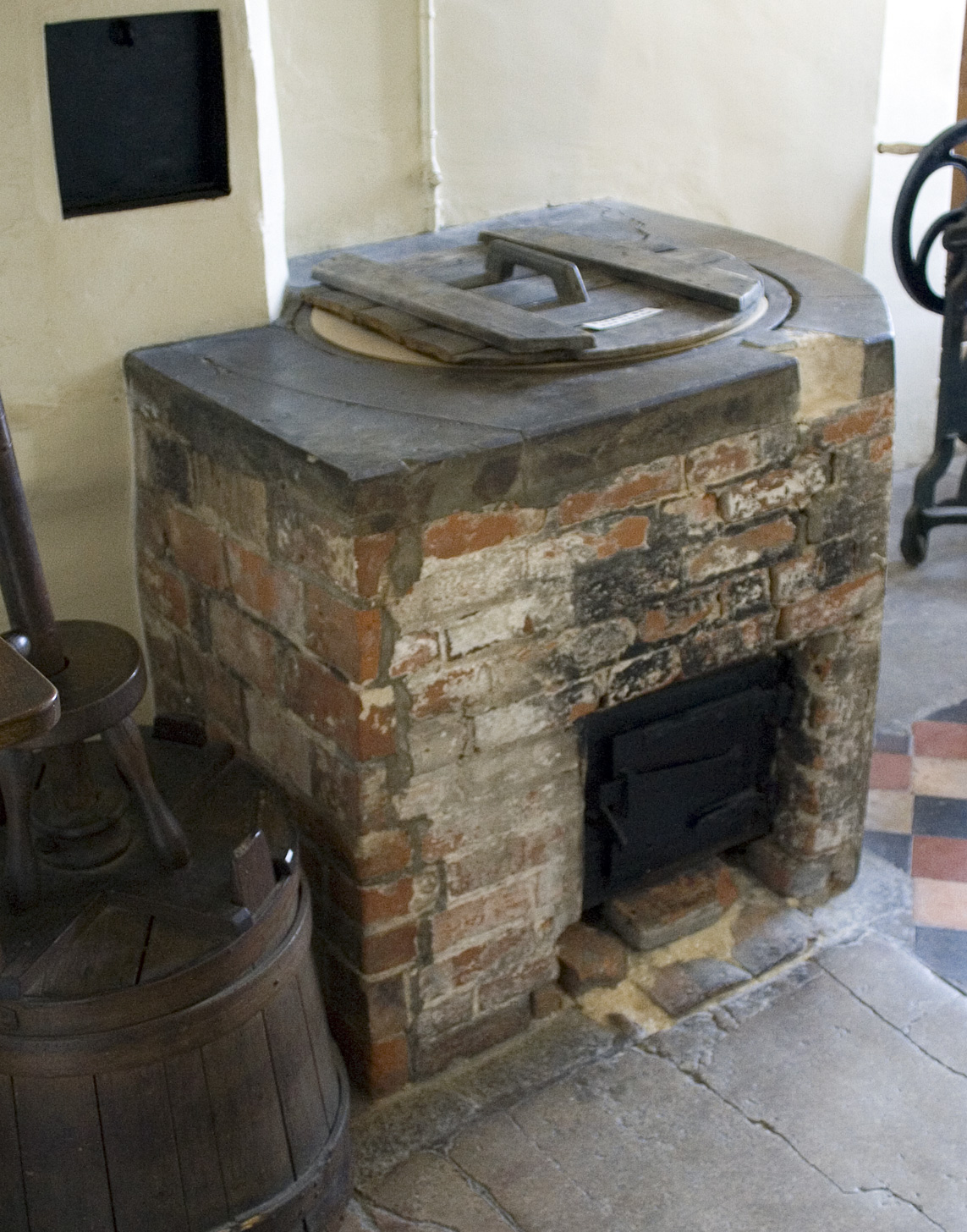
The water then had to  be heated in a copper, a large metal boiler set in a brick firebox in the corner of the kitchen or scullery, until it was hot enough to dissolve the soap and the grease on the clothes. The fire would be lit very early in the morning to have the water ready for the laundry after breakfast.

The clothes (which must often have been quite smelly) had to be sorted, soaked if necessary, treated for stains, then washed in a wooden tub or stone trough, using a bar of lye soap and a wooden 'dolly' to agitate and pound them. White clothes and sheets, as well as tougher, dirtier work clothes, were often boiled (separately) in the copper itself. After being put through a wringer, rinsed twice and starched, the wet clothes were wrung out and flattened using a mangle, and then hung to dry - outside in rural areas, but inside on racks in industrial areas where soot and other particles polluted the atmosphere.

Once the clothes were dry they were ironed using a heavy flat iron heated on the stove. Often several irons would be used, so that one could be in use while the others were re-heating. The whole process of soaking, washing, drying and ironing took several days, so the laundry was usually started on a Monday in order to have it done by Saturday afternoon.

Families saved up their laundry for as long as possible so that it could all be done at once, typically every few weeks if they had enough clothes to last that long. Nothing was put in the wash that could be spot-cleaned, and even underwear was worn several times before being washed. If they could afford to pay someone else to do their laundry, they did.

An unladylike occupation

Being a laundress, working independently or in a commercial laundry in one of the bigger cities, was one of the few occupations open to married women and widows. It could mean the difference between making ends meet and destitution for those without a husband's income or for women whose husbands had seasonal jobs, or who were poorly paid, as was the case for common soldiers such as David Whybrew.

Being a laundress allowed mothers to work at home and keep their children with them, though they were occupied with washing and ironing from early in the morning to late at night. The children were often used as unpaid labour to help with tasks such as carrying water, turning the mangle and hanging clothes. They also had to live with the steamy atmosphere, lines of wet washing, and the smell of damp clothes and laundry soap.

Because laundresses were often poorly educated, physically strong, independent women, who effectively ran their own businesses, they were considered 'unladylike' and lacking in social respectability. As a soldier's wife, Susan Whybrew was already pretty close to the bottom of the social heap. Being a laundress simply added another layer to her outsider status. Nevertheless, her labours helped to keep her family afloat.

References:

http://www.vintageconnection.net/VictorianLaundry.htm

http://www.avictorian.com/servants_laundry.html

https://washergenes.wordpress.com/2006/06/15/english-laundresses-a-social-history-1850-1930/

http://fet.uwe.ac.uk/conweb/house_ages/services/print.htm

___________________

You can find out more about Susan and David Whybrew and their family, in my book Susan: convict's daughter, soldier's wife, nobody's fool.
It's available on Amazon and other online books stores


Friday, July 29, 2016

William Whybrew - an update.

The Cemetery at Vis-en-Artois.
William Whybrew has no grave, his name is inscribed
on panel 5 of the curved memorial wall between
the two stone pillars.(image courtesy of wikimedia).
Back in March 2014 I wrote a couple of posts about the children of David and Susan Whybrew. At the time, much of what I wrote about their youngest son William (the youngest son to survive childhood at any rate) was speculative.

In the course of doing research for my book about Susan, I've been able to confirm many of the details for William and add a few new ones, though some create more mysteries than they solve. So here's an update.

William was born on 29 October 1884 while the family were living in Berry St, Sittingbourne, near Canterbury, Kent. At the time his father David was with the 3rd East Kent militia. Some time after William's birth David left the army without completing his five year contract, for reasons that are unclear, and the family moved to Colchester in Essex. Two sons, Alfred (1888) and James (1892) were born to Susan in Colchester but didn't survive infancy.

William was at home with David and Susan at the time of the 1901 census, working as an assistant gardener. In 1905, when he was 21,  he married Adelaide Williams, a woman from Ipswich, a coastal town in Suffolk, 30 km north east of Colchester.

At 38 Adelaide was considerably older than William. Their marriage certificate indicates that she was the daughter of Earle Henry Williams, deceased, a fish hawker of Ipswich. She seems to have spent some of her childhood in the Ipswich workhouse, and then disappears from the records until her marriage to William.

The couple moved to Canterbury, where William found work as a carman, driving a delivery cart for a mineral water company. They had a lodger living with them when the 1911 census was taken, an infirm elderly man named Abraham Langford, who was possibly cared for by Adelaide (or Annie as she was referred to on the census.)

In 1914, at the beginning of the First World War, William enlisted in the Army Veterinary Corp, which looked after the many horses, mules, dogs and other animals used by the army. He transferred to the Yorkshire regiment (Alexandra, Princess of Wale's Own) and fought in the trenches in  France and then saw action in Italy before returning to France in September 1918. I've now confirmed that William died in action in France on 29 October 1918, just a few days before his 34th birthday and only three weeks before the war ended.

The Hundred Days Offensive, August-november 1918
Battle of Courtrai.
British and Belgian wounded waiting to be taken
back by light railway. Dadezeele, 15 October 1918.
It’s likely that William was involved in the decisive “Hundred Days” battle or "Advance to Victory" in Picardy and Artois, which broke the Germans' resolve and ultimately led to the Kaiser’s abdication and the signing of the armistice on November 11. It was a massively destructive battle. William had no grave, perhaps no identifiable remains. His name is inscribed on the memorial at Vis-en-Artois amongst the 9,847 men of the Allied forces with no known burial place, who fell between August 1918 and the end of the war.

The news of his death would have been sent first to his widow Adelaide. In 1919 she applied for his medals, his belongings and the money still owed to him by the army. She was listed as the sole legatee. Later his name was inscribed on the war memorial in Ipswich, but strangely not the one in Colchester where he grew up and enlisted.

William and Adelaide had no children. However, it seems that Adelaide had either a son or a stepson by a previous relationship. A young soldier named Henry Alan Lawrence, born in 1890, joined the army in 1908 and gave a 'Mrs Whybrew' as his mother and next of kin. Her address at the time was in Colchester. He also listed two brothers, Archer and George Lawrence, whose address was in Stanstead in Essex.

At the end of WW1, in which Henry Lawrence was badly injured and became a prisoner of war, his address was the same as that of Adelaide Whybrew on William Whybrew's records - 195 Bramford Rd Ipswich.

How Henry fits into Adelaide's story is something I still haven't worked out. In the 1891 census he and his brothers  appear  to be the sons of William and Martha Lawrence of Sawbridgeworth in Hertfordshire. Martha Lawrence (nee Archer) died in 1897 and the family were scattered. There's no record of William Lawrence ever marrying Adelaide Williams. Perhaps she became an unofficial step mother to young Henry.

(I'm grateful to Andrew Beal of the Ipswich War Memorial and Cenotaph page on Facebook for some of these details.)

__________________

You can find out more about Susan and David Whybrew and their family, in my book Susan: convict's daughter, soldier's wife, nobody's fool.
It's available on Amazon and other online books stores

Monday, April 4, 2016

Disturbing the peace - the Salvation Army

As I've mentioned before, William Beales and his family were dedicated members of the Salvation Army in Colchester. Recently I've been reading more about the history of the Salvation Army. It's not only fascinating in its own right, but also includes some intriguing links with our family history, both in Australia and England.

Catherine and William Booth
William Booth, a Methodist minister, began what was to become the Salvation Army as a mission in the slums of the east end of London in 1865. His focus was on bringing the gospel to the vast numbers of working class and underprivileged people who had no connection with the established churches. His unconventional methods, which included allowing women to preach and holding open air meetings with bands playing catchy tunes, created controversy but proved very effective.

The Christian Revival Ministry, as it was then known, soon extended its work of gospel preaching and started providing education, food relief and "penny banks" for the poor and destitute. The name was changed to the Christian Mission and then in 1878 it became known as the Salvation Army. It adopted an army-style uniform for its workers and began using military terminology for many of it's activities. Ordained ministers became "officers", it's local congregations "corps", and its buildings "citadels" or "barracks". William Booth remained the General. His wife Catherine was actively involved in both ministering and preaching.

The organisation soon spread beyond London to other parts of what William Booth referred to as "Darkest England". The first meeting in Colchester was held towards the end of 1881 in the Assembly Rooms in Queen St. When the local skating rink was put up for sale in 1882 it was purchased by an agent on behalf of General Booth and soon became the local  meeting place. General Booth himself visited Colchester and preached to large audiences on several occasions.

Initially the Salvation Army faced a lot of opposition in Colchester as elsewhere. The uneducated heckled and threw rocks and bottles, while the better educated tossed off letters to the editor such as this one to the Essex Standard in July 1882:
Sir, -- A short space in your columns, if you please, for a few valueless remarks of a simpleton.
We have in Colchester sixteen Churches, besides a Roman Catholic Chapel, and Meeting Houses, I don't know how many; and I suppose to these buildings are attached between thirty and forty Clergymen and other Gospel ministers; nor am I the one to say, or even think, that any individual member of that staff is negligent or his duties toward either God or man. Each, I hope, is serving his Master and his fellow-men to the best of his ability. So that to me it seems, there was no need whatever for a Salvation Army to march into this town with trumpet and drum, and flying colours, as if we were destitute of religious instructors, and it lead me to think, sir, that if General Booth, who I take to be commander in chief of these quasi-military forces, had ordered his obedient regiment into such as town, for instance, as Northampton, where it seems the Gospel preachers much have been utterly neglectful of their duties, where infidelity and atheism is riding paramount, they would have been doing much more real service in the great cause which they profess to support, than by disturbing the peaceable inhabitant of this town by their disorderly, and certainly most irreverent behaviour.
Perhaps the residents of Northampton had a different view. In any case, the Salvation Army's right to hold meetings both at the rink and outdoors was upheld by the local mayor and magistrates.

The Salvation Army in South Australia 


Individual members of the Salvation Army soon began to arrive in Australia as immigrants. Two early converts, John Gore and Edward Saunders, established the first official Corp in South Australia in September 1880, leading their first meeting from the back of a cart in the Botanic Gardens. The following week they held an open air meeting in Light Square, notorious for being the gathering place of prostititutes and larrikins, and this became a regular occurrence.

Members of the Salvation Army band
in Adelaide, c 1890
When the first officers, Captain Thomas Sutherland and his wife, arrived in Adelaide in February 1881 they were met by 68 people associated with the Corp. Within 3 years there were 32 officers and 12 Corps in South Australia. Meetings were held every night in a building in Morphett Street off Light Square, attended by hundreds of people. Though most saw the benefits of the Salvation Army's methods, not all were impressed. On July 30, 1881, the South Australian Register carried this report from the City Police Court:
Thomas Sutherland, "Captain" of the Salvation Army, was charged, on the information of Denis Sullivan, Inspector of Police, that in a certain place situated in the City of Adelaide — to wit, King William street — he did unlawfully disturb the peace, contrary to the statute in such cases made and provided.
The defendant, who appeared in a species of dark uniform with a silver S on the collar, pleaded not guilty. Mr. Pater opened the case by stating that the defendant was the so-called captain of the Salvation Army, a religious body who were in the habit of parading the streets in the evening, singing, screaming, and shrieking. On the occasion in question they had seriously frightened the horses on the cabstand and in the street, besides crowding passengers off the footpath by reason of the throng... 
...John Piper, commercial traveller, of Adelaide, gave evidence as to hearing very indecent language used in the crowd with the army on the night in question, on Sunday, July 24, and that the mob nearly jostled him off his feet. The army was singing 'Will you go,' each one trying to shout louder than the other. By the defendant— Saw the leaders of the army sawing up and down in the air with their arms. Did not know they were keeping time. Considered it a disgraceful exhibition.
Sutherland was fined one shilling, which he refused on principle to pay, and he was sentenced to being imprisoned "until the rising of this court".

A "Special" reporter for The Adelaide Evening Journal provided a more sympathetic if slightly bemused description of one of the Salvation Army meetings in May 1883, too long to include here, but worth reading.

The Salvation Army in Adelaide, as elsewhere, had a strong ministry to women and girls involved in prostitution, and those at risk of falling into it. In England the Salvation Army were at the forefront of a campaign to raise the age of consent from 13 to 18. In South Australia they opened several homes for "rescued girls", providing accommodation and assisting them to return to their family where appropriate. It's not outside the realms of possibility that they had some involvement in Harriet Whybrew's return to her parents in England, though I have no evidence of this.

Meanwhile, in 1882 the newly married Captain James Barker and wife Alice left Colchester and arrived at Port Adelaide to join the work in South Australia. But due to a labour strike on the docks, they had to keep going to Melbourne. They decided on arriving and looking around that they would establish their ministry there instead. The Salvation Army expanded its work rapidly, not just in Victoria but throughout Australia, as a result of the Barkers' pioneering activities.

My grandmother, Rosina,
in her Salvation Army uniform
The Barker family eventually returned to England in 1890. Their daughter Evalina, born in Victoria in 1884, became a Captain and in 1909 she married Albert William Thomas Orsborn.  Orsborn later became the 6th General of the Salvation Army, as well as the author of many of the songs in the Salvation Army song book.

Albert and Evalina employed William and Eliza Beales' daughter Rosina as a servant at their home in Ipswich during her teens. This photograph of Rosina in her Salvation Army uniform, must have been taken about this time.

Once again I'm struck by how different her life must have been after she married and moved to Lancashire, leaving behind not just her family and Essex but the Salvation Army background of her childhood.