Showing posts with label Essex. Show all posts

Sunday, May 17, 2020

James Whybrew revisited

St Andrews Church, Wormingford, where
most of James and Sarah  Whybrew's family were baptised.
After discovering that records for Sarah Baldwin's family are now available online, I decided to look again at the background for James Whybrew, Sarah's husband. Previously I'd come to a brick wall with his birth in about 1801 (a very rough date provided by the 1841 UK census). I didn't know where he was born or who his parents might be.

As I'd hoped, there are now records on genealogical sites for James' family too. I've been able to trace his family back several generations. Some of what I found was quite unexpected.

The first surprise was that James was born in Bures St Mary, the same Suffolk village as Sarah Baldwin. That's not surprising in itself, but the 1841 census indicated that he was born in Essex, while she was born outside that county. Since Bures St Mary practically straddles the border between Suffolk and Essex, perhaps that's the explanation.

James was born in 1797, to William Whybrew and Elizabeth Carter, whose families both came from Bures St Mary. (I'll write more about them in future.) The next surprise was to discover that James had at least seven siblings, all but one of them younger than him. Unfortunately most of them died quite young, but at least two, his older brother William and his sister Louisa, seem to have outlived James.

While I was looking at James and Sarah's family, I also came across two short-lived infants born to Sarah that I hadn't seen before: John (1829 - 1829) and Elizabeth (1835-1837).

The final surprise was discovering that James remarried after Sarah died in 1841. This was James' third marriage, but the first for his new wife, Mary Smith. They had two daughters, Martha, born in 1846 and Matilda, born in 1848, a few months after James' death. Altogether, James fathered (at least) fourteen children with his three wives.

All this left me wondering, once again, why James and Sarah's youngest son, David Whybrew, found himself in the Lexden and Winstree Union workhouse sometime before his thirteenth birthday. I knew that James Whybrew died in 1848, leaving David an orphan at the age of ten. But with so many family members around on both his mother's and his father's side, not to mention older siblings and a stepmother, why was there no-one to take him in?

It's perhaps understandable that his stepmother, Mary Smith, would be unable to look after him, being a young widow with two small children of her own to care for. She eventually married again, in 1857, but until then she would almost certainly have been struggling to survive. Her younger daughter, Matilda, died in 1854 at the age of six.

I don't know what date David entered the workhouse. Perhaps family members did care for him for a while, until he was almost a teenager, with a big appetite and little earning capacity. Most of James and Sarah's surviving family were farm labourers with large families to feed.

Whatever the case, it has been interesting and satisfying to put both James Whybrew and Sarah Baldwin into their own family contexts, instead of them being a full stop at the end of that branch of the family tree.
====================================

For more details about David Whybrew and his life, see my book Susan: convict's daughter, soldier's wife, nobody's fool. It's available on Amazon and other online books stores. To read a preview of the first chapters, click on the cover image.

Tuesday, May 5, 2020

A tale of two dragons, plus Baldwins and Brewsters

This week I've been doing some digging into the history of Sarah Baldwin, my 3x great grandmother. Sarah was the mother of David Whybrew, who married Susan Mason in Adelaide in 1869. What I've found is a still a little speculative, but I thought I'd share it, along with an unusual story about dragons. (Scroll to the end of the post for the dragon story and a summary in tree form of the people mentioned.)

St Mary's church, Bures St Mary
From the 1841 census and the record of her death later in that year, I knew that Sarah Baldwin was born about 1806. She married James Whybrew in Bures St Mary, in Suffolk, England, in April 1826.

As was common at this time, the marriage record makes no mention of her parents' names. After their marriage, James and Sarah lived in Wormingford, not far from Bures, but across the River Stour in Essex.

It seems likely that Sarah was born in Bures St Mary, since that was where she married. There were at least four Sarah Baldwins born within 20 miles of the Suffolk-Essex border between 1800 and 1811, but only one was born in 1806, and she was born in Bures.

She was the daughter of Samuel Baldwin and his wife Mary. They were the only couple named Baldwin producing children in Bures St Mary in the early 1800s. In fact, they produced at least ten children there between 1805 and 1826. The minister recording their baptisms helpfully noted Mary's maiden name, Warren.

Polstead, Suffolk
Samuel and Mary were married in 1804 in Polstead, Suffolk, the village where Mary was born. I haven't found out much about her yet.

Samuel was most likely the son of James Baldwin and his wife, Philadelphia Brewster. He (ie Samuel) was baptised in 1784 in Little Cornard, a village just a couple of miles north west of Bures St Mary. Again, there are other Samuel Baldwins born in the same area around the same time, but this one fits the facts best.

James Baldwin died in Little Cornard in 1831, and his burial record indicates that he was born in 1751, so he lived to a good age. I haven't been able to find out where he was born or who his parents were.

The Brewsters


All Saints Church, Little Cornard
Philadelphia Brewster, having a more unusual name, was easier to trace. She was the daughter of Ambrose and Thomasen (or Tomson, or Tomasen) Brewster, and was baptised in Little Cornard in 1756. She was the youngest of their children. The first child of theirs for which I can find a record was Sarah Brewster, born in 1746, but one online family tree has their first child, Thomasen, born in 1740.

Here the history becomes mystery. The only marriage I can find for anyone named Ambrose and Thomasen (or one of the many variations on the spelling of that name) around this time took place in Westminster, London, in 1739. Ambrose Berry married a widow named Tomson Lucas in what was described as a clandestine marriage. Such marriages were carried out without the usual banns being read in the couple's home church, and were often performed by clergy located in prisons or other institutions.

It looked as though there could be an interesting story emerging here. The timing of the marriage fitted with the information I had. Perhaps Ambrose had used a false name for some reason. But a bit more digging showed that Ambrose Berry died in Shadwell, Tower Hamlets in November 1741 and Tomson Berry, of the same address, remarried in April 1742, so they are obviously not the couple I was looking for.

Now for the dragons


I still haven't traced a marriage for Ambrose Brewster and Thomasen, or any other details of their lives. But I did come across a wonderful story relating to Little Cornard. Apparently on 26 September, 1449, two dragons fought a ferocious battle on the banks of the River Stour, near Little Cornard, at a site still known as Sharpfight Meadow. One dragon, from Kedington Hill, Suffolk, was black, the other, from Ballingdon Hill, across the river in Essex, was red. The red dragon from Essex won. After the fight, both went back to their lairs on the hills.


People mentioned in this post 

(click to enlarge):

Sunday, May 26, 2019

St Osyth in Essex

The strangely-named village of St Osyth lies about twelve miles (19 km) from Colchester, heading south-east towards the coast of Essex in southern Englad. It's named after a legendary seventh-century chieftan's daughter, Osyth or Osgyth (pictured here in an illuminated manuscript about her life).

She apparently left her arranged marriage to become a nun and set up a convent in the village of Chich or Chicc. She was beheaded by raiding Viking pirates in about 700 AD. Later Chich became known as St Osyth, though the earlier name continued to be used. Osyth's ghost, carrying her head in her hands, is said to haunt the Priory built in her honour in the 12th century.

No such drama was involved when Robert Beales moved to St Osyth around the time of his marriage to Hannah May in 1809. He was a carpenter, from Combs in Suffolk, and perhaps came to St Osyth looking for work. His family would remain in the village for several generations.
Gatehouse and walls of St Osyth Priory
 (image by Stephen Dawson)

Robert Beales might have found work as a carpenter on the grounds of St Osyth's Priory or in the house itself. The walls and gatehouse of the Priory were a dominant feature of the village, taking up one quadrant of the cross formed by the two main streets. At the time of the dissolution in 1539, under King Henry VIII, it was one of the richest monasteries in Essex. After its closure, it became a private home.

Robert and Hannah had seven children before Hannah's death in 1830, including James (b 1814) from whom my family line came. Most of them were baptised in the ancient church of St Peter and St Paul in St Osyth. The widowed Robert married Mary Ann (surname unknown, but possibly Farthing). She had no children as far as I know. Robert died in St Osyth in 1854.

19th century Ordnance Survey map (from Vision of Britain)
Click to see larger version

The land around the village, which is mostly flat, was used for grazing animals, and growing wheat, barley and oats. Instead of following his father into carpentry, Robert's son James became an agricultural labourer. He may have worked on the farm belonging to his father-in-law, John Potter. In the 1851 census the Potters were said to own a farm of 5 acres, employing one man. They lived next door to James and his wife Hannah.

St Osyth marsh
(image by Paul Franks)

Ten years later, in 1861, James and his family were living in a cottage on Wigboro Wick, a farm and hamlet located between the village of St Osyth and the salt marshes that separated it from the mouth of the Colne River. ('Wick' means a farm or settlement and there are several farms in the area with the same suffix).

They were still there in 1871. Their son James, also an agricultural labourer, lived, and probably worked, on the same farm, with his wife Rosanna (or Rosina, nee Bines) and their children.

Farmland around St Osyth. Wigboro Wick farm
 is near the top of the picture. (Image by Terry Joyce)


By the time of the 1881 census, Beales was the third most common surname in St Osyth. The older James was by now a stockman at Wigboro Wick. He died in 1887 at the age of 73. The younger James and Rosanna had moved to a house closer to the village, in Mill Street. This ran past the Mill Dam lake, formed by a dam across St Osyth Creek. Next door to James lived his brother George and his family. Both James and George were employed as agricultural labourers. Like their father, the two brothers became stockmen, looking after the farm's horses, as they grew older.

St Osyth seems to have been a quiet place in the 19th century. When it was mentioned in the Essex newspapers, it was mostly just a two-line report about the local flower show, an outbreak of disease on a farm or a fund-raising tea at the vicarage. Occasionally there would be something more out of the ordinary - a drowning off the coast, or an archeological find. The Post Office directory of 1874 shows all the usual occupations found in a village of this era - bakers, shoemakers, drapers, hairdressers, carpenters etc, along with services needed by farmers such as blacksmiths, wheelwrights and seedsmen. There were five beer retailers listed.

The agricultural depression of the late nineteenth century had a dampening effect on this rural community. According to speech to Parliament given by the Member for Colchester and reported in Hansard in June 1894, the state of things in Essex was "serious and urgent".

"The time was when Essex was one of the most prosperous agricultural counties in the whole Kingdom; it was one admirably adapted for corn growing; but the years since 1875 had been a period of accumulated decline, 19 years in which not one year had been a good one, with the exception of 1887. Even in that year the farmers did no more than pay their way, and then on the top of all came the worst season agriculture had ever known, to wit, the year 1893."

The depression, combined with industrialisation, led to villagers, particularly the young, moving to larger centres such as Clacton, Ipswich and London, to find work and St Osyth went into decline.

My great grandfather, William James Beales, left St Osyth and moved to Colchester when he married in 1891. But his parents, James and Rosanna, and several of his siblings and cousins, remained in the village all their lives. The last of the Beales family descended from Robert Beales left St Osyth in the 1970s.

William Beales' wife Eliza Whybrew was born in Adelaide in South Australia, and that is where we'll go next in this journey through places where my ancestors once lived.

General Sources:

St Osyth Conservation Appraisal and Management Plan

History of St Osyth (History House series)

Vision of Britain - St Osyth


Thursday, May 2, 2019

Colchester, Essex

In this series of posts on places where my ancestors once lived, we now travel across many counties, from Lancashire in the north-west of England to Colchester, in the south-east.

Colchester is one of the oldest towns in Britain. It has had a military presence since the Twentieth Victorious Valeria Legion established a garrison there in 43 AD, during the Roman conquest of Britain under Emperor Claudius. For a while it was the capital of Roman-occupied England, despite the best efforts of Queen Boudica to see them off. Over the centuries other armies followed in making Colchester their base. One end of the main street is still dominated by the great Norman keep, and the later castle, built on the mound of a Roman temple.

By the end of the 18th century, several barracks had been built in Colchester to house troops and cavalry regiments coming and going from wars on the continent. Wounded men were also brought to the military hospital in Colchester to recover. The townspeople were used to seeing the population of infantry and officers in the barracks swell in times of war, followed by an emptying out in peace time.

But they had probably never experienced anything like the influx of soldiers that occurred with the outbreak of World War 1. Volunteers flooded in. Two hundred men arrived in Colchester each day, to be trained as part of "Kitchener's Army" before being sent to the battlefields of Europe and the Middle East. At times there were as many soldiers in the town as local residents. The barracks couldn't house them all, so they were put in huts and tents, or even billeted with families.

Thomas Henry Ward goes to Colchester


Thomas Henry Ward
(Photo courtesy of M. Lucas)
As the war dragged on, the number of volunteers dwindled and in 1916 conscription was introduced. It's not clear whether my grandfather, Thomas Henry Ward, joined up as a volunteer in 1914 or found himself conscripted later on. But whatever the case, he would have been in his early thirties when he travelled by train to Colchester, to join the Army Ordnance Corp.

He would no doubt have found the flat Essex countryside, with its broad fields of wheat and other crops, quite unfamiliar after living in the hilly moorlands of eastern Lancashire all his life, among the mills and factories. Colchester itself was a pleasant, prosperous-looking town, with hardly a mill or a smoke stack in sight.

Before the war, engineering works such as Paxman's, which made steam engines and boilers, were among the main employers in Colchester. They turned to making armaments during the war. The presence of the army also helped keep a brewery and bottling works in business. But Thomas, by all accounts, was not a great drinker. A rather quiet, perhaps even shy man, he was also older than many of the recruits around him.

The Beales family in Colchester


One Sunday afternoon (according to my father) Thomas was invited to have tea with a local family. The Beales were members of the Salvation Army, which had a strong presence in Colchester from the late 1880s, although it was not always well received. The family made it their ministry to look out for lonely-looking soldiers who were far from home

William and Eliza Beales had lived in Colchester all their adult lives. Except for Eliza's mother, Susan, who was from Australia, all their forebears came from villages around Colchester. Eliza's parents, David and Susan Whybrew, came to live near the Beales in Colchester after David retired from active service in the army.

Rosina Beales
The Beales' daughter Rosina, still in her late teens, may well have been dressed in her Salvation Army uniform when Thomas Henry, in his army uniform, met her for the first time over Sunday afternoon tea. Or perhaps not - family lore says nothing about what they were wearing. They would have had little time to get to know each other before Thomas went off with his battalion to serve overseas, but they evidently managed to keep their friendship going during the war.

In 1921, after Thomas was discharged from the army, they married at St Botolph's Anglican church in Colchester. It was then Rosina's turn to find herself in a strange environment when she and Thomas went back to his home village of Milnrow in Lancashire. She was leaving behind her Salvation Army roots as well as her childhood home in Essex.

Thomas Henry died several years before I was born, but my grandmother Rosina still lived in Milnrow when I was growing up. As a child I knew that she was born "down south" somewhere, and used to belong to the Salvation Army, but she seemed a natural part of what I called "home". It wasn't until I began researching my family's history that it occurred to me that Grandma Rosina must have undergone quite a cultural change when she married. How long did it take her to adjust? How did it affect her? Unfortunately I never had chance to ask her such questions.

Rosina's parents, William and Eliza Beales, continued living in Colchester for the rest of their lives, surrounded by children, grandchildren, and members of their wider family. Their role as officers in the Salvation Army and members of the Salvation Army band shaped their daily lives as much as their location.

In the next few posts I'll look at some of the Essex villages where the Beales and Whybrew families came from.


This series of 13 slides by Xav Marseilles shows what Colchester looked like 100 years ago, overlaid with more recent images. It appeared in the Daily Mail, 2 January 2017. (Click on the photo or the link above to see all the slides).


You can find out more about Susan and David Whybrew and their family, in my book Susan: convict's daughter, soldier's wife, nobody's fool, available on Amazon and other online books stores

Thursday, April 26, 2018

Were James and William Beales brothers?

Here's the next family history "mystery" that I've yet to solve.

Robert Beales, born about 1785, was the great grandfather of my great grandfather, William James Beales. Robert and his wife Hannah (surname uncertain, but possibly May) had a number of children baptised in the church of St Peter and St Paul at St Osyth in Essex, or in nearby St Andrews, Weeley, between 1810 and 1827. Their names can be found in the baptism records on the freereg.org.uk search site*. Their eldest son, James, who is my direct ancestor, was born about 1816.

In the 1841 UK census the only Robert Beales of the right age living in the St Osyth area was married to Mary Ann, and they had an adult son, William, living with them. The same is true in 1851. What I'm still trying to discover is whether this Robert Beales is James Beales' father, or part of another family. And was William a brother to James, a cousin or half-brother, or unrelated?

It's quite possible that by 1841 Robert had remarried. Hannah's last two children were twins, Elizabeth and Benjamin, who lived only a few weeks after their birth in 1827. Perhaps she died in childbirth or soon after, though I can't find any record of her death.

The freereg.org.uk site has a marriage between a Robert Beales, widower, and "Merab" Farthing in St Osyth in July 1833. Could the strange first name be a poorly written "Mary Ann"? The date would be consistent with Hannah dying sometime soon after 1827.

According to the 1851 census William was born in St Osyth about 1819, which would fit in the gap between the birth of James and his next sibling Eliza, born about August 1820. The difficulty with adding William Beales to the list of Hannah's children is that his name doesn't appear among the baptisms recorded in the St Osyth area.

Was he perhaps born somewhere well beyond St Osyth? I can't find a baptism for any William Beales with a father named Robert anywhere in Essex, or the next county, Suffolk, between 1815 and 1825, even allowing for the various misspellings of Beales. Perhaps he was simply left unbaptised for some reason - some crisis in the family, or a period of dire poverty, for instance.

Nothing in William's own story gives any clues as to who his parents were. He enlisted in the 21st foot regiment in 1839, but was discharged a few months later after he lost the sight in  both eyes due to complications from smallpox, which is probably why he was still living with his father and mother (or step mother) as an adult. In 1852 he married Mary Ann Dale. (Sorry about the confusing repetition of first names!) He found employment as a broom maker. His army records don't name his parents, and his marriage certificate would only name his father, which doesn't help.

One detail that makes me think that William's father Robert may not be the same man as James' father is that William's father is described as a carpenter on the census records of 1841 and 1851. On most of the baptism records for Robert and Hannah's children Robert's occupation is given as labourer. Carpentry was a skilled trade that most people followed for a lifetime after being an apprentice. It would be unusual (though obviously not impossible) for a labourer to become a carpenter late in life.

For now, that's as far as I can go with solving this one. It doesn't affect my direct family line, but it would be nice to know where poor blind William fits in.


*For the record, the children of Robert and Hannah that I've been able to find are:
Hannah Beales 1810–
James Beales 1814–1887
Eliza Beales 1820–
Rebecca Beales 1825–
Elizabeth Beales 1827–1827
Benjamin Beales 1827–1827

Images: 1. Church of St Peter and St Paul, St Osyth, by Peter Stack
2. The chancel of St Peter and St Paul by John Salmon


Friday, April 21, 2017

Whybrew family past and present

This is a rather special post. A few weeks ago I received an email from Dawn Spradlin, who introduced herself as the great great granddaughter of Jeremiah Whybrew, David Whybrew's older brother. She had come across this site and realised that we must be related. I asked if she would be willing to write something about her research into her own family's history, or share some photos, and to my delight she said she would. Here's what she sent me.


*****

Finding ancestors today is at our fingertips, through the internet, and that is how I met Stella. My daughter, Erin, researched the English Whybrew line of my great great grandfather, Jeremiah Whybrew, who immigrated to NY from Liverpool and settled in Oro, Simcoe, Ontario, Canada in 1851. He travelled on a ship named the Forest Queen along with his girlfriend, Hannah Leatherdale and 16 members of the Leatherdale family.

The Crown Inn, Wormingford, and Whybrew's house opposite.
Jeremiah is mentioned in chapter 5 of Stella’s book, “Susan”. He spent his childhood living in Wormingford, Essex, England along with his family, James (father), Sarah (mother), and siblings including his little brother David. The 1841 census states that they lived opposite the Crown Inn, which is still operating, having been built in the 1600’s.

In 1851 Jeremiah’s mother and father had died, his sisters had gone into service, Jeremiah had boarded the Forest Queen and little 10 year old David had gone into a work house. My heartfelt curiosity about a little boy enduring the workhouse all alone prompted many internet searches, until I found Stella’s Clogs and Clippers blog, with a wealth of information about David and his wife Susan Mason, Stella's great great grandmother.

Stella brought Susan Mason alive in her book "Susan". It was a real page turner for me and brought me closer and more connected to the Whybrews, along with the added benefit of meeting (via email) a current living relative.

Lumber camp, Oro
I can only imagine how my great great grandfather Jeremiah and his new wife, Hannah, coped with their first harsh Canadian winter in Oro, Simcoe, Canada. The area was booming with lumber camps, ore mining camps, shipping and railroads along the Great lakes.

Hannah died in 1867 at 38 after giving birth to a daughter, Emily. Jeremiah was distraught and his children were absorbed into other families. Jeremiah died drunk and prostrate in a snowbank in 1878. He was 43. All the children survived and moved to Escanaba and Gladstone Michigan. 

Vira Whybrew
My grandmother, Vira Whybrew, was born in Escanaba in 1894. She fell in love with an amateur baseball player and moved to Chicago where I grew up. My Whybrew line ends here.

The Gladstone Butchers baseball team


Emily Whybrew Alger
Once again heartfelt curiosity overcame me regarding Emily (my great aunt who died in 1938 in Los Angeles, CA ) and her history prompted me to do several internet searches until I found a living Whybrew. His grandfather and my great grandfather were two of Jeremiah’s children raised by other families.

To actually meet living relatives while following clues and instincts about the past is an amazing gift of this technological age, recharging our curiosity and discovering the links to each other.


Dawn Spradlin
Exeter, New Hampshire


Do you have information, stories, or photos relevant to any of the people and families mentioned here on Clogs and Clippers that you would like to share? If you do, I'd love to hear from you. You can use the contact form on the right to send me a brief message and I'll get back to you by email.

Tuesday, March 7, 2017

And it's done!

View the book
The book I've been writing about Susan Mason and her family is finally complete and published on Amazon worldwide. It's available as an e-book which can be read on any Kindle device or Kindle app. A paperback version is also available (although sadly not through the Australian Amazon site, which doesn't stock printed books yet). I'm still looking into other e-book options such as epub and ibooks.

I hope if you've enjoyed reading my articles about the Mason and Whybrew families here on Clogs and Clippers you will find this much expanded and chronological version of their stories interesting and enjoyable. The book has extensive endnotes and a bibliography.

I've had great fun writing it. My sincere thanks to all who have helped with the research, editing, and revising of the book. Thanks especially to Katie for the cover and Amy for her editing.

For UK readers, the Kindle edition is available here.
For customers of the Australian Amazon site, it can be found here.

Visit my new "author page" on Amazon for more information.

Friday, November 25, 2016

Jeremiah Whybrew

Oro-Medonte in Ontario, Canada
A distant relative and fellow family historian recently forwarded me a link to an old discussion post about David Whybrew's older brother, Jeremiah. I knew that Jeremiah had migrated to Canada as a young adult, and married there, but that was about it. So it was interesting to learn more about what happened to him. Since then I've done a bit more research and filled in a few gaps.

Jeremiah was David's full brother, sharing not only the same father, James Whybrew, but the same mother, Sarah Baldwin. He was born in Bures St Mary, Suffolk, in about 1830 and was baptised on 6 June 1830. On one genealogy site his name on the baptism record has been transcribed as "Jeremiah Whybread", causing confusion.

More confusion arises around his date of birth because his father James' first wife, Mary Webber, had a child named Jeremiah in 1823. This child almost certainly died in infancy. Though there is no record of his death, I suspect that a burial record for "Jemima Whybrew" aged 3 in Bures St Mary in 1826 is probably his.

The second Jeremiah appears in the 1841 UK census as an 11 year old with the rest of the family in Wormingford. In 1850, after the death of both his parents, he migrated to North America, leaving from Liverpool and arriving in New York on 21 May aboard the Forest Queen. He is described on the passenger list as a labourer. From New York he apparently moved to southern Ontario in Canada and settled in Oro, a small rural community in Simcoe County.

Also aboard the Forest Queen were two families from Essex named Leatherdale, possibly a father and his son with their respective wives and children. Whether Jeremiah knew the Leatherdales before he migrated,  or whether he met them during the journey isn't clear. His name appears directly after theirs on the passenger list, and they also settled in Oro, so perhaps he travelled with them. Whatever the case, he married one of their daughters, Hannah, in 1853.

Jeremiah found work as a carpenter in Oro. He and Hannah had several children born to them there. Their first child, Jeremiah, died in infancy. The others (James, John Thomas, Charles D, George, Mary Ann and Emily) all seem to have reached adulthood.

Some online family trees include a son named William, but the only Canadian-born William that I can find in  the records is the son of a Solomon Whybra and his wife Agnes.  In the 1891 census a William Whybrow, born in 1873, lived in Simcoe County, but he was born in England. (While researching this I discovered that the Canadian Library and Archives site has census records dating back to 1825, which are free to search and view online.)

Hannah is said to have died in 1867, the year  Emily was born. The information sent to me says that the family then broke up and was "bound out". Later records show that several of the children moved  to Michigan, which despite being in the USA, is actually just west of Oro in Canada, due to the way the border weaves through the Great Lakes.

Sadly it seems that Jeremiah may have struggled after the death of Hannah. His death on 6 January 1878 in Simcoe was said by the doctor who wrote the death certificate to be due to "prostration following drink and exposure". It would be interesting to know if Jeremiah had kept contact with any of his family in England and whether or not David or any of his sisters heard of his death.

Image source: By P199 (Own work) [CC BY-SA 3.0 (http://creativecommons.org/licenses/by-sa/3.0) or GFDL (http://www.gnu.org/copyleft/fdl.html)], via Wikimedia Commons

_____________________

You can find out more about David and Susan Whybrew and their family, in my book Susan: convict's daughter, soldier's wife, nobody's fool.
It's available on Amazon and other online books stores


Friday, September 16, 2016

The life of a laundress


Several years ago we visited a 'living museum', a house set up and furnished just as it would have been in the early 1900's. The couple who owned and occupied the house tried, as far as possible, to live as the occupants would have lived in that era. The one concession they had made to modern life was the washing machine sitting in a corner of the laundry. They admitted that washing their clothes and bedding the old fashioned way was just too much work, and they couldn't bear to wear their clothes over and over again, as people once did.

Their comments came to mind when I began looking at what the life of a laundress in the 19th century involved. My great great grandmother, Susan Whybrew (nee Mason) described herself as a laundress in the 1891 census, and several newspaper items about her make reference indirectly to this role.

It's likely, for instance, that the bundle Susan was carrying along the street when she slipped and sprained her ankle in 1899 was laundry being returned to a customer (The Essex County Standard West Suffolk Gazette, and Eastern Counties Advertiser (Colchester, England), Saturday, June 03, 1899; pg. 7).

When we see how much work was involved in being a laundress we can also perhaps understand why Susan thought her 20 year old daughter Harriet should have paid her for washing her collar and cuffs (Essex Standard, 20 October 1888, p 8) . Delicate lace collars and cuffs were usually made removable so that they could be washed, dried and starched separately, but this all added to the work load.

'Twas on a Monday morning...


Until the invention of the electric-powered washing machine in the early 1900's, washing clothes was a long, laborious task. Before the turn of the century many homes had no running water on tap, particularly in working class areas, so the water had first to be carried from a pump or well. This was likely to be at the bottom of a hill or down the street. A full wash required many gallons of water.

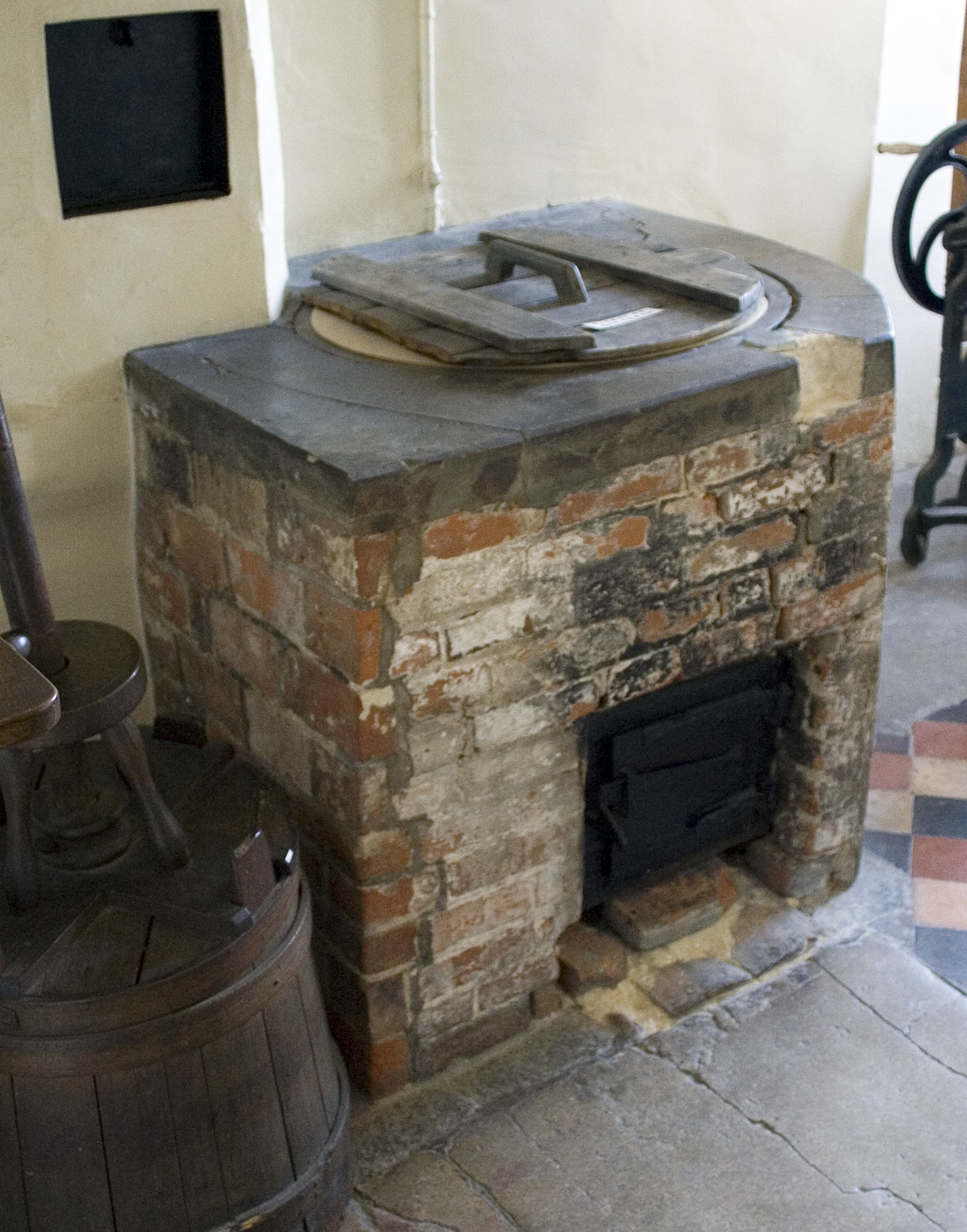
The water then had to  be heated in a copper, a large metal boiler set in a brick firebox in the corner of the kitchen or scullery, until it was hot enough to dissolve the soap and the grease on the clothes. The fire would be lit very early in the morning to have the water ready for the laundry after breakfast.

The clothes (which must often have been quite smelly) had to be sorted, soaked if necessary, treated for stains, then washed in a wooden tub or stone trough, using a bar of lye soap and a wooden 'dolly' to agitate and pound them. White clothes and sheets, as well as tougher, dirtier work clothes, were often boiled (separately) in the copper itself. After being put through a wringer, rinsed twice and starched, the wet clothes were wrung out and flattened using a mangle, and then hung to dry - outside in rural areas, but inside on racks in industrial areas where soot and other particles polluted the atmosphere.

Once the clothes were dry they were ironed using a heavy flat iron heated on the stove. Often several irons would be used, so that one could be in use while the others were re-heating. The whole process of soaking, washing, drying and ironing took several days, so the laundry was usually started on a Monday in order to have it done by Saturday afternoon.

Families saved up their laundry for as long as possible so that it could all be done at once, typically every few weeks if they had enough clothes to last that long. Nothing was put in the wash that could be spot-cleaned, and even underwear was worn several times before being washed. If they could afford to pay someone else to do their laundry, they did.

An unladylike occupation

Being a laundress, working independently or in a commercial laundry in one of the bigger cities, was one of the few occupations open to married women and widows. It could mean the difference between making ends meet and destitution for those without a husband's income or for women whose husbands had seasonal jobs, or who were poorly paid, as was the case for common soldiers such as David Whybrew.

Being a laundress allowed mothers to work at home and keep their children with them, though they were occupied with washing and ironing from early in the morning to late at night. The children were often used as unpaid labour to help with tasks such as carrying water, turning the mangle and hanging clothes. They also had to live with the steamy atmosphere, lines of wet washing, and the smell of damp clothes and laundry soap.

Because laundresses were often poorly educated, physically strong, independent women, who effectively ran their own businesses, they were considered 'unladylike' and lacking in social respectability. As a soldier's wife, Susan Whybrew was already pretty close to the bottom of the social heap. Being a laundress simply added another layer to her outsider status. Nevertheless, her labours helped to keep her family afloat.

References:

http://www.vintageconnection.net/VictorianLaundry.htm

http://www.avictorian.com/servants_laundry.html

https://washergenes.wordpress.com/2006/06/15/english-laundresses-a-social-history-1850-1930/

http://fet.uwe.ac.uk/conweb/house_ages/services/print.htm

___________________

You can find out more about Susan and David Whybrew and their family, in my book Susan: convict's daughter, soldier's wife, nobody's fool.
It's available on Amazon and other online books stores


Friday, July 29, 2016

William Whybrew - an update.

The Cemetery at Vis-en-Artois.
William Whybrew has no grave, his name is inscribed
on panel 5 of the curved memorial wall between
the two stone pillars.(image courtesy of wikimedia).
Back in March 2014 I wrote a couple of posts about the children of David and Susan Whybrew. At the time, much of what I wrote about their youngest son William (the youngest son to survive childhood at any rate) was speculative.

In the course of doing research for my book about Susan, I've been able to confirm many of the details for William and add a few new ones, though some create more mysteries than they solve. So here's an update.

William was born on 29 October 1884 while the family were living in Berry St, Sittingbourne, near Canterbury, Kent. At the time his father David was with the 3rd East Kent militia. Some time after William's birth David left the army without completing his five year contract, for reasons that are unclear, and the family moved to Colchester in Essex. Two sons, Alfred (1888) and James (1892) were born to Susan in Colchester but didn't survive infancy.

William was at home with David and Susan at the time of the 1901 census, working as an assistant gardener. In 1905, when he was 21,  he married Adelaide Williams, a woman from Ipswich, a coastal town in Suffolk, 30 km north east of Colchester.

At 38 Adelaide was considerably older than William. Their marriage certificate indicates that she was the daughter of Earle Henry Williams, deceased, a fish hawker of Ipswich. She seems to have spent some of her childhood in the Ipswich workhouse, and then disappears from the records until her marriage to William.

The couple moved to Canterbury, where William found work as a carman, driving a delivery cart for a mineral water company. They had a lodger living with them when the 1911 census was taken, an infirm elderly man named Abraham Langford, who was possibly cared for by Adelaide (or Annie as she was referred to on the census.)

In 1914, at the beginning of the First World War, William enlisted in the Army Veterinary Corp, which looked after the many horses, mules, dogs and other animals used by the army. He transferred to the Yorkshire regiment (Alexandra, Princess of Wale's Own) and fought in the trenches in  France and then saw action in Italy before returning to France in September 1918. I've now confirmed that William died in action in France on 29 October 1918, just a few days before his 34th birthday and only three weeks before the war ended.

The Hundred Days Offensive, August-november 1918
Battle of Courtrai.
British and Belgian wounded waiting to be taken
back by light railway. Dadezeele, 15 October 1918.
It’s likely that William was involved in the decisive “Hundred Days” battle or "Advance to Victory" in Picardy and Artois, which broke the Germans' resolve and ultimately led to the Kaiser’s abdication and the signing of the armistice on November 11. It was a massively destructive battle. William had no grave, perhaps no identifiable remains. His name is inscribed on the memorial at Vis-en-Artois amongst the 9,847 men of the Allied forces with no known burial place, who fell between August 1918 and the end of the war.

The news of his death would have been sent first to his widow Adelaide. In 1919 she applied for his medals, his belongings and the money still owed to him by the army. She was listed as the sole legatee. Later his name was inscribed on the war memorial in Ipswich, but strangely not the one in Colchester where he grew up and enlisted.

William and Adelaide had no children. However, it seems that Adelaide had either a son or a stepson by a previous relationship. A young soldier named Henry Alan Lawrence, born in 1890, joined the army in 1908 and gave a 'Mrs Whybrew' as his mother and next of kin. Her address at the time was in Colchester. He also listed two brothers, Archer and George Lawrence, whose address was in Stanstead in Essex.

At the end of WW1, in which Henry Lawrence was badly injured and became a prisoner of war, his address was the same as that of Adelaide Whybrew on William Whybrew's records - 195 Bramford Rd Ipswich.

How Henry fits into Adelaide's story is something I still haven't worked out. In the 1891 census he and his brothers  appear  to be the sons of William and Martha Lawrence of Sawbridgeworth in Hertfordshire. Martha Lawrence (nee Archer) died in 1897 and the family were scattered. There's no record of William Lawrence ever marrying Adelaide Williams. Perhaps she became an unofficial step mother to young Henry.

(I'm grateful to Andrew Beal of the Ipswich War Memorial and Cenotaph page on Facebook for some of these details.)

__________________

You can find out more about Susan and David Whybrew and their family, in my book Susan: convict's daughter, soldier's wife, nobody's fool.
It's available on Amazon and other online books stores

Saturday, May 21, 2016

Rosanna (Rosina)Bines

It's difficult to know what name to use for the woman who would become William Beales' mother. Her birth, late in 1846, was registered as "Rosana" Bines and that's how her name is spelled on the 1851 census. But in 1861 she was recorded as "Rosina" and in 1871 as "Rose Anna".

When she married James Beales in 1867 she was "Rosanna". The confusion is perhaps an indication that she and her family were illiterate and didn't really know how her name should be spelled. For this post, I'll refer to her as Rosanna.

Rosanna Bines was the first child of John Bines, an agricultural labourer from Little Clacton in Essex and his wife Eliza Barnes from the adjacent Great Clacton. Rosanna lived in Little Clacton until her marriage to James Beales, then spent the rest of her life in St Osyth, less than 7 kilometres (4.5 miles) away. Apart from her name appearing on the census every 10 years, and the records of her birth, marriage and death, her life went mostly unrecorded.

But not quite. Surprisingly, photographs of her still exist. The copies I have posted on this blog came from the internet some time ago, but who originally posted them and when is unknown. (If you know, let me know and I'll give them the credit.) I've also received copies of the same pictures from a cousin.

In the oldest of these, probably a wedding photo, a young Rosanna sits in a voluminous white dress besides the heavily bearded James Beales, looking a little startled by the camera. She holds a book in her hand, most likely a prayer book. James is neatly but rather shabbily dressed.

Many years later she and James have their photos taken with their grown up children, all dressed in what would surely be their Edwardian Sunday Best and wearing buttonholes. It's not clear whether the two photos - one with their daughters, the other with their sons - were taken on the same occasion. The clothes that Rosanna and James are wearing and the barn wall behind them are different in the two photos.


In these photos, Rosanna looks composed and remarkably well preserved for someone who has given birth to 15 children. Only two of her children failed to reach adulthood. Emily died in 1895 at the age of 9. The other child missing from the photo was possibly Ann*, born in 1874, who died in 1876.

None of the Beales' children seem to have been baptised as infants. Their names are absent from the on-line records of either the parish church of St Peter and St Paul or the Wesleyan Methodist church in St Osyth.  Other Beales names are recorded, presumably cousins and more distant relatives. Whether this was because the family belonged to a non-conformist church or sect, or they simply didn't have any religious affiliation before they joined the Salvation Army is another unknown.

They wouldn't have had to look far to find an alternative to the local Church of England parish. Essex seems to have attracted a number of unusual religious groups in the 19th century. St Osyth had a chapel belonging to the New Church, or Swedenborgians, based on the teachings of Swedish theologian Emanuel Swedenborg (1688-1772).

The Peculiar People, a puritan offshoot of the Wesleyans founded by Robert Banyard in 1838, was also active in east Essex at this time. They believed strongly in healing by faith and refused to allow their children to be vaccinated against smallpox or to receive medical treatment. The deaths of some of their children led to the parents being taken to court.

St Osyth is reputed to be the driest place in England. Perhaps it was the salubrious climate, her life as a farm labourers' wife or the disciplines of the Salvation Army lifestyle that preserved Rosanna's health. She lived to the venerable age of 85, dying in 1931.

* Some online family trees list Anna Maria Beales as a child of James and Rosanna, but the only child I can find by that name was born in 1881, the same year as John Beales, and seems to be the child of George Beales. Possibly Ann was also known as Anna Maria. Her birth in 1874 fits in well between the births of George and Alfred, though I don't have confirmation that she was a child of Rosanna and James.

Wednesday, March 16, 2016

William James Beales

When Eliza Whybrew married William Beales in the autumn of 1891, she was marrying a man whose childhood was distinctly different to her own. Whereas she had spent her childhood moving from place to place with her father's army regiment, Bill had always lived in the same small village where his father and his grandfather had spent their whole lives.

Bill was born and raised in St Osyth, on the coast of Essex. His father James Beales was a farm labourer and horseman, and his mother Rosina (or Rosanna, nee Bines) the daughter of another agricultural labourer from the nearby village of Little Clacton. The extended Beales family was a large one - in the 1881 census Beales was the third most common name in St Osyth. 

James and Rosina with their sons c 1900(?)
Bill is on the far right
Like Susan Whybrew, Rosina Beales gave birth fourteen times*, but all except one of her children survived childhood (Emily, born in 1886, died at the age of 9). Life in St Osyth was certainly not luxurious, but it was stable and the village was perhaps isolated from many of the epidemics that spread rapidly through larger towns.

William received a very basic education at the local school. By the age of 12 he was already employed as an agricultural labourer. The Elementary Education Act of 1880 made school compulsory until the age of 10, and the school leaving age in England was nominally raised to 13. However, if parents could produce a certificate to show that their child had reached a satisfactory level of education, they could be employed sooner than this.

The Beales girls with James and Rosina
It's difficult to find out much about the Beales family. They didn't frequent the Police Courts, and they weren't far enough up the social ladder for their social life to be of interest to anyone, so their names don't appear in the newspapers or on local directories. It seems there are no records of baptisms of their children in the parish church registers at St Osyth. Most of what is known about them comes from the census records.

By the time of the 1891 census in April, William had found work as a coal porter and had moved to Colchester, where he boarded with a young couple named Edmund and Mercy Child. There he met Eliza, and they were married in Colchester at the end of 1891.

Though Eliza and Bill were in their early twenties when they married, both had younger siblings who were still toddlers. This was not uncommon in the days when many women produced a child every two years for 30 years. James and Rosina Beales' last child, Hannah, was born in 1890, but David and Susan had another three children born after Eliza's marriage  - James, Ada and Lily - though sadly neither James nor Lily lived long.

Bill and Eliza's first child,  Alice was born early in 1893, followed by Rosina (registered as Rosanna in February 1895), William James (June 1897) and Ada Kate (late 1899). Ernest David was born at the end of 1901, after the census. He was to be the only child of theirs that didn't live to adulthood, dying at the age of five. On the census Ada is listed as 'Adam', though she is described correctly as a daughter aged 1 year old.

In 1901 the family were living in a typical Victorian terrace house ('two up, two down') in Albion Grove in Colchester, not far from Pownall Cresent where David and Susan Whybrew and their younger children lived. Bill was now working as a grocer's porter, carrying goods for the shop owner and his customers and perhaps also helping to keep the shop in good order. It would not have been a highly paid job, so it's likely that the family had to live quite simply.

 A London bread van, circa 1910
By 1911 Bill had a job as a 'carman' with the Co-op, driving a horse-drawn cart. An article written in 1903 about the carmen of London described them as being poorly paid and  working long hours. Perhaps the Co-operative Society were more generous to their employees, but again it's unlikely that Bill earned much.

With the addition of Henry (born 1904 and nicknamed 'Son') and Miriam (born 1906 and known as "Mill", ) the family expanded to 6 children. Some time before the 1911 census they moved to a six roomed house in Campion Road, an even shorter walk from Eliza's parents' home in Pownall Cresent. A young soldier and his wife boarded with the Beales, which perhaps helped to pay the rent.

William and Eliza and their family were very much involved with the Salvation Army in Colchester. Bill played the cornet and was the bandmaster for many years. Eliza was possibly an officer, though that is uncertain. Alice and Ada both married officers and were officers themselves, according to my father. (Officers in the Salvation Army are the equivalent of the ordained clergy in other churches. Both men and women can be appointed.)

Rosina, as a teenager, worked in Ipswich as a servant to Albert Orsborn, who later became the 6th General of the Salvation Army. As mentioned previously, she left the Salvation Army when she married my grandfather, Thomas Ward. William James Beales junior followed his father into the Colchester band after his military service during World War 1. His son Bernard became bandmaster at an early age.

My father tells me that Son (Henry) was seen as something of a black sheep in the family, as he smoked and liked to have an occasional drink. Soldiers of the Salvation Army are supposed to "abstain from the use of all enslaving substances." I'm not sure how long his sister Mill (Miriam) remained in the Salvation Army, but it was she who recalled that her mother was born in Australia, thus setting off my search for the Whybrew and Mason families.

Bill Beales senior retired from his post as band leader in 1938, but apparently continued to play his cornet even when he was too ill to get out of bed. He died on June 13, 1945. He was much respected and his funeral was well attended. He was buried in Colchester cemetery.

William James Beales' grave in Colchester cemetery

Colchester cemetery
(both photos from findagrave.com)
*I've now discovered from the 1911 census that Rosanna gave birth to 15 children, of whom 13 survived.