Showing posts with label Genealogy methods. Show all posts

Sunday, March 1, 2020

Keeping online and offline family trees in sync


I've mentioned before that one of my goals for this year is to bring this blog up to date. That means, amongst other things, updating the family trees (available in the top tabs) and making sure that the Index of Individuals has useful links to profiles and relevant posts.

One difficulty with doing this is that often the most up-to-date information I have is stored online, on my family trees on Ancestry.com. But the most useful, editable, way of creating profiles and lists is through the genealogy software that I use offline at home, RootsMagic*. In theory, I should be keeping my online and offline records in sync, but I'm not always methodical about adding information to RootsMagic as I find it on Ancestry.

I also think it's important to have the information from my online research backed up offline, including copies of all the media files from my Ancestry trees. That way, if I ever drop my subscription to Ancestry, or the internet fails in some way, I will still have access to them. So, how can I get the information from Ancestry onto my laptop and into RootsMagic?

It's easy enough to export a whole tree from Ancestry as a .ged file and then import it into RootsMagic (or any other software). The problem is that this only exports the actual information. It doesn't allow me to download all the media files - photos, images of original documents such as census records - that are attached to each person. Downloading them all one-by-one would be a huge task.

The TreeShare button in RootsMagic


Fortunately RootsMagic has a tool called TreeShare, which allows me to download the media files with the data from Ancestry. I've been trying it out recently and found it fairly easy to use. I simply have to hit the icon in the RootsMagic menu bar, log in to Ancestry and specify which tree I want to download. I could also upload trees to Ancestry this way. The process might take quite a while to complete if the tree was very large, but with my trees of around 1,000 entries each, it takes less than half an hour.

The TreeShare start screen


The media files from Ancestry all download to one folder, and come with what, to me, seem meaningless labels. So I can't just look through the folder to find, say, the 1851 census for Walton le Dale. It is possible to find them through the individual they are attached to, via the media button.

TreeShare has some other limitations. I can only download from Ancestry into a new, empty RootsMagic file, not an existing one. Once the tree is imported I can keep syncing any new information between the online and offline version. RootsMagic also allows me to compare two offline trees and merge them. My preference is to keep the two separate and use the Ancestry-downloaded tree as a back up and resource.

Comparing two entries, offline and online, before syncing

There's no way to export part of a tree from Ancestry, either as a .ged file, or through TreeShare, although it is possible to export and upload part of a tree from RootsMagic to a new Ancestry tree.

Another drawback is that the source citations downloaded with the file are not in the format recommended by professional genealogists. Perhaps not surprisingly, most of them refer back to a database on Ancestry rather than the original source.

For instance, the citation for the baptismal record for my great grandfather, John Ward, says the record comes from "Ancestry.com, Lancashire, England, Church of England Births and Baptisms, 1813-1911", with an additional note that its source is the "Lancashire Anglican Parish Registers, Preston, England: Lancashire Archives." It tells me nothing about the actual source of the information: page 165 of the parish register for St Leondard's church, Walton le Dale, for the years 1831-1854.

I must admit, I've never mastered the recommended method for citing sources. But even I can see that this isn't really adequate for telling a future researcher where to find the information (although it does tell them where I found it.) Nevertheless, TreeShare does provide me with a way to get the basic information off Ancestry and onto Rootsmagic on my laptop.

So, in the next few months I'll gradually be adding new information to the profiles and family trees on this site. But even with the tools available, it may take quite a while to complete. I'd love to hear from you if you have any recommendations or you want to share your own experience of trying to keep your records up to date.


*Why RootsMagic? Because when I first started researching my family history, I downloaded the free version of the software, RootsMagic Essentials, which served me well. Eventually I upgraded to the paid version, which does all that I want and more. I don't have any affiliation to RootsMagic. I'm sure other genealogy programs offer features that RootsMagic lacks. I just haven't felt the need to change it.


Saturday, January 5, 2019

Other places, other times

Happy New Year everyone! The start of a new year seems a good time to decide on a theme for the posts on Clogs and Clippers for the next twelve months.

Last year I chose to review some of the unsolved mysteries in my family history. Having just come back from visiting some of the locations in England where my ancestors lived, I've decided my theme for this year will be "places".

I'll be looking particularly at the cities, villages and towns where my family lived for several generations, and asking questions such as: When did they move there? What did they do there? What was the place like at the time? How did their environment influence their lives, and what influence did they have on the place itself? Why did they leave?

By learning more about where my forebears spent their lives, I find I understand their stories better. Visiting some of the places in England and Australia that my family once called home has helped me to imagine more clearly what their lives were like. I hope to be able to share my impressions with you (along with some of the many photos I've taken!)

So, I hope you'll come along for the ride. First stop will be the little English village of Walton le Dale.

Places mentioned in this series

Walton le Dale, Lancashire
Littleborough, Lancashire
Milnrow, Lancashire
Colchester Essex.

Thursday, April 12, 2018

How did Harriet find her family?


One of the things I most enjoy about having a family history blog is the contact it provides with people from far and wide. It's always a thrill to find an email in my inbox from someone who has read my blog and found a connection with their own family. Often this is followed by both of us exchanging information and photos that we would never have come across through the normal methods of research.

But there's also a rapport that comes, if not from a shared ancestry, at least from a shared interest in family history. I have friends all over the world who I've never met, but still have something special in common with.

Last week I had the pleasure of actually meeting one of these people. He was in Australia for work and family reasons, and we spent a couple of hours sitting in a seaside cafe, drinking coffee and talking about a whole range of topics, including his great great grandmother, Harriet Whybrew. Harriet was sister to Eliza, my own great grandmother and was the original reason for us making contact.

Who brought up Harriet?

Despite the fact that we know quite a lot about Harriet, there are still some mysteries about her life yet to be solved.* The first is, who looked after her during her childhood. She was born in Adelaide in 1868, before her parents Susan Mason and David Whybrew were married. When the British army moved David back to England, Susan and their second daughter, Eliza, went with him, but two year old Harriet remained in Australia.

One story is that she was brought up by the Lindrum family. Frederick and Clara Lindrum were German migrants who ran a billiard hall in Adelaide. Their son Frederick married Harriet's cousin, Harriet Atkin. Walter Lindrum, the famous billiards player, is said to have visited Harriet at her home in England, causing quite a stir. So there were definitely connections between Harriet and the Lindrum family.

The difficulty I see with the idea that the Lindrums brought up Harriet is that Clara Lindrum was heavily pregnant with her own daughter when Harriet was born. The two girls were born only a month apart. It seems an odd time to be taking in another baby, unless Clara was able to feed two infants. Harriet may not have been handed over to the Lindrums at birth, of course. But there is also no official record of Harriet being fostered by the Lindrums, though it could have been a private arrangement.

If she wasn't brought up by the Lindrums, who did look after her? Records suggest that in her teens, her aunt and uncle, Mary Ann and Henry Atkin, were her guardians. This was after the death of Frederick Lindrum senior, and the disappearance of Clara (another unsolved mystery!) so it doesn't necessarily indicate that the Atkins had always been her carers.

When did Harriet leave Adelaide?

The next question about Harriet is how and when she travelled to England. She is mentioned several times in the newspapers in Adelaide during the 1880's, due to her regular appearances in court for "loitering" and other anti-social behaviour. The last mention I've found of her in Adelaide is in August 1885.


After this her name disappears from the records, and doesn't appear again until she was mentioned in an English newspaper in August 1888. By then she was back with her family in Colchester.

Harriet must have sailed to England, but when? Did she travel alone, or with someone else? Over the years that I've been researching her story, I've come up with all sorts of hypotheses about this, some wilder than others. So far I have found very little evidence for any of them.

Perhaps she was encouraged to rejoin her family by the Salvation Army, who were active in rescuing "girls at risk" in Adelaide at this time. They might have persuaded her to go back to her family. They might even have organised the travel arrangements for her. It would be interesting to know if the Salvation Army in Adelaide kept any records of who they helped. So far I haven't come across any, but I haven't contacted the SA directly.

Perhaps she was escorted by someone already known to her. Her father David left the army rather suddenly in 1885. Could he have travelled to Australia to bring his wayward daughter back to England? Given the cost of travelling even one way, and the financial situation of the Whybrew family, that seems unlikely. His name is not on any passenger lists in the UK or Australia.

Another of my wilder theories is that she might have been accompanied by Clara Lindrum. That would neatly explain Clara's disappearance from Australian records around the same time. Unfortunately neither Harriet's nor Clara's names appear on any official ships' list. Few of the UK incoming passenger lists from before 1890 have survived.

I found one tantalising possibility for Harriet's departure from Adelaide in this newspaper list of passengers departing aboard the Garonne in November 1886. The passengers included  a "Miss S Wybrow".


Harriet's name was often mis-spelled in the newspapers, so it's tempting to think this could be a typo.

However, it's much more likely that Harriet travelled the cheapest way, in steerage. If so, it's unlikely that her name would be mentioned in newspaper reports, since they usually only listed cabin and saloon passengers by name.

Unless I can think of some less obvious way of tracing her journey, I may never know when and how Harriet got to England. Does anyone have any suggestions?

*I'm currently working through some of the unsolved "mysteries and puzzles" in my family history, which is why I'm repeating information from previous posts.

__________________


You can find out more about Susan and David Whybrew and their family, in my book Susan: convict's daughter, soldier's wife, nobody's fool.
It's available on Amazon and other online books stores

Monday, January 22, 2018

Richard Ward - born twice?


Church door, St Leonard's
Walton le Dale
One of the most long-standing mysteries in my family history research is the date of birth of Richard Ward, my paternal great great grandfather. I know from several sources that he was the son of Thomas and Frances Ward, and that he was born in Walton le Dale, in Lancashire.

The problem with determining his date of birth is that two baptism records exist for Richard Ward in the Walton le Dale registers. Both say Richard's parents were Thomas and Frances (or Fanny) Ward. But one says he was born in 1809, and the other gives a date of 1813.

The most obvious solution would be that Thomas and Fanny had a son named Richard in 1809, who died in infancy. They then used the same name when they baptised another son in 1813. That was a common practice at the time. But I can't find any record of a burial for a child name Richard Ward between 1809 and 1813.

Besides that, most of the census records for Richard suggest that he was born in 1809 or 1810. Only in the 1851 census does his recorded age suggest a later date. At his death in December 1881 he was said to be 72 years old, which again gives a date of birth around 1809.

Images of the originals of the two baptism records are available online on the Ancestry website, so it's not a case of a transcription error causing confusion. The first record comes from the Parish Registers of Walton le Dale from 1698 to 1812. Among the christenings for 1809 is this one:
"Richard, son of Thomas and Frances Ward. Born Aug 17, baptised Oct 1." 
The names and dates are quite clear.

The same details appear in the Bishop's Transcripts, the local bishop's copy of the records for all the parishes in his diocese.

The second baptism record is from the Parish register of the Parochial Chapel of Walton le Dale, 1813-1887. Again the record is quite clear and unambiguous.
"Richard, son of Thomas and Fanny Ward" . His date of birth is recorded as 27 April, and his baptism 20 June 1813.

Another Thomas and Fanny

One possible explanation of the two baptism records is that the Richard born in 1813 belonged to another couple named Thomas and Fanny, and the minister at the time, E.S. Radcliffe, has recorded the wrong surname for some reason.

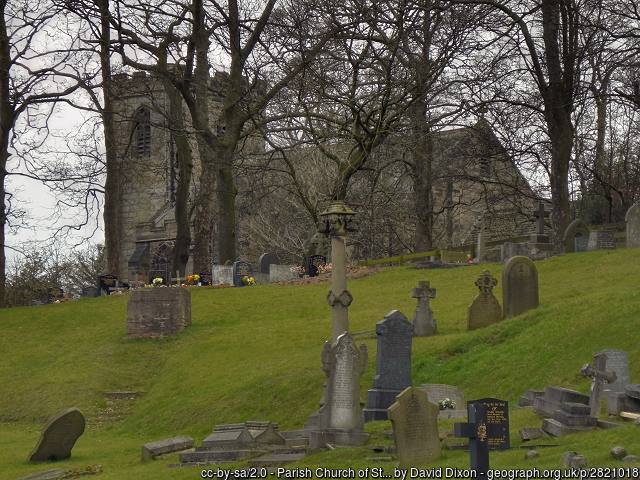
Only one other child-bearing couple named Thomas and Fanny lived in Walton le Dale at this time. Thomas Marsden married Fanny Bushby (or possibly Buskey) in 1805. They had three children baptised in Walton le Dale - Elizabeth in July 1808, John in April 1810 and Sarah in September 1811. Sadly all three, plus an older child named Mary, died in infancy and were buried in Walton le Dale.

The graveyard at St Leonard's Parish Church
Walton le Dale.
Their mother, Fanny Marsden, died in 1813 at the age of 30, and was buried on 25 April*. Is it too far fetched to suggest that she might have died giving birth to the Richard who was said to have been born on 27 April 1813? Obviously there is an awkward discrepancy of a couple of days between her burial and his reported date of birth. But given that the child wasn't baptised until two months later, perhaps the date of birth could be in error by a few days. It's easy to imagine a grieving husband mixing up the dates.

To give this theory a bit more weight, a Richard Marsden, born about 1812 in Walton le Dale, appears in the 1851 and 1861 census in Leyland, Lancashire. In the 1841 census his place of birth isn't recorded, but he was living in Leyland with a Thomas Marsden, with no other relatives listed. That would be consistent with Thomas being widowed and Richard being the only surviving child.

Since he was born in Walton le Dale, we might expect that Richard would have been baptised there, but I can't find any record of a baptism for a Richard Marsden in the Walton le Dale registers within 10 years of 1812. Could that be because his baptism in 1813 was recorded as Richard Ward?

Against this theory is the fact that the 1813 baptism record describes Thomas Ward's occupation as "joiner" (ie a carpenter). This was, in fact, his occupation according to other records. Thomas Marsden's occupation was a "cotton operative" when his wife was buried, and an agricultural labourer in 1841. For my theory to hold water, I'd have to explain why the minister not only wrote "Ward" instead of "Marsden", but also inscribed the occupation of Thomas Ward rather than Thomas Marsden. Any suggestions?

In the meantime, I'm leaning towards the earlier date of birth being the correct one for Richard Ward, though I'll keep the other one recorded as an alternative.


(*Burials, Parish register for 1813-1819, p 8, entry 58. Reference Number: Pr 2948/1/17)

Tuesday, January 16, 2018

Mysteries and puzzles

Happy New Year! For the past few years I've used the new year as the time to alternate between writing about the maternal and paternal sides of my family history. If I kept to that pattern, this should be the year I switch back to writing about the Ward and Beales families, on the paternal side. But since I've now covered most of the main individuals on both sides of the family tree in this blog, I've decided to do something a little different. This year, most of my posts will re-visit a mystery yet to be solved.

By mystery, I don't mean those points in the family history where I simply can't go back any further, due to non-existent records. Most lines of my family tree begin somewhere about the middle of the 18th century. That's about as far back as the records go. I accept that some things are impossible to know.

The "mysteries" I have in mind involve aspects of people's lives that don't make sense, at least based on the information I have. Or there are large holes in their story that I haven't been able to fill. I have a nagging feeling that if only I could find more information, or the right information, it ought to be possible to solve these puzzles.

An example of such a mystery was the long-standing question I had about where John Mason, my great great great grandfather, came from. I knew he was almost certainly transported to Australia as a convict, and my hunch was that he was from Ireland, but which of the many convicts named John Mason was he? I've written previously about how that mystery was finally solved.

There are many similar mysteries on both sides of the family. My hope is that, while I'm revisiting the research I've already done, I might see some different possibilities that hadn't occurred to me before. Or perhaps, with new material coming online all the time, I'll find some new sources of evidence that will make things clearer. It may be that someone reading the posts might have an answer to those puzzling questions. As I've discovered, we all hold fragments of stories that together make up the whole picture of our family history.


Monday, September 4, 2017

7 tips for searching newspapers on Trove

The digitised newspaper collection at Trove, the National Library of Australia site, is an amazing (and free) resource. It proved invaluable when I was doing the research for my book about Susan Mason. Trove has many more resources available besides newspapers of course - maps, diaries, journals, government gazettes, and videos, to name but a few - but for those researching their family history, or other historical events, newspapers can be a fantastic source of information.

If you're lucky you might even find images related to your search. This photo of  Adelaide Police Magistrate, Mr Samuel Beddome, comes from the Evening Journal, 1 Sept 1888.
The Trove site itself offers  a comprehensive online help page on how to search the newspaper collection effectively, but I thought I would list a few tips that I've found most useful in my own research. For starters, I suggest going straight to the Advance Search page.

1. Start with a fairly wide search under Places and Titles. Even if you know that someone only ever lived in one state, include newspapers from all the states in your search to begin with. (This is the default if you don't tick any boxes). News items were commonly shared from one newspaper to another, within states and interstate, so even if the search misses an item in a local newspaper, you might find a similar item elsewhere. You may even find relevant news from overseas newspapers published in Australian newspapers.

2. Don't restrict the publication date too much. You may know the person you are looking for died in, say, 1860, but search beyond this date. You might come across an "in memorium" notice, one or several years later. The same goes for other events, not just deaths. Newspapers often published anniversary articles many years after an event.

3. Try variations and spelling 'mistakes'. If you're looking for a person's name, use as many variations as you can think of in your search. For instance, to find items mentioning John Mason, I searched for "John Mason", "Mr Mason", "J Mason", and "Jno. Mason". (Jno was often used as an abbreviation for John, just as Thos was used for Thomas and Hy for Henry.) Sometimes it's worth trying some deliberate mis-spellings of a name as well.

4. Make good use of excluded words. If your search brings up a lot of items that are similar to what you're looking for but irrelevant, use the box labelled "without these items" to get rid of most of them. The results of my search for "John Mason" included a lot of items about a much more famous Rev. John Mason Neale. I also got a lot of results referring to Masonic meetings. By putting "Neale" and "Masonic" in the "without these words" box, I could exclude many of them.

5. Build on what you've found. Once you've found an article that you are fairly sure refers to the person you're looking for, look carefully for other information in the article that might be useful in narrowing down or expanding your search. For instance, I discovered from one article that Susan Mason lived in Currie Street in Adelaide. By combining "Currie" with "Mason" I found several other references to people named Mason in Currie St. Other clues helped me decide whether these were about the right family or not.


Similarly, after finding a funeral notice for Brother John Mason inserted by the Court Perseverance of the Foresters, I was able to search for "Mason" with "Court Perseverance" and/or "Foresters" to find other articles that mentioned him. I also did some research about who the Foresters were, which helped me to understand why John Mason might have been a member.

6. Don't rely on the article titles in search results. When going through the results of a search, don't take too much notice of the article titles shown in bold capitals. Scan the snippet of news instead, if there's one provided. The search results seem to use the closest heading on the page, but the item you want may not have a heading, or the heading may be too small to get noticed. I found an article about the Court Perseverance annual dinner listed under the heading "Representation of Willunga" in the search results. The heading referred to the previous item and had nothing to do with the item about the dinner underneath it. I've also found several useful short articles listed under "Advertising". Birth, marriage and death announcements are not always under "Family notices".

7. Get updated results on your search. The information on the Trove newspaper site is being updated and corrected all the time. After doing a search, you can ask to be sent an email alert whenever new results are available, by clicking on the "Subscribe to this webfeed" link down at the bottom of the page of search results.

Don't forget that newspapers are not always accurate! Once you've found information from a newspaper, always try to check it out some other way. My own experience is that the information in most newspapers from the past has been pretty reliable, and has sometimes provided invaluable clues about dates of birth, marriage and death, and family relationships. But it's always better to have more than one source of information.

Do you have a favourite tip of your own for using Trove newspaper searches? Why not share it with everyone in the comments below.

Thursday, July 7, 2016

Certificates, transcriptions and Brexit

Well, here's some positive news at last about Brexit. As a result of events on June 23, it has become less expensive for Australians like me to purchase certificates from the UK General Registry Office (GRO). This time last year one British pound was equivalent to roughly $AUD 2.0. Now it's down to $AUD 1.70. That takes about $3 off the cost of a certificate.

Politics aside, ordering copies of birth, marriage or death certificates is an expensive way to do family history research. If I can find reliable information about the people I'm researching by some other means, I'm usually content with that. But there are times when the only way to find information, or check dubious sources, is to order a copy of the certificate.

Copy of Lily Whybrew's birth certificate from the UK GRO
Lily was the youngest child of Susan and David Whybrew.
She died in infancy.
Each country has its own approach to the issuing of certificates. The UK GRO allows orders to be made online or by mail, then sends a certified copy of the original registry entry by mail. Curiously, the cost (currently £9.25 each) is the same whether you provide complete details, including a reference to the GRO index, or just a few details such as a name, place and year, requiring the GRO to do the research themselves to find an entry on the index. Even more strange, the cost is the same whether it's posted to Highgate in London or to Highgate in Perth, Australia. There's no option to have copies delivered electronically.

Despite the ready availability of family history sources online, there's still something exciting about finding a long brown envelope in your letter box marked with Her Majesty's Government seal. If family history is your 'thing', nothing beats the thrill of seeing a certificate issued a hundred years ago and finding that vital piece of information that you were looking for inscribed in handwritten scrawl. Occasionally there's the disappointment of finding the certificate belongs to someone different than you were expecting, or it contains information that blows a long-cherished theory apart.

The Irish GRO also issues certificates by mail, which can be ordered by post or electronically, for €20. Alternatively they will send a photocopy of the record by email, for a reduced price (about €4). If all you want is the information, rather than something to hang on the wall, that's a good option. For some reason, emailed photocopies can't be ordered online, but have to be ordered by fax or mail after downloading the request form and ticking the box that says 'photocopy'. Odd, but that's the way it is.
Another of Brexit's effects is the appearance on the Irish GRO site of a warning that "Due to a significant increase in orders for certificates as a result of the recent referendum in the United Kingdom (UK), the delivery time for certificates from this service will be up to thirty (30) days from the date of order." A sudden increase in interest in family history? Maybe not.


Rosina Whybrew's death in Ireland in 1874.
This is a photocopy of the original entry from the Irish GRO.

Birth, marriage and death records in Australia are kept by each State's own registry offices, and certified copies are generally very expensive. (The NSW registry charges $32 for an emailed copy of a birth entry. That's twice the price of a hard copy British certificate mailed overseas.) One way around this is to order a modified version of the certificate through a transcription agent. They will send all the information that's found on a registry entry, usually laid out on their own attractive presentation form, for about half to two thirds of the price. Transcription agents can be found by searching online.

Transcript of Mary Mason's birth in NSW,
provided by a transcription agent from the original entry.

If you have ancestors in South Australia, and live outside the state, you're in luck. The City of Unley Library has a wonderful bunch of family history volunteers who will look up births, marriages and deaths in that state free of charge. All that's required is the details of the person you're researching, mailed or emailed on one of their request forms (up to a limit of 3 requests at a time) and a stamped, self-addressed envelope. Since they are volunteers, it can take several weeks to get a result, but they'll often add helpful comments to the report. A fantastic service. (I'm not aware of similar services in any other state, but if you know of one, please let us know about it in the comments box.)


Tuesday, April 19, 2016

Facts can sometimes ruin a good story

Old records - where it all begins
A few months ago I started writing a book about Susan Mason and her family. In a way, I've already written most of her life story on this blog, but it's quite fragmented. I wanted to draw together all the information I've discovered about her into a continuous narrative. She's such an interesting character, and her life, while not remarkable in any historical sense, provides insights into many different situations and places. It's a great story.

I've just finished the first draft, and now I'm in the process of rewriting and editing it. But I found myself with a dilemma. Some time ago I discovered a record on ancestry.com that seemed to indicate that in 1876, while the family were stationed in Ireland, Susan had given birth to a child, a boy named Charles. The child wasn't David's.

The father, named on the record as Charles Newman, was a soldier from David's regiment, the 50th. The record gave the date (October 1 1876) and the place of birth, and it seemed quite feasible that it could be true. The child's birth (but not his parents names or the date) was also included on the the index to the Irish Civil register on Ancestry and the British Nationals Armed Forces Register of Births on Find My Past.

An affair with another soldier would certainly add colour to the story, but should I be revealing such details about Susan or the Newmans? (You've probably guessed by now that the reason I'm telling you this is that it isn't actually true.) And besides, the more I thought about it, the more I felt that something about the record didn't seem quite right.

Bantry, Co Cork, where David Whybrew
was stationed in 1876.

© Copyright Pam Brophy and licensed for reuse under this Creative Commons Licence

Susan was in the right place and could have had another child in October 1876 after giving birth to Alice late in the previous year. But the two births would be quite close together, and Rose Whybrew was born only fifteen months later. The soldier's wife, Mary Newman, on the other hand, had one child who was two years old at the time and she had another child two years later. Charles' birth would fit neatly into her family. From later censuses I knew that Charles Newman had been brought up by the Newman family in Bristol after his father left the army.

There was also no image of the actual documents available. It was just a transcript, details copied by someone at some time. Where had the information come from? The army's records? The Irish Civil Register? How reliable was it?

I posted that question on the British Genealogy forum, which is always a good place to get other opinions and advice. "Get the original documents from GRO (the General Register Office in England) and the Irish Civil Register" was the predictable response, along with some equally predictable "hmmphing" about the reliability of sites like Ancestry. Someone also provided me with helpful advice about how to go about ordering the documents for the least expense.

To be fair, sites like Ancestry and Find My Past are now providing access to more and more  images of original documents on-line and not just transcripts, as was once the case. The original hand-written census documents, army enlistment and medical records, church registers of baptisms, marriages and burials, convict records and ships' passenger lists can all be seen and checked against the transcripts provided (which are occasionally quite inaccurate.) It's not Ancestry's fault if people don't check the original documents and think about the plausibility of information before adding it to their family trees.

So I sent for certified copies of the information on the registers. The Irish Registry Office hasn't replied, probably because they couldn't find any record of a birth with the details I provided. The GRO sent me full details from the Army Register of Births, Baptisms and Marriages, which show that not only was Susan Whybrew not the child's mother (Mary Newman is named as mother) but the date of birth was also different from the on-line transcription (July 1, 1876, not October 1). The father's name and regiment are the same, so it seems to be the right child.

It's possible that whoever transcribed the details of the birth from the Army Register inadvertently copied Susan's name from the previous entry. Few army wives travelled with their husbands when they went overseas, and it may well be that Alice Whybrew was the last child born to a family from the 50th regiment in Ireland prior to the one in question. Or at least her entry appeared on the same page.

I'm pleased to know that Susan didn't have a love child in Ireland, even if it does remove a potentially interesting chapter from my book. But it did serve to remind me how important it is to check facts with reliable and original sources when you're doing family history research.

__________________

You can find out more about Susan and David Whybrew and their family, in my book Susan: convict's daughter, soldier's wife, nobody's fool.
It's available on Amazon and other online books stores

Thursday, September 18, 2014

James or William? - James Ward (1837- maybe 1882)

A few weeks ago I was looking again at the Ward side of the family tree and noticed that I had the dates of death for all the children of Richard and Mary Ward (nee Baines) except for James, born in about 1837.

Being a bit obsessive, I decided to tidy things up by finding his date of death. Not a good idea! After many hours of searching over several days I'd managed to add quite a few details to his life story, but I still don't know his date of death for certain.

Previously I had only his baptismal record from St Leonard's church in Walton le Dale, and his presence with his parents in the 1841 and 1851 censuses. James was the fourth child of Richard and Mary and was baptised in June 1837. His next older brother, William, died in 1838, a fact that seems to have some relevance to James' later story. After 1851 James seemed to disappear.

I'd managed to find a James Ward, born in Walton le Dale, in the 1881 census before. He was a house painter, married to Alice, with children named Enoch (22) and Mary Alice (19). They were living in Salford. But I couldn't find any of them in the 1861 and 1871 censuses, despite Enoch's unusual name. Nor could I find a marriage to Alice that would fit in with the ages of the children (both born in Bury, Lancashire, according to the 1881 census). This was the point where I'd given up on James before.

"Hundred of Salford" by John Speed - John Speed's Map of Lancashire (1610)
The town of Salford ("Sauford") is just north of Manchester (near the bottom of the map).
Heywood ("Hawood") lies between Rochdale and Bury.
Preston and Walton le Dale are off to the north west of this map.
Licensed under Public domain via Wikimedia Commons 

This time I decided to widen my search, so I looked in the 1861 census for a house painter named Ward (leaving the first name blank) born Walton le Dale in a 20 year period around 1837. What came up, apart from all of James brothers and sisters, was a William Ward, a house painter living in Bury. He was a lodger in a house with a woman named Susan Harwood. She had a baby daughter, Mary A.

It seemed a long shot, but I did a bit of research on Susan and her daughter. It seemed that Susan, nee Barlow, was the (ex?)wife of Enoch Harwood, who was still living. They had a son named Enoch who was living with relatives at the time of the census. I couldn't find a Mary A Harwood born in Bury, but I did find a Mary Alice Ward, born in Bury in 1860, whose mother's maiden name, according to the lancashirebmd.org.uk site was Barlow. That seemed promising.

The problem was, why would James be calling himself William? Perhaps he adopted his dead brother's name because he was living with a married woman? Or maybe I was just joining too many dots together, and this wasn't really James at all.

Next I looked for Susan in the 1871 census - and found her living in Heap (near Heywood) with a lodger named  James Ward, a house painter born in Preston. Preston is a large town close to the village of Walton le Dale. This time Mary A was gone (I still haven't found her in this census) but Susan had a daughter, Amelia Ann Harwood, aged 10, living with her. I couldn't find a birth for Amelia Harwood that fitted, but an Amelia A Ward was registered in Castleton, Rochdale in 1862.

Again it seemed intriguing, but I was worried that I was joining too many dots. So next I looked for Susan Harwood and Amelia in 1881. They were still living in Heap, but their lodger had disappeared.

To Salford, perhaps? If James was married to Alice in the 1881 census, they must have married between 1871 and 1881. One marriage that fit those dates was James William Ward's marriage to Alice Iddon (nee Alice Kirkham Hill) in Preston in 1876. The groom was a house painter, and his father, Richard Ward, was a gardener, which fit the facts from the 1871 census. Not only was Alice a widow, but James William claimed to be a widower too.

So it seems quite likely that at the time of the 1881 census James was living with his wife Alice, his stepson Enoch Harwood and his daughter Mary Alice.

By 1901 Alice Kirkham Ward was a widow again, living in Walton le Dale. I haven't been able to find her for sure in the 1891 census, so I don't know when she became a widow. It seems most likely that it was in 1882, when a James William Ward died in Salford. But I have no way to be certain of that.

Amelia Ann Harwood married Charles Frederick Falshaw Lupton in 1885. On the marriage record her father is named as "William Harwood, painter, deceased." Her mother, Susan Harwood, was living with the Lupton family in Oldham in 1891, along with Amelia and Charles' two sons, John and Enoch. Susan died in 1893.

Laid out like this, it all seems fairly straight forward. What took me hours of research was weeding out all the other possible James and William Wards born about the right time in Lancashire, many of whom also had fathers called Richard. One had a wife called Alice. I also needed to make sure that there wasn't a house painter named William Ward born in Walton le Dale in any other census. (I didn't find one.)

In the end, James William is just a side branch on my family tree. But tracking down his records has given me some insights into how tricky it can be to trace people who were trying not to be easily traced. It has also given me hope that I might one day be able to tie up some other loose ends that so far have been impossible to unravel.


As usual, I haven't given detailed references to the census records etc in order to keep things easy to read. But if you would like more detailed references to the records that I've mentioned please contact me (stella(dot)budrikis(at)gmail.com and I'll be happy to pass them on.


Sunday, December 8, 2013

What's your evidence?

Photo credit Photo credit: Foter.com / CC BY-SA
In a comment on my last post (about the Masons and their neighbours in Currie Street) Amy asked if there were any standards in genealogy. "How much evidence you would need to say a Mr X mentioned in one place is definitely the same person as the Mr X you're interested in?" she asked.

It's a very good question, one that set me thinking about how do I ensure that I'm not just throwing names together to produce a totally fictitious family history. Up to now I've used my knowledge of how historians generally evaluate evidence, tips and information from genealogical books and websites, and plain common sense, to check that my facts are reliable. But is there a widely accepted standard for genealogical research?

There is, I've discovered. It's known as the Genealogical Proof Standard, and it's produced by the Board for the Certification of Genealogists. The document runs to 190 pages and has 74 standards, which anyone who wants to work as a professional genealogist must be able to meet. I must confess, I haven't read it, but the standards are summarised under five main points which apply to any family history research. In order to be credible, the researcher must ensure:

1. A reasonably exhaustive search has been conducted.

2. Each statement of fact has a complete and accurate source citation.

3.The evidence is reliable, and has been skillfully correlated and interpreted.

4. Any contradictory evidence has been resolved.

5. The conclusion has been soundly reasoned.

And, any proof statement is subject to re-evaluation when new evidence arises.

Let's look at what these mean in practise.

1. A reasonably exhaustive search has been conducted. Simply assuming that the first person you come across with the right name is the person you are looking for can lead to chaos. The web is full of family trees with thousands and thousands of names attached. The sheer number of names immediately suggests that the people who created those trees have either been working on them for a very long time, or they've not done adequate research. Sadly, information from one tree often gets copied into another and misinformation gets spread. 

To avoid this situation, the family historian needs to find as much evidence as possible to support their conclusions. Negative evidence (no-one else can be found who reasonably fits the facts, and no other history can be constructed for this person) is as important as positive evidence. In the case of Mr Mason in Currie Street, I have some evidence (newspaper reports) that some members of the Mason family lived in Currie Street, but I need a lot more evidence than that to link them to the other newspaper reports mentioning "Mr Mason". I know from other research that there were several people named John Mason in Adelaide at the time, and even more men with the surname Mason. 

A newspaper report or other information about Currie Street that gave Mr Mason's first name, and his age or the name of his spouse would be helpful, (though I'm not likely to find that much detail). But I should also be looking for evidence that John and Catherine Mason lived in another street at the time, as a means of excluding John Mason from being the Mr Mason mentioned in the Currie Street stories. (I already made sure that the newspaper reports were from before the date that John Mason died.)

2. Each statement of fact has a complete and accurate source citation. The actual standards for recording source citations are quite complex, but they boil down to being able to easily find the information again, and allowing others to do the same. Most family history software allows sources to be recorded in accurate detail. One of the reasons I prefer my current program to some of the simpler, and often more attractive, software that I've tried is that it allows for recording multiple sources for the same fact.

For the sake of brevity and ease of reading, I don't often quote my sources in detail on this site, but I do have a record of where I found the information, which I'm always happy to share with anyone who requests it.

3. The evidence is reliable, and has been skillfully correlated and interpreted. No historical evidence is 100% reliable, since it was all recorded by fallible human beings. In general, though, the closer the source to the original, the more reliable it will be considered. So if it were possible to find the full name, age and address of Mr Mason living in Currie Street on, say, a municipal record, a bill of sale, or some other legal document, that would far outweigh the reliability of a newspaper article.

Skillful correlation and interpretation is where knowledge and experience play a role. When I first started looking at family history, I was totally stumped by things like how to tell one John Mason from another. Now I know more about the sort of records that are available and how to find information, but also how to exclude some of the John Masons from my list. But I'm still learning new things all the time.

4. Any contradictory evidence has been resolved. There's little point in constructing a whole life story for someone, no matter how good the evidence seems to be, if they died in infancy! Likewise, it's generally impossible for a person to appear in two places simultaneously on the same census. 

Sometimes the explanation for contradictory evidence is simple, such as a family naming a later child after an earlier child who died (thus leading to two dates of birth for the same name), or a newspaper getting their facts wrong (yes, it sometimes happens!) Sometimes the contradictory evidence has a surprising explanation - a bigamous marriage, for instance, or an adoption. 

5. The conclusion has been soundly reasoned.  It would be silly to say "The Mr Mason mentioned in the newspaper articles about Currie Street must be John Mason,  because I know some of his family lived in Currie Street." All I've got is a tantalising possibility that the two may be connected, but nothing more.

Any proof statement is subject to re-evaluation when new evidence arises. That's common sense really. All history, including family history, is provisional. It's far better to say "I have a hypothesis, and here's my reasons for it, but I'm happy to change my hypothesis if new evidence comes to light." than to insist on only one possible explanation.


Tuesday, October 1, 2013

Is it worth subscribing to commercial family history sites?

For the first couple of years of my research into family history, I didn't subscribe to any of the commercial family history sites. Most of the time I went as far as I could by using non-commercial sites such as familysearch.org (provided by the LDS), freebmd.org.uk, freecen.org.uk, and the Lancashire OnLine Parish Clerk project. The data in the last three are all provided by an army of incredibly generous volunteers who have spent hours transcribing records so that others can have access to them.

It was perhaps fortunate for me that most of family lived in Lancashire - the Parish Clerk projects in many other counties are not nearly so comprehensive as the one for Lancs. I also found the New South Wales Government State Records online service and the Genealogy SA online database very helpful in researching my Australian ancestors. Sometimes I discovered useful information simply by Googling a person's names and dates.

Over time I became quite adept at squeezing as much information as I could out of the commercial sites' free indexes. But often I found that I just couldn't confirm the leads I had without purchasing some pay-as-you-go credits to access the full database. Eventually I decided that life would be a whole lot simpler if I forked out the money for a subscription. Most sites cost around $20-30 per month for a basic subscription, which is the cost of a couple of magazines or a weekly coffee. It's certainly much easier to do the research if you can click on links to your heart's content without thinking "there go another 5 credits" if some turn out to produce irrelevant information.

One of the reasons for not subscribing earlier, apart from a (familial?) miserly streak, was that the sites all have different sets of data, and none of the sites offered everything I wanted. In the end I went with Ancestry.co.uk because it seemed to be the most comprehensive, and didn't ask for separate subscriptions to access the Australian site. But I still sometimes find information on other sites and use pay-as-you-go to purchase it. (David Whybrew's army records, for instance, could only be found on FindMyPast.co.uk.)

Most of the commercial sites also offer other benefits, such as  being able to upload your family tree so that you have access to it online (and make it available to others if you choose to), the chance to connect to other people doing research on the same ancestors, and 'hints' about possible links to your tree (though sometimes these seem to be quite ridiculous and clearly churned out by a computer programme without being checked to see if they are reasonable.) Many offer these options even with a free account. Some also provide the ability to create all sorts of charts and booklets (MyHeritage.com is one example of a site that does this.)

Overall, I could probably have reduced the amount of time I spent researching quite a bit if I'd taken out a subscription earlier. Having said that, the amount of genealogical information available online is growing all the time, and I could also have shortened my research time if I'd started five years later. I'm full of admiration for those who researched their family history on foot and by mail before the internet made it so much easier.


Sunday, March 3, 2013

Which Richard is 'our' Richard?

On the 17th of August 1809, in Walton Le Dale, Thomas Ward and his wife Frances had a son named Richard. His birth date was recorded in the register of St Leonard’s Anglican church when he was baptised on October 1st of the same year.1

However, on the 20th June, 1813, another child named Richard Ward was baptised at St Leonard’s. The record states that he was born on the 27th April 1813 and his parents were Thomas Ward, joiner, and Fanny.2

This creates a problem – which of these two Richards was ‘our’ Richard, husband of Mary, the father of John, and the grandfather of Thomas Henry Ward? Having looked at the images of the original documents (online) there doesn’t seem to be any doubt about the accuracy of the transcriptions. The fact that the dates for the two births and baptisms are so different makes it highly unlikely that they’re records of the same events. I can think of a number of other possibilities:
  1. The first child died in infancy and Thomas and Frances called the later child by the same name. This was a common practice in those days. Unfortunately for this theory, I can’t find any record of a death for a Richard Ward between 1809 and 1813.
  2. Another child of Thomas and Frances was mistakenly recorded as Richard instead of by their correct name. If so, it would be very difficult to trace them.
  3. There could have been two couples in Walton Le Dale named Thomas and Frances/Fanny Ward and both had sons named Richard. These names are all very common.  However, I can’t find any record of another Thomas Ward married to a Frances, or Fanny, anywhere in Lancashire, who would be of roughly the right age.
The census records don’t shed much light on the problem. The date of birth for ‘our’ Richard, calculated from his stated age on the census, varies from 1809 (in 1861), 1810 (1871 and 1881) to 1812 (in 1851). When he married for the second time in 1861 he was said to be 51, giving a date of birth about 1810. Overall, these dates suggest that Richard was more likely to have been born in 1809, but that leaves the question of what became of the Richard (if he was Richard) born in 1813?

In all the census records I can only find one Richard Ward of approximately the right age who was recorded as being born in Walton Le Dale, although there was another Richard Ward living in Walton Le Dale in 1841 and 1851. (Born in Treales in 1801, he was the husband of Margaret, and possibly a cousin of the other Richard.) It’s all rather confusing.


Notes
1. Ancestry.com. Lancashire, England, Baptisms, Marriages and Burials, 1538-1812 [database on-line].
2. Ancestry.com. Lancashire, England, Births and Baptisms, 1813-1911 [database on-line].

Thursday, July 26, 2012

Trees and logs

Perhaps I should have read the instructions before I started. 


Instead I've learned about family history research by trial and error as I've gone along. There's so much genealogical information available on the internet these days that it's easy to keep following one trail after another, collecting bits and pieces along the way that seem interesting or potentially useful. The result can be a hard-drive full of disorganised notes, files, and images. 


Fortunately since I have a bit of an obsessive streak, I've kept things fairly organised, and left myself trail markers. I've taken care to keep a record of where I've found information. I've also made sure that I've excluded every other possible explanation of a fact before I add new details to the family history. 


But I'm starting to regret that I haven't kept any systematic record of what I've excluded. Sometimes I find myself going back over the same search results on the same database because I can't remember whether I've tried a particular combination of search terms before or not. I know I had a good reason for deciding that this Thomas Ward was not the Thomas Ward I was looking for, but six months later I can't always remember why. 

 Maybe that's the reason why most 'Introduction to Genealogy' articles recommend keeping a research log, that details exactly what you've looked for, and where, and what the results were (useful or otherwise.) I guess it's never too late to start.