Showing posts with label Walton le Dale. Show all posts

Saturday, March 9, 2019

Littleborough in Lancashire

The so-called Roman Road on Blackstone Edge near Littleborough.
Photo by Humphrey Bolton

Let's follow John and Mary Ward, as they leave Walton le Dale in the 1870s and move to Littleborough, close to the Lancashire border with West Yorkshire. How different they must have found this village in the hilly, sheep-grazing moorlands of the Pennines, to the flat farmland and market gardens around Walton le Dale, where they had both spent most of their lives.

Like Walton le Dale, Littleborough had been a quiet village until the 19th century. It was on a trade route that crossed the Pennines into Yorkshire, with the remains of an ancient road (once thought to be from Roman times) still visible in places on the moorland of Blackstone Edge. The main industry in the 18th century was woollen milling and weaving. Wool "pieces", woven on handlooms in people's homes in Littleborough and the nearby hamlets of Calderbrook, Smithybridge, and Summit, would be carried over the hills to the Piece Hall in Halifax, in Yorkshire, for sale.

Map of Littleborough and surrounds
from Vision of Britain 
Littleborough remained an important link in several trade routes as the industrial revolution got underway. In the early 1800s,  the Rochdale Canal, linking Sowerby Bridge in Yorkshire with Manchester in Lancashire, was completed. Littleborough became the site of one of the locks along the canal. A large reservoir, Hollingworth Lake, was constructed nearby to feed water into the canal, and this became something of a tourist attraction over time.


Hollingworth Lake
Own photo

In 1839 the first section of the new Manchester to Leeds railway was built as far as Littleborough. It was extended to Leeds by 1841. Soon the home-based woollen weavers were replaced by steam-powered mills and factories. By the late 1870s, when my great grandparents John and Mary Ann Ward moved to Littleborough, there were numerous cotton and woollen mills in the area, along with associated industries such as bleaching and dyeing, and the population was growing. By 1879 there were nine schools, many of them denominational, with over 1000 students between them.

I still have no clear idea why John and Mary Ann decided to move their family from Walton le Dale sometime between the birth of their fifth child, Edward, in 1874 and their sixth, Mary Ann, in 1877. Was it something to do with the depression in the cotton industry around Preston in the mid 1870's, the result of disputes between the employers and the operatives? Perhaps Littleborough was faring better economically.

Or could they have been trying to remove their family from the smallpox epidemic which struck Preston and surrounding areas in 1876? When she was three years old, Mary Ann had lost two older brothers in the same week, during what was probably an epidemic. She may have been keen to move her young family to a healthier place. Sadly, if that was their reason for moving, it was in vain. Their infant daughter Mary Ann and their seven-year-old son Richard died within days of each other in April 1879, probably from some type of infectious illness. They were buried in the graveyard near the church of St James, Calderbrook, just north of Littleborough.

This was close to where John and Mary Ann and their family were living. In the 1879 MacDonald's Directory, John was listed as a clogger, living in Caldermoor.  The 1881 census records their address as Crabtree Street (no longer in existence). John was just one of at least fifteen cloggers and bootmakers listed in the MacDonalds Directory who were living in the Littleborough area at the time.

Moving on again

John and Mary Ann had three further children born to them in Littleborough, after the deaths of Richard and baby Mary Ann - Fanny (1879), Thomas Henry (my grandfather, in 1882) and Henrietta in 1886. But Littleborough wouldn't remain their home for decades, as Walton le Dale had been for previous generations of the Wards. Sometime after Henrietta's birth they moved to Rastrick in Yorkshire, where they stayed only a short time, then settled in Milnrow, on the other side of Hollingworth Lake.

Again, there's nothing to indicate why they moved. John's widowed brother, Richard, married Elizabeth Clarkson, one of John and Mary's neighbours from Crabtree Street, in 1886. John was one of the witnesses at the wedding, so it seems unlikely this caused any sort of family conflict. Perhaps there simply wasn't enough work in Littleborough for so many cloggers. John and Mary's eldest son, John Willy, had most likely become a clogger and bootmaker by this time, since that was his profession in 1891.
Old mill by the Rochdale Canal, Littleborough
Photo by Tim Green from Bradford

By a series of co-incidences, my husband and I lived just outside Littleborough for a while in the 1980s, By then, the mills were no longer operating and many stood derelict, but it was still a thriving small town. We had no idea then that my father's family had ever lived there, although I was aware of their association with Milnrow.

As I've described before, one of our daughters was baptised in the same church as her great grandfather, Thomas Henry, even though we didn't realise it at the time. Hollingworth Lake was one of our favourite spots for Sunday afternoon walks, and the tow-path along the canal was the easiest and most pleasant way to push a pram to the shops.


Monday, February 18, 2019

Walton le Dale

The sun was shining, but the air had a bitterly cold bite to it, when we left the station in Preston, Lancashire, and made our way south in December last year. We were planning to walk to Walton le Dale via the London Road (the A6), over the stone arched bridge which is famous as the site where Oliver Cromwell fought a battle with the Royalists in 1648.


Instead we came to a footbridge, which took us across the broad Ribble river and along a footpath to Walton Green. This pretty lane is the site of one of the oldest houses in Walton le Dale, The Cottage, built in 1675.


We had come to see the village where at least four generations of my father's family, the Wards, lived between 1785 and 1875. The name Walton is said to come from wahl tun, meaning a settlement or farmstead of the Britons. There's another Walton (Walton-on-the Hill) near Liverpool.

Map from Google Maps


The first thing that surprised me was how flat the farmland was along the river. I grew up in Lancashire, but in the hilly country closer to the Pennines. The whole plain looked as though it could easily flood. And in fact there have been many times when the area has flooded, most notably in 1866.

Walton le Dale village itself is built on a rise between the Ribble (which makes almost a right angle bend near the bridge) and the Darwen river which flows into it. Its position, on what is effectively a peninsula, makes it an easy spot to defend. The Romans once built a fort here.


The Ward family arrive

Although at least two Ward families were already resident in Walton le Dale in the early 1700s, the first of my own line seems to have been Cuthbert Ward and his wife Ellen (nee Catterall) who arrived in the mid 1780s, with their children Thomas, Ellen and Sarah. They came from Kirkham, a small town in the Fylde district to the east of Preston. After settling in Walton le Dale, Cuthbert and Ellen had another five children (Betty, Nancy, Robert, Margaret and Cuthbert).

It's not clear what prompted Cuthbert, a carpenter, to uproot his family, although it probably had something to do with finding work. As far as I can discover, there were no major building projects going on in Walton le Dale itself at this time. The industrial revolution was already underway by the 1780s, and a calico printing factory operated in Walton le Dale, run by Livesy and Hargreaves. It went bankrupt in 1788. But the first cotton mill in Walton le Dale, Moons' Mill, didn't  begin operations until 1793. Perhaps Cuthbert found work building houses for the people migrating to Preston from the surrounding villages.

By the 1790s, there would have been plenty of work for a carpenter.  New cotton milling machinery was being installed at Moons Mill and the old water-powered corn mill at Higher Walton. By the early 1800s a cotton mill was being built on Calvert's Flats near the Ribble river. In the early years, cotton was spun in the mills, but often was still passed on to handloom weavers who produced woven cloth in their homes.


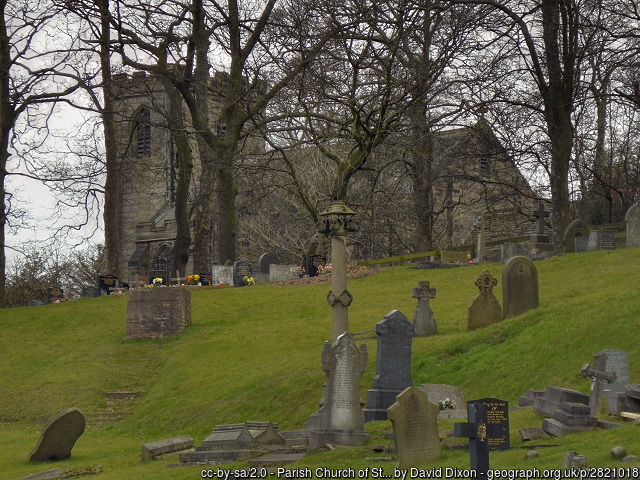
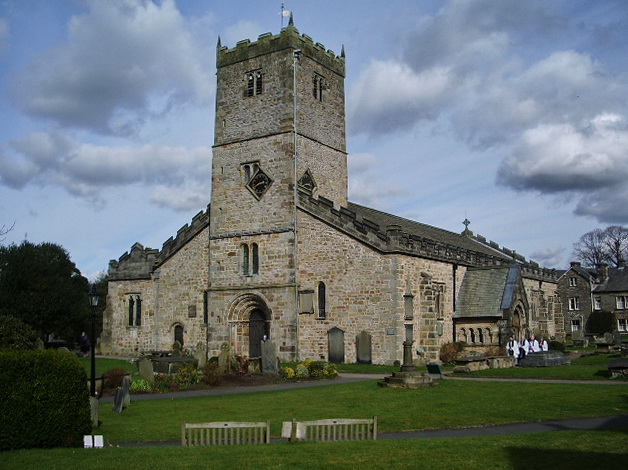
Work also began in 1795 to replace the nave, or main body, of the Parish Church of St Leonard. The church, in a prominent position on the tree-covered hillside, was established in the 12th century. Parts of the building date back to the 16th century, including, I understand, the tower. The circular font is also said to be many centuries old. I haven't found out whether the church was still used for Sunday services, weddings and baptisms while it was being rebuilt.

The font, mentioned in
British History Online's
account of Walton le Dale
Until the 19th century both Protestants and Catholics were interred in the graveyard which tumbles down the hillside around the church. Records show that many of the Ward family were buried there, though unfortunately, when we visited, we had no way of knowing where. In any case, the family may not have been able to afford to mark the graves with gravestones.

Cuthbert Ward died in 1799. His son Thomas, who was also a carpenter, married Frances Dickinson from nearby Chorley in 1802. By 1813, when Thomas died at the early age of thirty four, there were four mills and an iron foundry, and the population of Walton le Dale was beginning to boom. It had increased to 5,740 by 1821, with nearly 2000 new inhabitants added between 1809 and 1829.* By the 1840's a large proportion of the population in Walton le Dale was employed in the cotton industry.

The 1840s and 1850s

Thomas Ward's widow Frances, and three of their four children eventually left Walton Le Dale. The eldest son John, another carpenter, moved to Liverpool, while the rest moved to Manchester. Only the youngest son, Richard, remained in Walton le Dale.

The 1841 census shows that he was one of at least ten shoemakers, bootmakers, cloggers and 'cordwainers'  living in the village itself, and there were others in the surrounding area. People working in factories needed hard-wearing shoes, and they needed someone to repair them when the soles wore out. Their leather work-clogs, boots and shoes were all locally made.

Walton le Dale was not often in the news, but in 1847 two tragic murders occurred within weeks of each other, both of which were reported in the national and colonial newspapers.


In February, the married daughter of a local businessman and retired cotton mill owner, James Livesey, poisoned her five children, before drowning herself in the river Ribble. Fortunately, with medical treatment, four of the children survived but the fifth, Fanny, died.

Late in May, the body of a young baby was found in a stream near Walton le Dale by two boys. People remembered seeing an Irish woman with a baby pass through the village a few days earlier, and then the same woman travelling the other way, without the child. This was during the time of the Great Famine in Ireland, which resulted in a rapid influx of destitute Irish people into Lancashire.

But even the local people had their struggles. While conditions for the working class were usually not as dire in places like Walton le Dale as they were in larger centres such as Manchester, they were by no means easy during the 1840s. An economic depression in the early 1840s, which resulted in workers' wages being cut, bolstered demands by the working class for better conditions and the right to vote.

In August 1842, workers in Preston, just across the river from Walton le Dale, went on strike, in what is known as the Plug Plot riots. Three men were killed and several others injured when troops opened fire on a crowd who were moving from factory to factory, urging workers to strike. No doubt both the workers and the mill owners in Walton le Dale were keenly interested in these events.

It would be a long time before the workers finally did get to vote. In 1859 Walton le Dale was listed as one of many places in Lancashire with a population of over 5,000 that had no representation in Parliament.


In the 1850's, it seems, Richard Ward was no longer able to support his family as a shoemaker. At the time of the 1851 census he was working instead as a gardener. His wife Mary died in 1852, leaving him with six children. The two older boys were both employed as apprentices, while Ann, the eldest daughter, was working in one of the cotton mills.

The 1860s

As in the previous generation, most of the Ward family children moved away from Walton le Dale as adults. In early 1861, only Ann (who was married) and the youngest son, John, were still living there. Richard Ward, the father, had returned to shoemaking, and John was working as a clogger's apprentice. They were living in Mansleys Row, an address that no longer exists, but presumably was one of several "rows" of houses built to house the influx of people during the previous decades.

Lancashire suffered another great economic depression in the early 1860s, as a result of the so-called cotton famine. Overproduction of cotton fabrics, coupled with stockpiles of raw materials in the late 1850s, led to a drastic fall in prices. This was followed by a shortage of raw cotton when British shipping was blockaded during the American civil war. Many mills ceased production and there was mass unemployment. People from as far away as South Australia contributed to a relief fund, from which Walton le Dale received £100 (pounds) in December 1862.


Industry picked up again after 1865. In 1869, Walton le Dale was mentioned during a Parliamentary commission into river pollution. The river Ribble was said to be badly polluted as it flowed past the village, resulting in a dreadful stink, and dead fish. Despite this, Dr Ashton, who said he had lived and practised in Walton le Dale for twenty years, thought it was a healthy place. The death rate was 22 per 1000.  (The death rate in the UK in 2017 was 9.4 per 1000.)

He was asked about an outbreak of fever among workers at Calvert's Mill the previous year. He denied that it was due to typhoid, saying that, in his opinion, it was caused by overheating and sunstroke. He also denied that water from many of the privies (toilets) in the village drained into the wells from which people drew drinking water, or that polluted river water could reach the wells. He did disclose that many houses shared a privy. (My impression reading this account is that Dr Ashton was keen to protect the reputation of the owners of Calvert's Mill.)

But life in the village was not always dull or dangerous. Many of the mill owners organised annual outings to the seaside by train for their workers^. Events such as the Floral and Horticultural Show, and the St Leonard's Church School field day provided innocent but enjoyable entertainment.

The White Bull, Walton-le-Dale.
Photo by Alexander P Kapp 

For those whose tastes ran to something less refined, there were numerous drinking places - the Unicorn, the Queen's Arms, the Black Horse, Sir Robert Peel, the Black Bull, Grey Horse, Gardener's Arms, Yew Tree, Bridge Inn, White Bull, Ring O'Bells, the Beef tub (or Beefsteak) and the Red Lion. (Many of these no longer exist.) Perhaps it was no co-incidence that Walton le Dale also produced one of the stalwart campaigners of the Temperance movement, Joseph Livesey, and even a Temperance poet, Henry Anderton.

In 1864 Richard Ward's son John (my great grandfather) married the girl next door, Mary Ann Cragg. Their first five children were born in Walton le Dale and baptised at St Leonards. At the 1871 census, John was a clogger and Mary Ann worked in one of the cotton mills. And then, about 1875, they moved to Whitelees, between Littleborough and Calderbrook, near the Lancashire-Yorkshire border.

Why they moved is still a mystery. John's father, Richard, had remarried in 1861, and he and his second wife, Betsy, had a son, Robert, in 1866. Richard continued to live in Walton le Dale until his death in 1881. Was there not enough work for John in Walton le Dale? Did some family dispute lead to the move? Perhaps we'll never know.


I said when I began my series on "Places" that I wanted to see how the places where people lived influenced their lives, and vice versa. Visiting Walton le Dale, and reading more about it, made me realise how much the river played a part in the life of the villagers, both as a source of life and death, and as a barrier between Walton le Dale and the much larger Preston. Even now, I'm told, it is not a good idea to suggest to a local that Walton le Dale is a suburb of Preston!

Despite the industrialisation that happened in the 19th century, the place has maintained the feel of being a village. As such, it apparently didn't offer enough opportunities for everyone in the Ward family to stay, but it provided stability for the four generations of the Ward family who did remain there.

The Wards left no obvious mark on Walton le Dale or its history, as is to be expected of a working-class family. But as carpenters and cloggers, mill workers and parents, they no doubt contributed to the smooth running of village life.


*According to Pigot and Co.'s National Commercial Directory for 1828-9, p 436. This seems to have included the population in nearby Bamber Bridge.
^"LOCAL INTELLIGENCE." Preston Guardian etc [Preston, England] 4 Sept. 1861: n.p. British Library Newspapers.

All images are taken by me, (and are copyright), unless otherwise labelled.

Monday, January 22, 2018

Richard Ward - born twice?


Church door, St Leonard's
Walton le Dale
One of the most long-standing mysteries in my family history research is the date of birth of Richard Ward, my paternal great great grandfather. I know from several sources that he was the son of Thomas and Frances Ward, and that he was born in Walton le Dale, in Lancashire.

The problem with determining his date of birth is that two baptism records exist for Richard Ward in the Walton le Dale registers. Both say Richard's parents were Thomas and Frances (or Fanny) Ward. But one says he was born in 1809, and the other gives a date of 1813.

The most obvious solution would be that Thomas and Fanny had a son named Richard in 1809, who died in infancy. They then used the same name when they baptised another son in 1813. That was a common practice at the time. But I can't find any record of a burial for a child name Richard Ward between 1809 and 1813.

Besides that, most of the census records for Richard suggest that he was born in 1809 or 1810. Only in the 1851 census does his recorded age suggest a later date. At his death in December 1881 he was said to be 72 years old, which again gives a date of birth around 1809.

Images of the originals of the two baptism records are available online on the Ancestry website, so it's not a case of a transcription error causing confusion. The first record comes from the Parish Registers of Walton le Dale from 1698 to 1812. Among the christenings for 1809 is this one:
"Richard, son of Thomas and Frances Ward. Born Aug 17, baptised Oct 1." 
The names and dates are quite clear.

The same details appear in the Bishop's Transcripts, the local bishop's copy of the records for all the parishes in his diocese.

The second baptism record is from the Parish register of the Parochial Chapel of Walton le Dale, 1813-1887. Again the record is quite clear and unambiguous.
"Richard, son of Thomas and Fanny Ward" . His date of birth is recorded as 27 April, and his baptism 20 June 1813.

Another Thomas and Fanny

One possible explanation of the two baptism records is that the Richard born in 1813 belonged to another couple named Thomas and Fanny, and the minister at the time, E.S. Radcliffe, has recorded the wrong surname for some reason.

Only one other child-bearing couple named Thomas and Fanny lived in Walton le Dale at this time. Thomas Marsden married Fanny Bushby (or possibly Buskey) in 1805. They had three children baptised in Walton le Dale - Elizabeth in July 1808, John in April 1810 and Sarah in September 1811. Sadly all three, plus an older child named Mary, died in infancy and were buried in Walton le Dale.

The graveyard at St Leonard's Parish Church
Walton le Dale.
Their mother, Fanny Marsden, died in 1813 at the age of 30, and was buried on 25 April*. Is it too far fetched to suggest that she might have died giving birth to the Richard who was said to have been born on 27 April 1813? Obviously there is an awkward discrepancy of a couple of days between her burial and his reported date of birth. But given that the child wasn't baptised until two months later, perhaps the date of birth could be in error by a few days. It's easy to imagine a grieving husband mixing up the dates.

To give this theory a bit more weight, a Richard Marsden, born about 1812 in Walton le Dale, appears in the 1851 and 1861 census in Leyland, Lancashire. In the 1841 census his place of birth isn't recorded, but he was living in Leyland with a Thomas Marsden, with no other relatives listed. That would be consistent with Thomas being widowed and Richard being the only surviving child.

Since he was born in Walton le Dale, we might expect that Richard would have been baptised there, but I can't find any record of a baptism for a Richard Marsden in the Walton le Dale registers within 10 years of 1812. Could that be because his baptism in 1813 was recorded as Richard Ward?

Against this theory is the fact that the 1813 baptism record describes Thomas Ward's occupation as "joiner" (ie a carpenter). This was, in fact, his occupation according to other records. Thomas Marsden's occupation was a "cotton operative" when his wife was buried, and an agricultural labourer in 1841. For my theory to hold water, I'd have to explain why the minister not only wrote "Ward" instead of "Marsden", but also inscribed the occupation of Thomas Ward rather than Thomas Marsden. Any suggestions?

In the meantime, I'm leaning towards the earlier date of birth being the correct one for Richard Ward, though I'll keep the other one recorded as an alternative.


(*Burials, Parish register for 1813-1819, p 8, entry 58. Reference Number: Pr 2948/1/17)

Sunday, March 1, 2015

Matthew Cragg (1810-1878)

The Royal Oak and market cross, Garstang
Recently I took a break from researching my mother's side of the family and had another look at Matthew Cragg (1810 - 1878), my father's great grandfather and the husband of Esther Lambert. Apart from knowing that both his father and his grandfather were also named Matthew Cragg, I didn't know much about him.

Matthew was born in Kirkland, near Garstang, Lancashire, in 1810, the eldest son of Matthew Cragg and Mary Helm. His father's occupation is listed as "labourer" on his baptismal record. Matthew himself was a calico printer by trade, first in Radcliffe and then in Walton le Dale. I haven't found any mention of Matthew in the local newspapers of the time, which suggests that he was too poor to be noteworthy and stayed out of trouble with the law.

He married Esther Lambert in Preston in 1833. I've mentioned before that Esther and Matthew had two sons, Richard and William, who died within weeks of each other in 1847. It seems they also had another son, also named Richard, born in May 1837. He died before his first birthday, in March 1838. Only their daughter Mary Ann survived childhood.

Matthew's father, Matthew Cragg born in 1786, and his grandfather, Matthew Cragg born in 1745, were both associated with St Michael's on Wyre in the parish of Upper Rawcliffe. Several of the Cragg families in this area were Quakers, but I haven't been able to connect 'our' line to theirs. As we'll see in my next post, three of Matthew's nephews became Mormons. Matthew and Esther seem to have been solidly C of E all their lives.

Image © Alan Godfree under a CC license


Thursday, September 18, 2014

James or William? - James Ward (1837- maybe 1882)

A few weeks ago I was looking again at the Ward side of the family tree and noticed that I had the dates of death for all the children of Richard and Mary Ward (nee Baines) except for James, born in about 1837.

Being a bit obsessive, I decided to tidy things up by finding his date of death. Not a good idea! After many hours of searching over several days I'd managed to add quite a few details to his life story, but I still don't know his date of death for certain.

Previously I had only his baptismal record from St Leonard's church in Walton le Dale, and his presence with his parents in the 1841 and 1851 censuses. James was the fourth child of Richard and Mary and was baptised in June 1837. His next older brother, William, died in 1838, a fact that seems to have some relevance to James' later story. After 1851 James seemed to disappear.

I'd managed to find a James Ward, born in Walton le Dale, in the 1881 census before. He was a house painter, married to Alice, with children named Enoch (22) and Mary Alice (19). They were living in Salford. But I couldn't find any of them in the 1861 and 1871 censuses, despite Enoch's unusual name. Nor could I find a marriage to Alice that would fit in with the ages of the children (both born in Bury, Lancashire, according to the 1881 census). This was the point where I'd given up on James before.

"Hundred of Salford" by John Speed - John Speed's Map of Lancashire (1610)
The town of Salford ("Sauford") is just north of Manchester (near the bottom of the map).
Heywood ("Hawood") lies between Rochdale and Bury.
Preston and Walton le Dale are off to the north west of this map.
Licensed under Public domain via Wikimedia Commons 

This time I decided to widen my search, so I looked in the 1861 census for a house painter named Ward (leaving the first name blank) born Walton le Dale in a 20 year period around 1837. What came up, apart from all of James brothers and sisters, was a William Ward, a house painter living in Bury. He was a lodger in a house with a woman named Susan Harwood. She had a baby daughter, Mary A.

It seemed a long shot, but I did a bit of research on Susan and her daughter. It seemed that Susan, nee Barlow, was the (ex?)wife of Enoch Harwood, who was still living. They had a son named Enoch who was living with relatives at the time of the census. I couldn't find a Mary A Harwood born in Bury, but I did find a Mary Alice Ward, born in Bury in 1860, whose mother's maiden name, according to the lancashirebmd.org.uk site was Barlow. That seemed promising.

The problem was, why would James be calling himself William? Perhaps he adopted his dead brother's name because he was living with a married woman? Or maybe I was just joining too many dots together, and this wasn't really James at all.

Next I looked for Susan in the 1871 census - and found her living in Heap (near Heywood) with a lodger named  James Ward, a house painter born in Preston. Preston is a large town close to the village of Walton le Dale. This time Mary A was gone (I still haven't found her in this census) but Susan had a daughter, Amelia Ann Harwood, aged 10, living with her. I couldn't find a birth for Amelia Harwood that fitted, but an Amelia A Ward was registered in Castleton, Rochdale in 1862.

Again it seemed intriguing, but I was worried that I was joining too many dots. So next I looked for Susan Harwood and Amelia in 1881. They were still living in Heap, but their lodger had disappeared.

To Salford, perhaps? If James was married to Alice in the 1881 census, they must have married between 1871 and 1881. One marriage that fit those dates was James William Ward's marriage to Alice Iddon (nee Alice Kirkham Hill) in Preston in 1876. The groom was a house painter, and his father, Richard Ward, was a gardener, which fit the facts from the 1871 census. Not only was Alice a widow, but James William claimed to be a widower too.

So it seems quite likely that at the time of the 1881 census James was living with his wife Alice, his stepson Enoch Harwood and his daughter Mary Alice.

By 1901 Alice Kirkham Ward was a widow again, living in Walton le Dale. I haven't been able to find her for sure in the 1891 census, so I don't know when she became a widow. It seems most likely that it was in 1882, when a James William Ward died in Salford. But I have no way to be certain of that.

Amelia Ann Harwood married Charles Frederick Falshaw Lupton in 1885. On the marriage record her father is named as "William Harwood, painter, deceased." Her mother, Susan Harwood, was living with the Lupton family in Oldham in 1891, along with Amelia and Charles' two sons, John and Enoch. Susan died in 1893.

Laid out like this, it all seems fairly straight forward. What took me hours of research was weeding out all the other possible James and William Wards born about the right time in Lancashire, many of whom also had fathers called Richard. One had a wife called Alice. I also needed to make sure that there wasn't a house painter named William Ward born in Walton le Dale in any other census. (I didn't find one.)

In the end, James William is just a side branch on my family tree. But tracking down his records has given me some insights into how tricky it can be to trace people who were trying not to be easily traced. It has also given me hope that I might one day be able to tie up some other loose ends that so far have been impossible to unravel.


As usual, I haven't given detailed references to the census records etc in order to keep things easy to read. But if you would like more detailed references to the records that I've mentioned please contact me (stella(dot)budrikis(at)gmail.com and I'll be happy to pass them on.


Sunday, September 15, 2013

Esther Lambert

Esther Lambert was my grandfather's grandmother. She was the youngest daughter (or at least the youngest known daughter) of William and Betty Lambert, and was born in Catterall, near Garstang, Lancashire, on 31 August 1807. She was christened at Garstang in September 1807. Esther didn't have an easy life, but nevertheless she lived to the relatively great age of 79, dying in 1887 in Walton le Dale.

Her life story is full of unanswered questions and intriguing hints. I haven't been able to find out much about William and Betty, nor about Esther's oldest sister Betty (born July1802). Her other sister, Hannah (born 23 March 1805) seems to have had two children while she was still unmarried and living in Garstang - Daniel in April 1829 and Esther in 1831.

In May 1831 an Esther Lambert and a Matthew Cragg were witnesses at the wedding of Grace Lambert and John Singleton at St John's church in Preston, Lancashire. It seems likely, but it would be fascinating to know for sure if this is the same Esther and Matthew who were later to marry in the same church. I haven't been able to find any connection between Grace Lambert (born about 1801) and William and Betty, or with the other members of the family. Unfortunately although Grace and John appear in the 1841 census with their two children, Grace had died before the 1851 census when her place of birth would have been recorded. She remains an enigma.

William and Betty both died within a few weeks of each other in June 1833, aged in their sixties. A few months later, in October, Esther married Matthew Cragg at St John's, Preston. The witnesses were Samuel Smails and Margaret Beesley, neither of whom seem to have any family connection.

In 1834 another son, James, was born to Hannah Lambert, who was now living in Accrington. She married a widower, James Cronkshaw, in 1834 and the whole family was living in Accrington at the time of the 1841 census. Whether she had any further contact with Esther is unknown.

Esther and Matthew's first son, William, was born in 1835 and Richard followed in 1839. At the time of the 1841 census the family were living in Cabbage Row, Radcliffe, Lancashire. A nephew, William Newsham, aged 9, was also living with them. Mary Ann came along in December 1843. As mentioned previously, tragedy struck in February 1847 when the two boys, William and Richard, died. 

It looks as though Esther and Matthew continued to provide accommodation for William Newsham, along with his older sister Mary Newsham. They were living with Esther, Matthew and Mary Ann, still in Radcliffe, at the time of  the 1851 census. 

Who were William and Mary's parents? One possibility is that they were the children of William Newsham and Anne Lambert, who married at St John's Preston in 1829. Anne died in 1832 (aged 37) and William senior in 1835. I haven't been able to discover what the connection was between Esther and Anne, although Mary and William Newsham are described as niece and nephew in the census, suggesting that Anne may have been a sister. There is a baptism record for an Anne Lambert, daughter of William and Elizabeth Lambert, in Warton, near Lancaster, in May 1795, which could fit. 

By 1861 Esther and Matthew had moved to Walton le Dale. William and Mary Newsham were gone, but another child, Nancy Heap, was living with them. Here is another puzzle - who was Nancy? Matthew had a sister Mary who married a William Heap, but they don't seem to have had any children name Nancy or Anne (Nancy being the diminutive form of Ann.)

It's possible that Nancy was the daughter of Mary Newsham. A Nancy Heap was born in Radcliffe in 1852 whose mother's name was Newsham. A Mary Newsham (father's name William) married Joseph Heap in 1851. This is all rather tentative evidence, but seems to be confirmed later, as we'll see.

The 1871 census records that Nancy was still living with Esther and Matthew Cragg in Ribblesdale Place, Walton le Dale. By this time Mary Ann had married John Ward and they had 3 children (John Willie, Matthew and Esther). John and Mary Ann moved to Littleborough sometime between 1874 and 1877, leaving Esther and Matthew and John's father Richard behind. Why did they move? It's one of those questions I'd love to know the answer to, but probably never will.

Matthew died in August 1878. Now Esther had no immediate family in Walton le Dale. However, it seems that Nancy had become very much part of the family. In 1881 Esther was living with Annie and John Parkinson and their three children in Walton le Dale, and she's described as "mother in law". My guess is that Annie is Nancy. An Annie Heaps, daughter of Joseph Heaps, married John Parkinson, clogger,  in Walton le Dale on Christmas Day 1875. Annie Heaps' address on the marriage record is Ribblesdale Place, the same as Matthew and Esther's address in the previous census. Perhaps Nancy and her children filled the place left in Esther's life when her grandchildren moved away.


Sunday, August 18, 2013

John Ward’s siblings

Recently I've been trying to trace what happened to the siblings of John Ward. While I don't have any great interest in extending the family tree sideways, I often find that information about siblings can be helpful in understanding the life of the person I'm focusing on.

Of Richard and Mary Ward’s nine children, four (William, Frances, Mary and Margaret) died in infancy, and were buried in Walton le Dale. The only remaining daughter, Ann (born about 1833) remained in and around Walton le Dale all of her life and in 1860 she married Thomas Gardner. As I've mentioned before, it seems likely that Thomas Gardner was the younger brother of Elizabeth (Betsy) Gardner who became Richard Ward’s second wife after the death of Mary. When the 1911 census was taken, Ann was still living in Walton le Dale, aged 78, in the home of her son Richard and daughter Margaret.

John Ward’s oldest brother, Thomas (born about 1832) was a joiner’s apprentice when he was 18, but later he worked as a railway guard in Salford. In 1857 at about the age of  25, he married Sarah Ann Surr, a 17 year old girl from Manchester. They were married at the cathedral in Manchester. They had three children, Fanny, Mary Ann (both born in Manchester) and Andrew, born in Walton le Dale. In 1861 they were living in Preston, but their stay in Preston may have been brief, as Sarah is recorded as having died in Salford at the age of 25 in April 1863.

In January 1865 Thomas remarried, to Lucy Mansley, nee Sharples, a widow. Perhaps they had known each other growing up, as Lucy was also born in Walton le Dale. Her father, Johnson Sharples, was a clogger there. Thomas and Lucy had a daughter, Margaret Ann, and in 1871 the couple were living with the four children in Hope Street, Salford. Lucy, Andrew and Margaret Ann were still living at the same address in Salford at the time of the 1881 census, but I haven’t been able to trace what became of Thomas. Presumably he died between the 1871 and 1881 census.

John’s second oldest brother, James, is much more elusive. The only definite references I can find to him are his baptism in Walton le Dale in 1837, and his residence with Richard and Mary in the 1841 and 1851 census. In 1851 he is described as a tailor’s apprentice, aged 14. A James Ward born in Walton le Dale appears in the 1881 census, married to Alice and with a son named Enoch and a daughter named Mary Alice. He is a painter and plumber. Despite the unusual name of his son, I haven’t been able to trace him back to the 1871 or 1861 census or forwards to 1891.

Fortunately the third of John’s surviving brothers, Richard, is much easier to follow. Like Thomas, he worked on the railways in Salford. He married Hannah Moss, from Eccles, in 1861 (the same year his father Richard married Betsy.) In 1871 they were living in Preston, where Richard was a railway guard. They had four children at this stage – John, Alfred, George and Sarah. Little Sarah died in Preston in 1873. By the time of the 1881 census the family had moved back to Salford, and had added Clara (born in Preston) and Bertha (born in Pendleton).

Hannah died sometime after 1881. In February 1886 the widowed Richard married  Elizabeth Clarkson, who was a 40 year old 'spinster' and one of John and Mary Ann’s neighbours from Crabtree Street. They married at Holy Trinity in Littleborough and John Ward was one of the witnesses at the wedding. Richard and Elizabeth had a daughter, Amy, born in Pendleton in December 1887. By the time of the 1891 census only 13 year old Bertha and 3 year old Amy were at home with the couple in Pendleton. By now Richard had become a railway inspector. He had retired by 1891 and he, Elizabeth and Amy had moved to Littleborough. Richard appears to have died and been buried at Calderbrook, above Littleborough, in 1911.


Wednesday, July 31, 2013

Happy and sad family events in Littleborough

Holy Trinity in the snow
© Copyright SMJ 
licensed for reuse under this CC Licence
 

Many years ago my husband and I were temporarily part of the congregation at Holy Trinity in Littleborough, Lancashire, and our first child was baptised there. So when I came across the parish records for Holy Trinity online recently, I was delighted to discover that my grandfather, Thomas Henry Ward, was also baptised there, on 9 January 1883. His sister Mary Ann was baptised at Holy Trinity on 20 August 1877, Fanny was baptised 24 January 1880, and Henrietta 26 September 1886.

Thomas' baptism is recorded as a private baptism, and John Ward, Mary Ann Ward and Thomas Howarth were his godparents.

Another happy event happened at Holy Trinity in February 1886 when John Ward's widowed brother Richard married one of John and Mary Ann's neighbours, Elizabeth Clarkson. (Elizabeth was also Fanny's godmother.) They moved to Pendleton, but eventually moved back to Littleborough when Richard retired from his job as a railway worker.

On a much sadder note, the local parish registers also record the burials of two of John and Mary Ann's children, Richard and little Mary Ann, within four days of each other in April 1879. They were buried at St James churchyard, Calderbrook, just above Littleborough.  Richard was 7 years old, and Mary Ann was about 20 months. The register doesn't record the cause of death, but some sort of infectious disease seems most likely.

It must have been a terrible time for their parents, and especially for their mother Mary Ann, who would have been pregnant with Fanny at the time. As I mentioned in a previous post, Mary Ann’s two brothers, William and Richard Cragg, both died in the same week when she was 3 years old, so the deaths of Richard and Mary Ann must have brought back sad memories for her, and also for her mother, Esther Cragg, who was still alive in Walton le Dale at this time.

The Ward family continued living in Littleborough until sometime after Henrietta's birth in 1886, and then for reasons that are unclear they moved to Rastrick in Yorkshire.


Saturday, July 13, 2013

John Ward, clogger

Clogger's tools
cc licensed ( BY NC ND ) flickr photo shared by Kevin Harber
John Ward (1842-1905) was a "clogger". In other words, he made the tough wooden-soled, metal-tipped lace-up clogs worn by labourers and mill workers all over Britain during the 19th and early 20th century.

Some cloggers were itinerant, but most villages had one or more resident clog-makers who made clogs on order, individually fitted to the buyer's feet. The traditional village clogger usually carved the wooden soles themselves, before cutting the leather uppers and nailing them in place. A well made pair of clogs was waterproof and would last for years.

John possibly learned some of his trade in Walton le Dale from his father Richard, who was a bootmaker. He continued as a clogger when he moved to Littleborough, then to Rastrick and finally to Milnrow. Whether he worked from home (as in the picture below) or had a workshop elsewhere I've yet to discover.

Clogger's Shop in Weaver's Cottage Museum - geograph.org.uk - 528761
Clogger's shop in a weaver's cottage museum


More information about English clog making:


The Last Clog Maker in England - series of YouTube videos on clogs and clog making by Jeremy Atkinson

Informative website by Chris Brady

Clogs (Mike Cahill, maker and repairer of traditional English clogs)


Thursday, June 20, 2013

Mary Ann Cragg

When Mary Ann Cragg married “the boy next door”, John Ward, she was twenty years old and he was 22. Her parents, Matthew and Esther Cragg had moved to Walton le Dale sometime between 1851 and 1861 and took up residence as neighbours to the widowed Richard Ward and his son John in Mansleys Row. Both Mary and her father worked in the cotton mills, he as a block printer and she as a cotton loom weaver. The marriage entry in the church register lists her as 'Mary Craig' daughter of Matthew Craig, but this is almost certainly an error. The mother's maiden name for their children, where it is recorded, is Cragg.

http://www.geocities.com/radcliffeuk/misc/rad-bridge.jpg
Radcliffe Bridge about 1854
Photo taken by William Smith
Mary Ann was born in Radcliffe, near Bury in Lancashire, on December 21, 1843. She had two older brothers, William (born 1835) and Richard (born 1839). Tragically, both boys died within a few days of each other in February 1847. Perhaps they were victims of the typhus epidemic which swept through Britain that year, hitting Lancashire particularly hard, with nearly 10,000 deaths recorded in the Northwest. If so, three year old Mary was very fortunate to have survived. Perhaps it is an indication of her strong constitution.

Following her brothers' deaths, Mary Ann seems to have remained the only child of Matthew and Esther.  But she was not always alone with them. The 1851 census shows that Matthew, Esther and Mary were still living in Radcliffe, though they had moved from Cabbage Row to Radcliffe Hall. Living with them were a nephew and niece, William and Mary Newsham. They were much older than Mary, and were already working.

By 1861 they had left, but a 9 year old child named Nancy Heap was living with Matthew, Esther and Mary. She is described as a niece, but as far as I can tell she was probably the daughter of Mary Newsham. (More of these connections in a later post).

Lower Newlands, Rastrick, Yorkshire
Photo  copyright Humphry Bolton under a CC license
After her marriage to John Ward in June 1864, Mary Ann continued to work as a cotton weaver, even after the birth of John Willie, Matthew and Esther. According to the 1911 census, she and John went on to have 10 children in all, 7 of whom lived into adulthood. The family moved from Walton le Dale to Brighouse near Calderbrook before 1881, then to Rastrick in Yorkshire, and finally by 1901 to Clifton Street in Milnrow, Lancashire. Later in life, after John’s death in 1905, she continued his business as a boot and shoe retailer until her own death in 1916.

Sunday, April 7, 2013

Mary Baines of Westmorland

Kirkby Lonsdale (now in Cumbria)
Photo: cc licensed ( BY NC ND ) flickr photo by Cheekablue:
http://flickr.com/photos/cheekablue/2769879983/

We know from the 1851 census that Mary Ward (nee Baines) was born in Kirkby Lonsdale in Westmorland. Her stated age in the 1841 and 1851 census suggest she was born about 1814-1815. This also tallies with her age given when she died. In the absence of records of any other person of the same name and approximate age, it seems likely that she was the daughter of James and Anne Baines (nee Preston) of Kirkby Lonsdale.

St Mary's church, Kirkby Lonsdale
Photo: A P Kapp via Wikimedia Commons


Mary and four of her siblings (George, Thomas, James and Anne) were all christened on the same day, 28 June 1818, at St Mary's church in Kirkby Lonsdale. This sort of family baptism en masse was apparently not uncommon in the past, and could mean that James and Anne had a rather itinerant lifestyle. Or it could simply be that a more diligent minister arrived in the village. Since births (as opposed to baptisms) were not registered before 1837, it's difficult to know in what order the siblings were born.

Another son of James and Anne Baines, Joseph, was baptised in Kirkby Lonsdale in November 1815. If this was the same family, it's strange that Mary was not baptised at the same time, unless she was born right at the end of 1815. There are also a couple of other earlier baptisms (William in 1796 and Diana, in Great Mitton, in 1798) that may have been children of the same family.

Mary's father appears to have died in Kirkby Lonsdale in 1827. Perhaps some of the family, including Mary, moved to Lancashire looking for work, or perhaps they had distant relatives there. It's not clear what happened to her mother, Anne. An Anne Baines, aged 72, was buried in Walton le Dale in 1845, but her name doesn't appear in the census four years earlier. This could be Mary's mother, but it could just as likely be one of several Anne Baines in the local area.

Mary married Richard Ward at St Leonard's church in Walton le Dale on June 26, 1831. If she really was born in 1815 or so, she would have been 16 years old. One of the two witnesses recorded on the parish register - James Tomlison snr - was a chapel clerk who witnessed many other weddings in the same church. The other, John Briggs, doesn't seem to be related to the family, as far as I've been able to discover.

In the next 20 years Mary gave birth to 9 children who lived long enough to be recorded and baptised. Given the strain this must have placed on her body, and the living conditions and health care available at the time, it's perhaps not surprising that, like many other women, Mary died at an early age. She was 38 and her youngest child only 18 months old when she was buried in 1852. (A quick count shows that of the 99 deaths recorded in Walton le Dale in 1852, only 1 in 3 were aged over 50).


Sunday, March 17, 2013

Richard Ward, a summary

Richard Ward must have been less than 4 years old when his father, Thomas, died in 1813. He was the youngest of four children. His mother, Frances, seems to have remarried in 1829, when Richard would have been in his teens and probably already supporting himself. Nothing more is known about him until he married Mary Baines on 26 June 1831 at St Leonard’s in Walton Le Dale.

The marriage entry in the parish register records that Richard was a bachelor, and Mary a spinster of the parish of Preston, but gives no details about their age, their parents, or Richard’s occupation. We know from the 1851 census that Mary was born in Kirkby Lonsdale in Westmorland, so it would be interesting to know when she moved to Lancashire, and how she and Richard met, but that too is a mystery. We do know that they continued to live in Walton Le Dale, in fact Richard remained there for the rest of his life.

By the time of the 1841 census, Richard and Mary had four living children – Thomas (c 1832), Ann (c 1833), James (1837) and Richard (1839). Another child, William (1835), had died in infancy. Richard senior recorded his occupation as shoe maker. It was a trade he passed on to his youngest son, John (born 1842), who in turn passed it on to his youngest son Thomas Henry.

Further children were born in the following 10 years – John (1842), Frances (1844), Margaret (1845)  and Mary(1850). Frances survived only 8 weeks old, and Margaret only 5 weeks. 

By the time of the 1851 census the eldest son Thomas, now 18, was working as a joiner’s apprentice, a trade followed by his grandfather and his uncle John (Richard’s oldest brother). Ann was working in one of the local cotton mills and  James, at 14, was a tailor’s apprentice. For some reason Richard himself was employed as a gardener at this time.

Sadly Mary, his wife, died in 1852 at the age of 38. Further tragedy followed with the death in 1859 of Richard’s youngest daughter Mary, at the age of 9. Of nine children born to Richard and Mary, only five survived into adulthood. Yet such statistics were not uncommon amongst the working class at the time.

Only John, now aged 18, was left at home with Richard when the 1861 census was taken. Richard was working as a shoe maker again, and John as a clogger's apprentice. Walton Le Dale had more than one shoe maker at this time, and the census doesn't record who John was apprenticed to. Did Richard teach him his trade, or someone else?

In July 1861, with all his surviving children grown up, Richard re-married. His wife, Elizabeth (Betsy) Gardner was several years younger than him, having been born in 1827 in Kirkland, near Garstang, in Lancashire. Richard’s daughter Ann had married a Thomas Gardner, also from Kirkland, in May 1860. It seems likely that Betsy and Thomas were sister and brother, since Stephen Gardner is recorded as the name of the father on both marriage records. If so, it must have been strange at family gatherings with Ann having her sister-in-law as her step-mother, while Richard’s son-in-law was also his brother-in-law.

Richard and Betsy had a son, Robert, in 1866 and they continued to live in Walton Le Dale. Ann and John both lived in Walton Le Dale with their spouses and produced several grandchildren who would have been of a similar age to Robert.

By 1871 Richard had returned to working as a gardener. By the time of 1881 census Richard was 72 years old and almost blind. He could no longer work, although with no pension scheme to fall back on, most men his age were still employed. Betsy found work as a washerwoman and Robert, now 14, was employed as a cotton weaver in one of the mills.

Richard died some time before 1890. (When Robert married his father was already deceased). The most likely date seems to be late in 1881 and he was probably buried in the church yard at Walton Le Dale.

Sunday, March 3, 2013

Which Richard is 'our' Richard?

On the 17th of August 1809, in Walton Le Dale, Thomas Ward and his wife Frances had a son named Richard. His birth date was recorded in the register of St Leonard’s Anglican church when he was baptised on October 1st of the same year.1

However, on the 20th June, 1813, another child named Richard Ward was baptised at St Leonard’s. The record states that he was born on the 27th April 1813 and his parents were Thomas Ward, joiner, and Fanny.2

This creates a problem – which of these two Richards was ‘our’ Richard, husband of Mary, the father of John, and the grandfather of Thomas Henry Ward? Having looked at the images of the original documents (online) there doesn’t seem to be any doubt about the accuracy of the transcriptions. The fact that the dates for the two births and baptisms are so different makes it highly unlikely that they’re records of the same events. I can think of a number of other possibilities:
  1. The first child died in infancy and Thomas and Frances called the later child by the same name. This was a common practice in those days. Unfortunately for this theory, I can’t find any record of a death for a Richard Ward between 1809 and 1813.
  2. Another child of Thomas and Frances was mistakenly recorded as Richard instead of by their correct name. If so, it would be very difficult to trace them.
  3. There could have been two couples in Walton Le Dale named Thomas and Frances/Fanny Ward and both had sons named Richard. These names are all very common.  However, I can’t find any record of another Thomas Ward married to a Frances, or Fanny, anywhere in Lancashire, who would be of roughly the right age.
The census records don’t shed much light on the problem. The date of birth for ‘our’ Richard, calculated from his stated age on the census, varies from 1809 (in 1861), 1810 (1871 and 1881) to 1812 (in 1851). When he married for the second time in 1861 he was said to be 51, giving a date of birth about 1810. Overall, these dates suggest that Richard was more likely to have been born in 1809, but that leaves the question of what became of the Richard (if he was Richard) born in 1813?

In all the census records I can only find one Richard Ward of approximately the right age who was recorded as being born in Walton Le Dale, although there was another Richard Ward living in Walton Le Dale in 1841 and 1851. (Born in Treales in 1801, he was the husband of Margaret, and possibly a cousin of the other Richard.) It’s all rather confusing.


Notes
1. Ancestry.com. Lancashire, England, Baptisms, Marriages and Burials, 1538-1812 [database on-line].
2. Ancestry.com. Lancashire, England, Births and Baptisms, 1813-1911 [database on-line].

Sunday, November 4, 2012

Children of Thomas and Frances Ward

Here's a brief summary of the lives of the children of Thomas Ward and Frances (nee Dickinson).

John (1803) was born while the family were still living in Charnock Richard near Chorley, and was baptised at St Laurence, Chorley. He became a joiner like his father. John would have been about 10 years old when Thomas died.

Sometime before the age of 25 he moved to Liverpool. He married Rosa Connor at St Peter's in Liverpool in 1828. Rosa was recorded as being from Cheshire in every census except in 1871, when she was said to be from Ireland.  They had four children (that I'm aware of) - Frances (1829), Ann (1831), Ellen (1834) and John (1838). The family moved to West Derby, near Liverpool, after 1851.

John died sometime between the 1871 and the 1881 census, possibly towards the end of 1872 in West Derby.

Margaret (1805) was born in Walton Le Dale. She married Peter Warburton Lowe at Manchester Collegiate church (later Manchester Cathedral) in 1838. Peter was the son of Joseph and Mary Lowe and was born in Rainow, Cheshire. Margaret and Peter had four recorded children - Joseph (1839), Thomas Henry (1841), Fanny (1842) and Roger Leigh (1847). They continued to live in Salford.

Peter's name is mentioned along with a William Tomlinson and a Richard Tomlinson in a business venture announced in the London Gazette of March 27, 1857. Whether this is the same William who was his father-in-law is unclear. The name William Tomlinson was quite common in Lancashire.

At the time of the 1841 census Margaret's niece Fanny, daughter of John and Rosa, was staying with them. I haven't been able to find the Lowe family in the 1851 census, but there are several gaps in the 1851 census in Salford due to the records being damaged. In the 1871 census Esther Ward, Margaret's sister, was included with the Lowes.

Margaret died sometime before the 1881 census. Peter died in 1872.

Esther (1807) was also born in Walton Le Dale. Her name appears as Easther on the baptism register. She never married. In the 1841 census she was living with her mother and step father in Salford. In 1851 she was with her step-sister Cathrine Tomlinson in Manchester, and was working as a mangle-woman. I can't find her in the 1861 census, but in 1871 she was with Margaret and Peter. She doesn't appear in the 1881 census.

The only Esther Ward of the right age who died in the period between the two census was registered in 1878 in Ormskirk, near Liverpool. Perhaps, if this is the correct Esther, she moved after Margaret and Peter died.

Richard (1809 or 1813?) lived in Walton Le Dale all his life. He married Mary Baines and they had 9 children, including John, our great great grandfather. I'll say more about this family in a later post.

Fanny (1818) was born to Frances 5 years after Thomas died, and no father is recorded in the Walton Le Dale baptismal record of November 24 1818. She was with Frances and William Tomlinson in Salford in 1841.

Fanny married George Hayes, a calico bleacher from Chorley, at Manchester Collegiate church in 1843. Their children were Joseph (1844), Thomas (1847), Esther (1850) Daniel (1854, died 1855) and Margaret (1857). In the 1851 census they were living next door to William and Frances Tomlinson in Salford (although the street names are different, presumably due to being on a corner). They remained in the same house in Hulme St, Salford for many years, even after the Tomlinsons moved on.

Fanny died in 1871.

Sunday, October 21, 2012

Frances Dickinson

We've recently returned from Italy, where we caught up with Zoe. It was lovely seeing her. We also had a great time exploring Italy. As far as I know, we don't have any Italian ancestors, but who knows...the Romans surely left some descendants in Britain. There were certainly Romans soldiers stationed in Lancashire, and they can't have spent all their time building roads. Walton le Dale was apparently a major Romano-British settlement.

Which brings me to the subject of this post, Frances Dickinson, who lived in Walton Le Dale with her first husband, Thomas Ward. Frances, the daughter of John and Margaret Dickinson (nee Ainsworth) was baptised at St Laurence church in Chorley in January 1780. A number of Dickinson and Dicconson families lived in the Chorley area (which includes Standish, Wrightington and Charnock Richard) at this time.

Interior of St Wilfrid's Parish Church, Standish
(courtesy of Alexander P Kapp)
Thomas and Frances were married on November 9, 1802 at St Wilfrid's parish church in Standish, the same church where John and Margaret were married. The church, built betweeen 1582 and 1584,  is noted for it's ornate Tudor ceiling (visible on the picture.)

On the parish register, Thomas was described as being "of the Parish of Bolton", but this doesn't necessarily mean that he was born there. It's interesting to note that Margaret Ainsworth was also said to be "of the Parish of Bolton when she married John Dickinson. Frances was "of this Parish", ie Chorley. She signed the register with an 'X'. Richard Dickinson, her brother, was a witness along with a Robert Ainscough.

Thomas and Frances' first son, John was baptised as St Laurence in Chorley in March 1803. At some stage the family moved to Walton Le Dale, where Margaret (1805), Esther (1807) and Richard (1809) were born.

Frances was only 33 when Thomas died in 1813 (cause unknown). How she managed alone with four children can only be guessed. In 1818, 5 years after Thomas' death, she gave birth to another child, Frances (also known as Fanny). In the parish register the officiating minister at her baptism records only Fanny Ward, widow, as the mother, with no father named.

In May 1829 Frances remarried, to William Tomlinson, a widower. The banns of marriage were read at St Mary's Eccleston (not far from Chorley), and both were said to be living at Wrightington, near Eccleston. Perhaps Frances had moved back to the Chorley area to be closer to her family. The marriage, on May 29, also took place at St Mary the Virgin, Eccleston. Robert Dickinson was one of the witnesses.

According to census records, William was born in Lancaster in about 1792, which makes him quite a bit younger than Frances. It seems likely that he is the same William Tomlinson who lived in Walton Le Dale for several years with his first wife, Ellen Porter. He was a labourer and later a weaver. They were married in Walton Le Dale in 1816 and their children John, Richard, Mary, Catherine and Ellen were all born there. Baby Ellen died a few days after her baptism in February 1828 and her mother Ellen died in August 1828. Note that if this is the same William who married Frances Ward, then he would have been already married when the younger Fanny was born in 1818. Was he her father? We'll probably never know.

After their marriage Frances and William moved to Salford. In the 1841 census they were living in Mason Street with Richard and Catherine Tomlinson and Esther and Fanny Ward. By 1851 all the children had moved on - Esther, still single, was living with Catherine Tomlinson in Butler St, Manchester, and Fanny seems to have married a George Hayes from Manchester and had three children of her own.

Possibly Frances Tomlinson's mother Margaret also lived with them for a short time. A Margaret Dickinson, aged 64, was buried at St Laurence, Chorley in December 1832. Her abode was said to be Manchester. However, since I don't know for sure when Margaret was born, this is just speculation.

Frances died at the age of 81 in Salford in 1861. This makes her one of the longest-lived of our ancestors prior to the last century. Her second marriage was also a long one, at over 30 years. William appears to have lived on until 1866. I'll describe what happened to Frances' other children in a later post.


Sunday, August 19, 2012

Thomas Ward - a hole in the wall

One of my long-standing "brick walls" has been Thomas Ward, the husband of Frances Dickinson. I knew that he and Frances married in Standish in 1802, and that she was a widow by 1818. His name didn't appear in the Walton Le Dale parish records for burials between 1809 (when his youngest son Richard was born) and 1818, but there was a tantalising gap in the records on the Lancashire Online Parish Clerks site between 1813 and 1814, and I couldn't find the records anywhere else.

Being able to narrow down his date of death to a two year period might seem more than adequate, but I was hoping to find his burial record to see if it gave me a clue to when he was born. Without a date of birth I couldn't go back any further.

Yesterday I finally found the 1813-1814 records on Ancestry.com.au. (or to be more accurate, the Bishop's Transcripts of the parish records). So now I know not only that Thomas Warde (sic) was buried in September 1813, but also that he was born about 1779 and worked as a joiner. Hooray!

A bit more searching on ancestry.com.au and lan.opc.org.uk produced a possible father and mother for Thomas - Cuthbert and Ellen Ward (nee Catteral). They had a son, Thomas, in Kirkham, Lancashire, in 1779, and then two daughters born in Kirkham, in 1781 and 1783. After that they vanish from the Kirkham records, but a Cuthbert and Ellen Ward appear in Walton Le Dale, with the birth of another daughter in 1785. Several more children were born in Walton Le Dale. Cuthbert died there in 1799 and his occupation at his burial was recorded as 'joiner'.

So it all seems to fit together nicely. I need to do a bit more research before claiming Cuthbert as 'one of ours'. Still, finding a way over or through walls is what makes the research so rewarding (and addictive.)