Sunday, February 22, 2026

The sad finale of Alfred Pearson Bentley

Back in 2015, I told the story of Alfred Pearson Bentley, my maternal great great grandfather. Alfred left his wife Annie (nee Reed) and four young children in Salford, Lancashire in about 1878, and sailed to America. Ostensibly he planned to establish himself in the States before bringing his family to join him. But in 1879, having settled in Boston, he bigamously married another English migrant, Annie Jane Smith. 

The first Annie was left in financial hardship to raise her family alone. Family lore has it that she was led to believe that Alfred had died in America. It's unclear whether or not deliberate deception was involved, but having listed herself as 'married' on the census of 1881, she declared herself a widow on the 1891 census. She died in 1899, apparently still believing that Alfred was dead.

Alfred and the second Annie returned to England some time in the 1880s with their Boston-born son, John Alfred (who shared his name with one of Alfred's other children). They settled in Annie's home county of Cheshire, only 33 miles from Salford, and there Alfred continued his career as an engraver. John, who worked as a clerk in an insurance office after leaving school, remained living with his father after his mother's death in 1914. 

I noted in my previous post that Alfred was baptised into the Church of England in 1890 at the age of 41. He died in September 1922, aged 73. My cousin records on his family tree that his death was said to be due to 'senile debility and cardiac failure'. 

The next record I had of John Alfred appeared in the 1939 England and Wales register, when he was an inmate of the County Mental Hospital in Cheshire. The last sad trace I could find of John was his death in a Cheshire mental hospital in September 1971. He left a considerable estate of over 12,000 pounds, presumably inherited from his parents. As far as I could tell, he remained unmarried and had no descendents. 

A new twist in the story

That was as far as the story went when I wrote about it ten years ago. But recently I've come across newspaper accounts and court records from 1922 that give a dramatic twist to the life of John Alfred and the death of Alfred Pearson Bentley.

On 12 November 1921, John Alfred Bentley, described as a 38 year old insurance clerk, was arrested for 'attempting to procure the commission of an act of gross indencency with males.' (Homosexual activity, even in private between consenting adults, was a criminal offence in England until 1967.) After appearing in the Birkenhead County Court on 24 November 1921, he was committed for trial three months later. His father, named in newspaper reports as Alfred Pearson Bentley, put up bail of 200 pounds. But rather than going home with Alfred, John disappeared.

A bench warrant for John's arrest was issued when he failed to show up in court in Chester both on 28 February and on 1 March 1922. He again failed to appear on either 10 July or 14 July. By now the judges' patience had run out. Bail and surety was 'estreated' i.e. forfeited. 

The Halifax Evening Courier reported on 15 July that the judge called John's elderly father, Alfred Pearson Bentley, to the witness box to explain why his son had not appeared. Alfred said he had made every endeavour to trace his son and to persuade him to turn up at his trial. 

'I am sorry that any act of mine should be done to defeat justice. When I went bail for my son, it was solely with the idea that he would be more comfortable at home than in confinement,' he said. 'He was always a very good son, considerate, generous and helpful; in fact all that a son could possibly be...He deceived me as he evidently had not the courage to come and face his trial... '

The judge asked, 'Did you write the letter I told you to write? I gave you an address in Paris.' 

To which Alfred replied, 'I wrote on Monday.'

'And you have had no reply?' 

'No.'


It's unclear what this address in Paris was about, or whether Alfred's letter had any effect. It doesn't seem to have prompted John to return immediately. According to a report in the Belfast Telegraph of Saturday 9 September, John was eventually arrested at his father's home two months later, on Tuesday 5 September. Alfred is reported to have collapsed at home the same day and died in hospital the following day, Wednesday 6 September 1922.* 

Perhaps the shock of John's arrest had hastened his death. Or possibly John had returned home in response to hearing of his father's imminent demise. Either way, it seems certain that the strain, and disappointment of the recent months had a dreadful and tragic impact on Alfred's health. He literally died of a broken heart.

Today it's difficult to imagine the depth of embarrassment and concern a parent in the 1920s would feel if a son was publicly exposed for homosexual activity. Alfred claimed he put up bail so that his son could await trial in the comfort of home. But it's also likely he wanted to spare John the experience of spending time in prison. Men accused of 'gross indecency' did not fare well in the prison environment.

Then there was the worry that he might forfeit the money he had put up as bail. While he was quite well off, 200 pounds was still a considerable sum in 1922. And unless he was complicit in John's disappearance, he would surely have been concerned about his whereabouts and well-being.

Finally, another great anxiety for Alfred must have been the possibility that someone from his first family might see and recognise his name in the papers. The same story carried in the Halifax Evening Courier appeared in newspapers across the country.  'Alfred Bentley' was a common enough name, but 'Alfred Pearson Bentley' was unique. He faced the possibility that his previous deceptive life might be exposed.

It was a dreadful situation for Alfred. Yet it's difficult not to see the irony of his words in court, 'He deceived me as he evidently had not the courage to come and face his trial'. How might his first wife Annie, had she been alive, have responded to that? The betrayer had surely been betrayed.

An unclaimed fortune?

John, who probably knew nothing of his father's past life, finally came to trial on 24 October 1922, and was found guilty of 'attempting to procure acts of gross indecency'. He was sentenced to twelve months imprisonment. How this 'crime' and his imprisonment related to his mental health issues is one of those things that can be imagined but never be known. It seems he led a very lonely life. 

Nearly three years after John's death in 1971, Bell and Joynson, a company of solicitors, advertised in The People magazine of 12 May 1974 for relatives of John Alfred Bentley, 'no matter how distant', to contact them, as they 'may hear something to their advantage'. By 1974 all of Alfred's other children were long deceased. I wonder if anyone ever enjoyed the benefits of Alfred Pearson Bentley's fortune?

*According to the probate record, Alfred died on 9 September. But if the newspaper was already aware of his death on that date, it seems more likely that 6 September is correct.



Sunday, January 30, 2022

Mrs C J Hough (Cecil Jean MacVicar Shaw)

For the past couple of years my blog posts have focused on the Whybrew and Mason families, on the paternal side of my family. But with the recently published 1921 UK census offering never-before available information, I've decided that it's time to take another look at some of the other branches of my family tree.

'Mrs C. J. Hough'

One of the first mysteries that the 1921 census allowed me to solve was the identity of 'Mrs C. J . Hough' who was listed on the National Roll of the Great War at the same address as my maternal grandmother's uncles, John and James Hough. I'd guessed that she was probably the wife of John Hough, since I knew James' wife was called Elizabeth. But I couldn't find out any more about 'C.J.' or a record of their marriage.

Looking up the address given on the National Roll (18 Shuttleworth Street, Pendleton) in the 1921 census revealed that there were two households listed at this address. The first consisted of James and Elizabeth Hough, their son Albert, plus a number of other relatives, including my 17 year old grandmother, Margaret Annie Bentley. (More of that another time.)

The other household contained only two names, Cecil Jean Hough, aged 37, and her one-year old son Cecil John Hough. Cecil Jean was described as 'wife' of the head of the family. Strangely, John Hough is listed as the person who filled in the census, but his details aren't included. But at least I could now be fairly certain that 'Mrs C. J.  Hough' was Cecil Jean, John's wife. 

From her son's birth registration in 1920 I discovered her maiden name was Shaw, and the baby was born in Marylebone, in London. A note, 'nee Shaw' also appeared on her entry in the UK, World War I Service Medal and Award Rolls, where she was listed under her married name. It seems likely that she and John met as a result of their time in the armed services. 

I haven't found a definite record of their marriage, but a marriage registered towards the end of 1918 between John Hough and 'Cecil J Shand' in Wandsworth is possibly theirs.

An Indian childhood

On the 1921 census transcript, Cecil Jean is said to have been born in India. This might have been a misunderstanding on the part of John Hough when he filled in the census details. Cecil Jean MacVicar Shaw's birth was registered in Marylebone, London, in the second quarter of 1885. When she was baptised on 2 March 1885, her parents were living at 6 Harley Place, Marylebone. This was a mews off the more famous Harley Street. 

But it seems likely that Cecil (sometimes listed as Cecilia) did spend most of her childhood in India.The baptism record describes her father, Robert John MacVicar Shaw, as an Indian coffee planter. 

Robert Shaw and her mother, Florence Carew Hutchinson, were married in Jersey in 1876. Florence, who was born in India, seems to have died sometime before 1904. Robert married Marie Ombrey Leacock in Tamil Nadu, India, that year. 

Joining the army


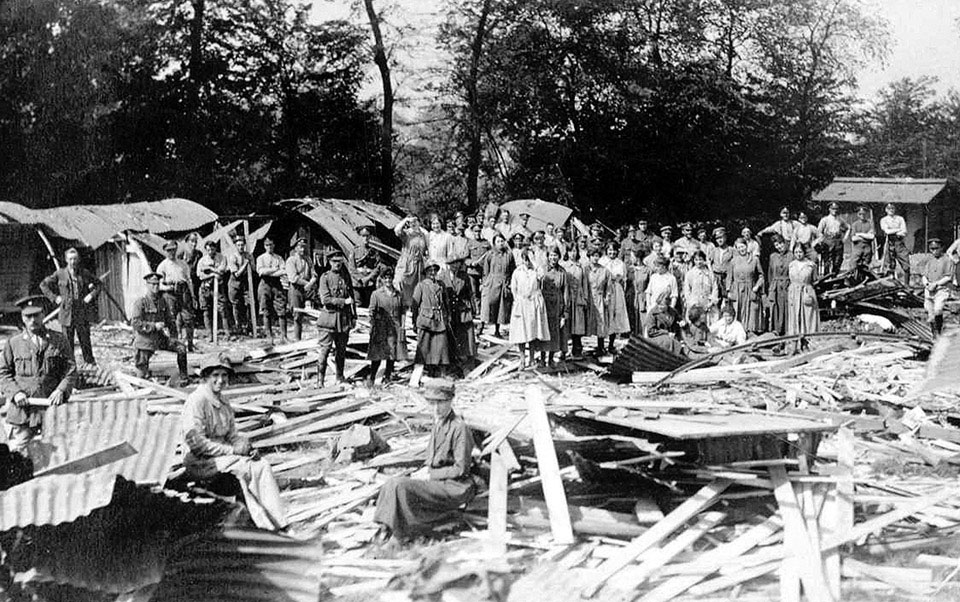
QMAAC clearing up after the air-raid at Abbeville

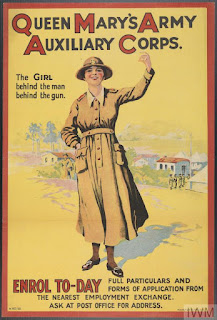
When the 1911 UK census was taken, Cecil was in Wales, working as a wardmaid at the Royal Alexandra Hospital in Rhyl. Her experience in that role would have made her a good candidate for the Queen Mary's Army Auxillary Corps. This began orginally in 1917 as the Women’s Army Auxiliary Corps (WAAC). It's purpose was to free up men from administrative and home service jobs for fighting on the front. 

On the National Roll her entry reads:

HOUGH, C. J. (Mrs.), Worker, Q.M.A.A.C. (Queen Mary's Army Auxiliary Corps)

Having joined in March 1918, she was sent to France, where she did excellent work as waitress in the Officers' mess at Abbeville, and was wounded during an air raid on that place. She remained in this area until June 1919, when she returned home and was demobilised, holding the General Service and Victory Medals.  18, Shuttleworth Street, Pendleton."

Cecil Jean was fortunate to survive the air raid on Abbeville, on the Somme. Nine women died in the raid. This film clip shows the damage done to the women's camp.

John Hough was a corporal in the 8th Lancashire Fusilliers and also spent time in France. His entry in the National Roll reads:

Volunteering in August 1914, in the following month he was sent to Egypt, and served there until drafted to the Dardanelles, where he took part in numerous engagements until the Evacuation, and was wounded. He then returned to Egypt, and in March 1917 proceeded to France, where he fought on the Ancre, at Ypres, and in the Retreat. After the Armistice he was sent to Ireland and served there until, owing to ill-health, he was invalided home and discharged in November 1920, holding the Star, and the General Service and Victory Medals. 18, Shuttleworth Street, Pendleton

John and Cecil had (at least) three children - Cecil John in 1920, Peter in 1922 and Margaret in 1926. Peter died in infancy, and possibly also Margaret. Cecil Jean herself died in 1927 and was buried in what seems to be a shared grave with several unrelated people. I haven't been able to discover for certain when John died, although 1942 seems likely. I can't remember my grandmother ever mentioning Cecil or Cecilia when she spoke about her family.

Tuesday, October 5, 2021

Harriet Whybrew - an update


Poor Harriet! I've found more information about her recently, but everything I've discovered has been bad news. 

To recap on what I've already written about her, Harriet was David and Susan Whybrew's first child. She was born in Adelaide in 1868, before they were married. When David's regiment returned to England, Susan went too, taking their second daughter, Eliza, with them, but leaving Harriet behind. I've discussed who might have taken care of Harriet and how she came to be reunited with her family in her late teens.

Harriet's name began appearing in the Adelaide press in January 1882, when she was only thirteen, though she was reported to be fifteen. She was charged with stealing a watch and other property. The police magistrate sent her to the Industrial School, a reformatory, for twelve months. Even there she got into trouble.

Between then and August 1885 she was constantly in and out of the police courts, often charged with 'loitering' or with the use of bad language. Sometimes she paid a fine, sometimes she went to prison for several weeks. 

I've recently come across some additional newspaper reports and records that I hadn't seen before. All together, I've found twelve mentions of Harriet in the police court between 1882 and 1885. On one occasion, in July 1883, she and her cousin, Rose Atkin, appeared together, both charged with 'using indecent language, loitering etc'. They were each fined two pounds. Rose paid the fine but Harriet went to gaol for three months, presumably because she couldn't pay. On the prison records (which are now available on familysearch.org) both girls were described as prostitutes. 

Time in hospital?

I still don't know what happened to Harriet between her last appearance in the Adelaide courts in August 1885 and her appearance in court in  Colchester in England in October 1888. But I did discover a 'Susan Whybrow' listed in the Adelaide hospital admissions in 1885. She was said to be eighteen years old, single, Roman Catholic, born in South Australia. She was admitted on 26 November.

Since I can't find any Susan Whybrow (or similar name) born in SA around the right time, and the details fit Harriet pretty well, I'm wondering if someone inadvertently listed her mother's name instead of hers. After all, the Destitute Asylum twice listed David Whybrew as her uncle rather than her father. The hospital admission records (which are also now on familysearch.org) show that she was in hospital for two weeks. 

The name 'J. Bonnin' is listed under the 'circumstances' column. Was this a doctor? An employer? A friend? Usually doctors were given their title in this column. The only Dr J Bonnin I can find in Adelaide, James A Bonnin, didn't graduate until 1895. A John Bonnin (or Bonnie or Bonney) appeared in the Police Courts around this time, charged with use of indecent language. Perhaps he brought Harriet to the hospital.

Harriet, if this is her, was treated for anaemia. Given her lifestyle, it's quite likely that Harriet would have had a poor diet, which could have led to chronic anaemia. But if she was admitted to hospital for treatment, it's more likely that the anaemia was acute. I can only speculate on what might have caused this, but it does seem that something happened at the end of 1885 that led to the end of Harriet's appearances in the Police Court.

If Harriet was in hospital in late November 1885, then she couldn't have been the 'Miss S Wybrow" who left Adelaide for England on 15 November. The identity of this Miss Wybrow is a mystery. I can't find any other mention of her existence. 

How Harriet came to rejoin her family is also still a mystery. My hunch continues to be that the Salvation Army might have had something to do with it, given their outreach to 'fallen women' in Adelaide, and Harriet's sister Eliza's association with the 'Salvos' in Colchester. An article about the Salvation Army 'home for fallen women' in Norwood reported in August 1886 that

Since the opening, thirty-four girls and women have been received, thirteen of whom have been placed in situations, and from reports that are received by the matron, they are giving entire satisfaction, and are most thankful to the officers of the institution for the great benefits derived by them from its establishment. Four of the number have been restored to their parents, and four have been transferred to the lying-in department of the destitute, whilst one married' woman has returned to her husband.

Perhaps Harriet was one of those restored to her parents. 

(My thanks to the South Australia Genealogy group on Facebook, who helped me to find some of this information.)

You can find out more about Susan and David Whybrew and their family, in my book Susan: convict's daughter, soldier's wife, nobody's fool.
It's available on Amazon and other online books stores

Tuesday, July 20, 2021

Alice Whybrew


Herbert & Alice Miller
with baby Alice c1901
(from a larger family photo)

Having tracked down the story of what happened to Rose Whybrew after she arrived in Chicago in the United States, I hoped I might find out more about her sister Alice, who also migrated to Chicago. Unfortunately, I haven't been able to find much to add to what I wrote about her in my post about the fourteen children of David and Susan Whybrew. But here's what's known.

Alice was born at Parsonstown in Ireland in September 1875, while her father David was stationed with the 50th Regiment in Kings County (now known as Co. Offaly). At the time of her birth her oldest sister, Harriet, was still in Australia, and two other siblings, David and Rosina, had already died. So she effectively became the second child in the family, with her sister Eliza nearly six years older. 

By the time her younger sister, Rose, was born in 1877, the family had moved back to England, to Canterbury. They eventually settled in Colchester. I can't find anything about Alice's childhood, other than what's known about the family generally. In the 1891 census, when she was 16, she was described as a tailoress.

In 1896 Alice married Herbert Arthur Miller, a carpenter from Colchester. He had enlisted in the army in 1889, but was discharged in 1891, apparently due to having flat feet. The couple went to live in Canterbury Road, Colchester.

A newspaper report in the Essex Standard in October 1899 suggests that their marriage was not going well. Herbert appeared in the Colchester police court charged with assaulting Alice. It was evident that this was not the first time that they had a violent argument. Alice wanted a separation order, but the judge would not allow it.

Perhaps things improved. A year later, in November 1900, Alice gave birth to their first child, Alice Frances. Three years later, in September 1903, Bessie Mary was born. She was named after Herbert's sister and was baptised at St Botolph's church in Colchester. I can't find a record of Alice Frances being baptised.

Moving to Chicago

In 1905, Herbert left England for Winnipeg in Canada aboard the Virginian, arriving in April. Alice followed with the two children on 10 August 1905, on the Tunisian. They all arrived safely in Canada. But the North West census for Canada in 1906 shows Alice and six year old daughter Alice living in what seems to be a boarding house in Winnipeg, with no sign of Herbert or little Bessie.

The census was taken in June. Possibly Herbert had already left for the USA. He crossed through Vermont into the United States with $30 to his name in June-July of 1906. (Most of this information comes from documents on familysearch.org)

It seems most likely that Bessie died while they were in Canada. She may be the 'Mary Miller' aged 2 whose death on 11 July 1906 is listed in the Manitoba Vital Statistics Agency database. It was a sad start to the family's new life in North America.

Eventually Alice and daughter Alice joined Herbert in Chicago. He found work as a bricklayer. When Alice's sister Rose and her husband George migrated in 1907, they gave Alice and Herbert's address, on 48th Avenue, Chicago, as their destination. Rose was still at this address in 1910.

By 7 December 1909, Alice was dead. I haven't discovered what caused her death. She was only thirty-four. There are no newspaper reports to suggest an accident. Her address when she died was recorded as 4742 W Ohio St. (See a photo of the house here.) She was buried at the Forest Home cemetery, 

Herbert remarried a few months later, to Alice M McKeon, an Irish immigrant who was a five years younger than Alice Whybrew. She is the Alice who appears with Herbert and his daughter Alice in the 1910 United States census, living as boarders with another family.


You can find out more about Susan and David Whybrew and their family, in my book Susan: convict's daughter, soldier's wife, nobody's fool.
It's available on Amazon and other online books stores


Monday, June 14, 2021

Benjamin John (Jack) Whybrew

I haven't written much about Benjamin John (Jack) Whybrew. For a long time there seemed little to add to what I said about him, when I wrote about the Whybrew's fourteen children. But recently I've come across some new information about his army career and his later life.

To recap, Benjamin John (usually known as John or Jack) was born in Canterbury in July 1879, while his father David Whybrew was a Staff Sergeant with the East Kent Militia. As the first boy in the family to survive infancy, he grew up with three older sisters. (Eliza, Alice and Rose. He was about ten years old when his eldest sister Harriet briefly re-joined the family.) 

Of the children born after Jack, two boys (David aka Henry and William) and two girls (Ellen and Ada) survived to adulthood. Jack was sixteen when Ada was born.

Cap badge of the York & Lancaster regiment


Like his younger brother, Henry, Jack joined the army in his late teens. He initially enlisted in the militia and then transferred to the York and Lancaster Regiment when he reached eighteen. But he was discharged unfit a couple of years later due to a perforated eardrum. The medical officer who diagnosed him was unsure of the cause, but seemed certain that it hadn't been caused or aggravated by his army service. 

His army records describe Jack as 5 feet 4 7/8 inches tall, with blue eyes, dark brown hair and a fresh complexion, which suggests he took after the Irish side of his family. On his discharge, his behaviour was described as 'fair' rather than 'good'. He'd faced a court martial and spent time in the lock-up on one occasion for breaking out of the barracks.

Marriage and family


In 1898, the year he left the army, he married Emily Licence, the daughter of a blacksmith from Suffolk. I have no clues as to how or where they met. At the time of the 1901 census they were living at 12 Charles Street in Colchester with Jack's sister Harriet, her husband Henry Malone and another married sister, Rose Anthony. Jack was employed as a general labourer and Emily was working as a 'tailoress'.

Their first and only child, Emily, was born in Colchester in 1902. That same year, Jack's brother Henry died from dysentery in South Africa while fighting during the Boer War. Jack must  have been acutely aware that he might well have had the same fate if he hadn't been discharged from the army.

Jack and Emily were living at 3 Smiths Yard in Colchester when the 1911 census was taken. Jack had work as a bricklayer's labourer and Emily was still tailoring. 

Two years later, in the summer of 1913, Emily died. She was only thirty-five. I've heard that their daughter, ten year old Emily, went to live with her paternal aunt and uncle, Eliza (Whybrew) and William Beales, but have no record of this.

Enlists again in WWI


Army Veterinary Corps staff treating a wounded horse, c1917 
(photo from National Army Museum)


When World War 1 began, Jack enlisted in the Royal Army Veterinary Corp, as a private, with the service number SE510. This was the same corp as his brother William.  The RAVC was responsible for looking after the many horses and other animals used by the army. Jack apparently served overseas from October 1914, but was discharged in February 1915, for reasons unrecorded. Perhaps his deafness became a problem again. 

He must have been devastated when William was killed in France just weeks before the war ended. Perhaps this contributed to the impression I have of him from distant family, of an unsettled, hard-living man. There are hints, too, that he didn't have a good relationship with his parents, but again, no record of this survives.

After the war


In 1920 he was awarded the Victory Medal and British War Medal, medals which were given to most returning soldiers. After that, tracing Jack becomes difficult. In 1927 his daughter Emily married George Sydney in London, but I don't know whether Jack attended the wedding. 

He appears next in the 1939 register, created by the British government just before the Second World War. Jack was living at 12 Childwell Alley with "Jessie Whybrew", born in 1878. A note against her name says 'Ward', suggesting that was her maiden name. 

But there's no record of them having married. In fact Jessie Ward was quite possibly still the wife of Edward Ward. At the time of the 1911 census, Jessie and Edward Ward were living at 4 Childwell Alley with their children. Edward was a hawker and a returned soldier.

The 1939 registered records that Jack, now aged sixty, was incapacitated, but gives no details. He died two years later in 1941. His daughter Emily and her husband George both lived on to a good age. They had three children. Whether Jack ever met his grandchildren is another unknown.


Sunday, April 18, 2021

Ada Whybrew

I wrote about Ada Whybrew when I listed the fourteen children of David and Susan Whybrew back in 2014. Ada was the youngest child in the family, of those who survived infancy. At that time I didn't know much about her. But thanks to the information sent to me by the same family member who provided the photo of Susan, I can now fill in some of the details.

Ada with Joseph Metson,
probably around the time of their marriage

Ada Louisa Whybrew was born to Susan in July 1895, when her oldest sisters, Harriet and Eliza (my great grandmother) were already into their late twenties and married. Susan had one further child after Ada, named Lily, but she died within a few weeks of her birth in 1896. 

So Ada was effectively the youngest child in the family for most of her life. As she grew older, she seems to have been close to her sister Ellen (Nell) who was five years older than Ada. 

Her parents were living in Colchester when Ada was born. Her father David had retired from the army and was working as a watchman. Ada was baptised at St Botolph's church in Colchester on 1 September 1895. She seems to have been the only girl in the family to have been given a second name. Possibly she was named after David's half sister Louisa.

With David retired and settled, and most of her siblings grown up and left, her life was very different to that of Harriet, Eliza and her other sisters and brothers, who had grown up during David's army days.

In later life, Ada recalled her father David being very strict but fair, wanting the best for his family. He didn't like his daughters to go to dances, so Ada would hide her dancing shoes under a hedge.

She also told the story of how, when she was fourteen, she went to work in Cambridge, helping Bill with his fish and chip shop. (Possibly this was her older brother, Bill Whybrew, who was living in Cambridge at this time, although the 1911 census described his occupation as a "carman" for a mineral water company.) She did all the chores around the shop. 

Apparently Susan, her mother, visited to see how she was getting on. When she saw Ada carrying heavy buckets of dripping in the street, she said: “Put that down!”  She took Ada back to the shop, told her to put her coat on and took her home to Colchester. This story is somewhat apocryphal, but it would certainly be in keeping with Susan's character.

Like many of the girls in Colchester, Ada liked to visit the barracks to see the soldiers, and that was where she met her husband, Joseph William Metson. She and Joe married in May 1913, when she was seventeen and he was twenty-four 

After the birth of their first daughter, Florence, in 1914, they planned to go to India. They had their papers signed and themselves vaccinated, ready to go. But war broke out and Joe was sent to fight. He was injured in the heel, and then, after returning into service, suffered a hand injury that put him out of action for the rest of the war. According to the records, he was formally discharged in September 1916.

Ada and Joseph's second child, named Joseph William after his father, was born in Colchester in the same month, September 1916. Joe senior was unable to find work in Colchester, so they moved to Islington in London, where he worked as a caretaker at a school. Their third child, Violet, was born there in 1919. 

The war was still on when they moved to the school. Islington was a target for air-raids by zeppelins. During the raids, everyone in the street would come to the school and shelter in the hall. Ada would play the piano while the raids were on and everyone else would sing.

After Joe was diagnosed with TB, they had to leave the school. Joe died in 1935. For many years Ada lived with her daughter Florrie and her husband. She died in 1980, at the age of 85, while on holiday with her son Joseph, in Devon. 

She is remembered as being short, soft and pretty, someone who was kind but strong. She was always smiling and happy and had a great sense of humour. 


Tuesday, March 23, 2021

More on the feisty Ellen (Nell) Whybrew

When I wrote about Ellen Whybrew in November last year, my information was all based on official records. But now I've received new information, direct from descendants of the Whybrew family, which sheds new light on some of the things that seemed uncertain or odd.

Just to recap, "Aunt Nell" as she was known to the family, was the daughter of David and Susan Whybrew. She was born in Colchester in 1890. Of the three children born after her, only Ada survived. There was a six year gap between Nell and her older brother Bill, due to the death of another brother, James, in infancy, and a five year age gap between Nell and Ada. Nevertheless, the two girls seem to have been close to each other as they grew older.

As I noted, Nell and her first husband, George Howard, had three children, all boys. The eldest, Alexander George Ernest was known as George. The second, William Edward, was known as Billy. He died at the age of three, apparently from meningitis. Leslie, the third, also died in infancy. Poor Nell lost two sons, her husband and her father in the period between 1915 and October 1917. 

Cap badge of the Rifle Brigade (Prince Consort's Own)


Apparently Nell met her second husband, Alfred Lloyd, through Ada's husband Joe Metson. In April 1919, Joe left the house to be out of the way while Ada was giving birth to their youngest child, Violet, as men did in those days. At the pub he found Alf, who he hadn't seen for years. They had both served in the Rifle Brigade (Prince Consort's Own) during the war. Alf is said to have been gassed, and had been a prisoner of war in Germany. (I haven't been able to find any record of this yet.)

After talking for a while, Joe took Alf home with him. Nell was in the house, helping Ada, and that was where she and Alf met. The story concludes with "Uncle Alf and Aunt Nell got together and married 3 months later," which is almost true - they married in September 1919.

According to family lore, Nell was quite a feisty woman, a trait she may well have inherited from her mother Susan. During the war (I think this refers to the second world war) she is said to have picked up a chair and waved it in the air during air raids, shouting "Where are you bastards? I'll get you!" At the age of ninety she had her ears pierced and bought a long cocktail dress. 

She was 94 when she died in 1984. Unfortunately no photos of Nell have come to light so far. I'd love to see her in that cocktail dress, wouldn't you?


Monday, February 8, 2021

Memories of Susan and David Whybrew


John Street, Colchester
I'd like to share some of the fascinating information that was sent to me recently with the photo of Susan Mason. It was recorded from a conversation with Susan's granddaughter, Violet, late in life. Violet had never met her grandparents, Susan and David. Her memories were based on recollections of what  her mother, Ada, had told her, many years earlier. So the source is rather distant in time. 

Having said that, it gives a wonderful insight into the characters of both Susan and David Whybrew, and also answers some questions that were left unanswered in the book, Susan

I've edited the information I was provided a little, and reformatted it to make it flow. But I hope you can still hear Violet's voice in it.

Susan was born in Australia in 1848. Her parents were Irish. She married David Whybrew while his regiment was stationed in Australia. After travelling around the world with the regiment, they returned to England and the barracks in Colchester.

Nell (Ellen) and Ada were the youngest of many children, born in many different places, including Cambridge. Susan was nearly fifty when Ada was born. Only Nell and Ada were still at home when Susan used to go away to work as a midwife. (This explains why Susan described herself as a nurse on the 1911 census, despite having no training as far as I could tell. Midwives then didn't need any qualifications.) 

In those days, midwives used to live in with the family in confinement. Susan used to go away for six weeks; three weeks before the birth and three weeks after the birth. Families used to send their pony and trap for her when she was needed. One particular family she used to attend to had lots of children and they always used to send for Susan.

Susan often used to be paid in kind. On one occasion she had been paid with sausages. As she was walking along, all the sausages were trailing along behind her!

Her husband, David, loved her dearly. He described her as 'the belle of the ball' and said that he loved every hair on her head.

David used to sing to Sue:

Sue, Sue, I’m very much in love with you, 

When your pretty little eyes of blue are smiling,

Few, few, few little girls are as nice as you,

There’s a lovely (lonely?) little part, in the middle of my heart,

Just for you, you, you.

David Whybrew was born in 1839. He was Welsh and a Regimental Sargent Major. He met Susan while with his regiment in Australia.  They married and eventually came back to live in Colchester. 

(My correspondent is unsure why the family thought David was Welsh. All the recorded evidence points to him being from Essex, with both parents English, but there's obviously a story yet to be uncovered.) 

He had retired by the time Ada was born. 

He was very strict but he loved his wife and children dearly.  Everything was done to precision. His rule was "no working on Sundays". Nell wasn’t even allowed to sew on a button. They had their own pew at church and went to church every Sunday.

Ada wasn't allowed dancing shoes.  She used to go out, hide her shoes under a hedge and collect them later. He called dancing girls “harlots”.

He did all the sewing and darning. He said that no woman could do it properly! Aunt Nell wanted to borrow some white cotton off him. He gave her some but said: “Don’t ever ask me again. You never lend or borrow, always replenish your stocks, before they run out.”

He used to clean their shoes every day, he even cleaned the soles. He had a piece of wood whittled down and cleaned the edges with it. When the children became fourteen years old, they had to clean their own. Last time he cleaned them was on their birthday. He used to say: “There you are my girl, that is the last time I will clean your shoes”, then he gave them an apple and a penny.

Stories like these are priceless. They say so much about ordinary family life, and they can't be obtained from public records or even newspapers. I'm very grateful to the lady who sent them to me.


Sunday, January 17, 2021

A wonderful photo surprise


(Click to enlarge)


This stunning image was sent to me by a lady who had just read my book 'Susan'. The original belonged to her grandmother, Ada. When it arrived by email it felt like Christmas all over again. Have you guessed who it is?

Yes, it's Susan Whybrew (nee Mason) the subject of the book. I understand the photo was taken in 1914, when Susan would have been in her sixties and living in Colchester with her husband David. Presumably it would have been in black and white originally and was coloured later. I'm sharing it with the permission of the owner, who has it hanging on a wall at home.

Along with the photo of Susan was one of Susan's youngest daughter Ada, with her husband Joseph (Joe) Metson. That too was a wonderful surprise, the first one of Ada that I'd seen. I plan to write a post about Ada later.

The lady who sent them to me very kindly provided me with lots of information about Susan, David and several of their children, which has been passed down through her family. Some of the stories are of the sort that can't be verified, and some were provided to me in confidence. But once I've gone through them again, I'll share what I can in later posts. 
 
Here are photos of Susan and four of her daughters (cropped from larger photos) so you can see the family resemblances. I don't have photos of David, nor of Rose, Ellen or any of the boys, but they too may turn up one day. I've been so blessed to have people share their family photos with me through this blog. 

(from L to R) Susan, Harriet, Eliza, Alice, Ada.

See The Fourteen Children of David and Susan Whybrew  parts 1 and 2, for more details about this family.

Tuesday, January 12, 2021

I found Rose Whybrew


The fate of Rose Whybrew after 1918 has been one of those brick walls that has been a long time in coming down. But I think I've finally cracked it. And I had the evidence I needed all along, without realising it.

To summarise what I already knew, Rose (born 1877) was the fifth daughter of David and Susan Whybrew (nee Mason). She and her husband, George Henry Anthony, migrated to Chicago in the USA in 1907. Their son, George, was born just before they migrated and died in Chicago at the age of six, leaving them childless. George senior seems to have become a permanent resident of an asylum by 1910. He died in the 1940s. The last trace I had of Rose was her address on George's unanswered military call-up papers in 1918.

After that she disappeared. Ages ago I found this small clipping which listed a Rose Anthony from Chicago applying for a marriage license in Indiana in 1917. At the time, I assumed that it probably wasn't the Rose I was looking for because she was still married to George in 1917.  And I couldn't find a record of the marriage anywhere.

Lake County Times, (Hammond, Indiana)
15 June 1917


This week I went back to the article, and realised for the first time, that the future husband's name was also listed - Robert Reichert. I'd been looking at it as a random list, but it's actually a list of couples. I still couldn't find a marriage record, but I had a new name to look for.

First I found a Robert and Rose Reichert in the 1930 US census in Chicago. Rose Reichert's date of birth (1877) was the same as Rose Whybrew/Anthony, and her year of arrival in the USA matched. She was said to have been born in Australia, which wasn't correct, but Rose Whybrew's mother was born in Australia. 

By the 1940 census, Rose Reichert's birth place had changed to England. Each census asks for different information, and in 1940 one of the questions was 'age at first marriage'. Rose Reichert's age at first marriage was 19, about 1897 (the same year that Rose Whybrew married George Anthony) whereas Robert was first married about 1917. So Rose Anthony had been married before she met and married Robert Reichert.

All of this was suggestive, but not conclusive. I couldn't find the couple in the 1920 census. I did find a marriage record (on familysearch.org) for their marriage in Lake County, Indiana, in 1917, though it gave no details except their names and the date (14 June 1917). Could they have gone to Indiana to marry because Rose was still married to George? Perhaps she couldn't afford a divorce, or perhaps a divorce would have been difficult with George in the asylum. Maybe the reason I couldn't find the Reicherts in 1920 was that they didn't want to be found easily.

I'd begun to feel pretty confident (and excited) that this was probably the Rose I was looking for. But the evidence was still rather circumstantial. From newspapers I discovered that poor Robert Reichert was knocked down by a car in December 1955 and died in January 1956. His death record said that he was a widower. 

From that information I was able to find Rose Reichert's death record (on familysearch.org) which included her father's name; 'David Weybrew'. She died in Chicago on 9 February 1944 at the same address as in the 1940 census. Her date of birth on the death record was 13 November 1877, the same as Rose Whybrew. Her mother's name was listed as Murphy, which was actually Rose Whybrew's maternal grandmother's name, and she was said to have been born in Australia. Given that her husband Robert would have been giving the details, it isn't surprising if some of them are muddled or inaccurate. 

So this, I believe, is Rose Whybew's gravestone, at the Montrose Cemetery in Chicago. She had a hard life, but I'm glad that, even if her second marriage was possibly bigamous, she seems to have had a few good years at the end. 


Saturday, November 14, 2020

Ellen Whybrew

I was looking again recently at the records I have for the children of David and Susan Whybrew (nee Mason). Of the fourteen offspring born to Susan, I've found the date of death for all but two - Rose, who disappears without trace in America after 1918, and Ellen (known in childhood as Nellie). 

I've written about Rose several times. Here's what I know about Ellen, the Whybrew's eleventh child. Her father David, a soldier, was close to retirement when she was born in 1890 and the family lived in Colchester during her childhood. Of the three children born after Ellen, only Ada (b 1895) survived infancy.

High St, Colchester (2019)


At the age of twenty Ellen married George Frederick Howard, who was five years her senior. He was the son of Alfred and Sarah Howard of Stotfold in Bedfordshire. Sarah died when George was only nine years old, and he and his siblings were brought up by their father, a farm labourer. By the age of fifteen George was also employed as a farm labourer. 

However, sometime before the marriage in August 1910, most likely when he turned eighteen,  George enlisted in the army. On the marriage register in Colchester his occupation was recorded as "Drummer, Bedford Rgt." Strangely, his father Alfred was described as a "baker" on the marriage register. Perhaps this has been incorrectly transcribed. (I don't have the marriage certificate, only the information included on the transcription on freereg.org.uk).

On the night the census was taken in 1911, George was resident in the barracks in Aldershot, as a private in the 1st Battalion of the Bedfordshire regiment. He was described as a drummer and musician. Ellen was alone in a six roomed house in Newport Road, Aldershot.

But she and George must have spent at least some time together over the next few years. Their first child, Alexander George Ernest, was born in 1911, followed by William Edward in March 1913 and Leslie Owen in December 1914. Sadly for Ellen, Leslie died before his first birthday, and it seems likely that William also died in infancy. His name doesn't appear with Ellen's in later records. 

Could William have been adopted by Ellen's brother William and his wife Adelaide? It's a tantalising thought, given that no record seems to exist for the birth of William and Adelaide's only child, William Ronald. (See Did William Whybrew have a son after all? ) But William Ronald is said to have been born on 20 August 1912, according to the 1939 register, which makes him at least seven months older than Ellen's child, so it seems unlikely that they are the same. It's more likely that Ellen's son is the William Edward Howard who died in Colchester at the age of two early in 1916.

With the outbreak of war in 1914, George went from being a drummer with the Bedfordshire regiment to a private with the Royal Sussex Regiment of the 11th battalion. He was sent to France with the British Expeditionary Force. On 4 August 1917, he was killed in action and was buried among the many fallen soldiers in the Etaples Military Cemetery, Pas de Calais, France. Ellen probably never got to visit his grave. Just a few weeks later her father David also died, at home in Colchester.


Etaples Military Cemetery


She received a widows pension, but it must have been difficult for Ellen raising her only child alone. By the time she received George's few possessions from the army in 1919, she had moved to Islington. She married Alfred Lloyd at St Paul's, Canonbury in Islington in September that year. Her sister Ada and Ada's husband, Joseph Metson, were the witnesses.

The last trace I can find of Ellen is in the 1939 England and Wales register, taken just as the second World War began. She and Alfred were living in Merton in South London, along with Alexander, who was still single. Alfred was working as a government messenger, while Ellen described herself as a retired tailoress. So far I haven't been able to determine which of the many death registrations for women named Ellen Lloyd, born around 1890, is the right one for Ellen. 


UPDATE: I've now confirmed that Ellen died in 1984 in Bromley, Kent, aged 94.


Sources

Births, deaths and marriages: Ancestry.com.au, GRO index search

Ellen's marriage to George Howard: Freereg.org.uk 

George Howard's military service: Bedfordshire Roll of Honour, Stotfold  

Images: Etaples Military Cemetery: Wikimedia 

Colchester High St: David Martin  on Georgraph.org.uk


Saturday, October 3, 2020

Mystery photographs

 A friend who is related to the Whybrews has sent me this photo of a family from Colchester. It was found among family photos, but neither of us know who they are. Does anyone recognise them? 


Here's another photo, also from Colchester. The reverse has the name of a photographic studio, Bradley and Blowers. 


If you can tell us anything about these photos, please leave a comment, or message me via the contact page on my website (https://www.stellabudrikis.com/contact/)

Tuesday, September 22, 2020

Walter Lindrum on video

Walter Lindrum, the champion billiards player, was born in Kalgoorlie in Western Australia in 1898. He was the son of Frederick Lindrum, another billiards great, and Harriet Mary Atkin, both from Adelaide. His grandmother, Mary Ann Atkin (nee Mason) was the sister of my great great grandmother, Susan Mason

I recently came across this video about him. It looks as if it was made in the 1970s and the sound is rather wobbly in places. It focuses mainly on Walter's career as a billiards player, but it has some interesting snippets about his personal life.


(Ignore the screen at the beginning that says 'Sorry there's a problem with this part of the video'. It continues after that.)


Friday, August 21, 2020

Jane Mason's daughter, Lizette

In my post about Henry Hartland, I mentioned that I'd received an email from a descendant of Jane Mason. (Jane was a younger sister of my great great grandmother, Susan Mason). She has very kindly provided me with an outline of the story of Jane's daughter, Lizette. Here it is, with some additional information that I've found online.

The Shamrock Hotel (since renamed several times) in 1927


Lizette was born to Jane in March 1879, in Campbelltown, Adelaide. Lizette's father, Thomas Boddington, was the landlord of the Shamrock Hotel in Currie Street. He was also the lessee of a notorious row of cottages on Light Square, known as Boddington's Row, which were let out as brothels. 

Thomas' father, a baker also named Thomas, had been transported to Western Australia in 1851, for receiving stolen goods. The rest of the family followed him to Australia in 1855. They moved to South Australia in 1859 and Thomas senior established a bakery in Rundle Street. His advertisements drew attention to his 'superior style of Wedding Cakes'.

Jane Mason worked as a servant for the younger Thomas Boddington. But sometime in 1877 she lost her job. On a Friday evening, 28 September 1877, she went to the Shamrock and pleaded to be taken back. 

When Boddington refused, she was "overcome with emotion", and grabbed him by the coat. She was charged with disturbing the peace and appeared in the police court the following day. The magistrate, Mr Beddome, made her promise not to return to the Shamrock and fined her 5 shillings plus costs.

Newspaper article about Jane Mason appearance in court

The Express and Telegraph, 29 September 1877

Despite this distressing experience, Jane must have had further contact with Boddington (who was divorced from his first wife) since she gave birth to Lizette 16 months later, on 11 March 1879. Sadly, as was often the case in those days, Jane was unable to keep her child, and it seems Lizette was handed over to the care of one of Thomas Boddington's brothers and his family. (The child's name was spelled Lizzette on the birth register and some later records.) 

Jane appears to have died of cirrhosis of the liver in 1886. In 1895, Lizette, still in her teens, gave birth to a boy named Herbert Harry Bartlett. His father was listed as Henry Bartlett on the birth registration. Nothing is known for certain about this Henry, but possibly he was the same Henry Bartlett, MP, who was charged in 1892 with failing to support an illegitimate child

Nor is it clear what happened to the baby. But  like her mother, Lizette probably handed him over to someone else to bring up, not by choice but out of necessity.

Lizette travelled to Western Australia in 1901. We next see her in 1912, at the age of 33, when she appears on the electoral roll at Twin Peaks station 'via Yalgoo', east of Geraldton in Western Australia. She is listed as a lady's help, and is living with Albert and Hannah Boddington. Albert was Thomas  Boddington's youngest brother, born in Western Australia after the family arrived from England.

In 1919, Lizette married Edward Charles Atkins, the owner of the sheep station adjoining the Boddingtons. They had two children, who had children of their own. So despite her hard and short life, Jane Mason has descendants who have been successful in ways she could not have dreamed of.

My correspondent, one of Lizette's grandchildren, writes "I feel sorry for Jane as she had a difficult life. I am also extremely proud of her and all the extended family she has produced." I'm delighted that Jane Mason is no longer one of the "unsolved mysteries" in my own family tree.


Thursday, August 13, 2020

A milestone


Here's a small milestone for this blog. According to Statcounter, posts on this site have been viewed 10,000 times. 

That's probably not an exact count, since all sorts of variables come into how visits are counted. And it has taken since April 2012 to get there. But it's good to know that what I'm writing is of continued interest to people. 

Thanks for your support, especially those of you who visit Clogs and Clippers regularly, and those who have left comments. I hope you will continue to enjoy reading the posts.

Saturday, July 11, 2020

Henry Hartland - another child of Jane Mason?

Two years ago I wrote a post about Jane and Bridget Mason, the two youngest sisters of my great great grandmother, Susan Mason. I mentioned that I'd come across a child named Naomi, reportedly born in 1881 to a Jane Mason in the Adelaide Railway station. I wasn't sure if this was the same Jane Mason or not.

A couple of weeks ago I was excited to receive an email from someone who is a descendant of Jane Mason. Not through Naomi though, but by another daughter. (More on that in a later post.) That was enough to send me back to do some more research on Jane.

I found a family tree online that included Naomi Mason, one I hadn't seen before. But Naomi's mother was said to be a girl named Sarah Jane Mason, the daughter of Thomas F Mason. The information on the tree was well documented, including a photo of the entry for Naomi's birth in the Destitute Asylum records. There was no doubt that Naomi didn't belong on my tree. So I went back and added an update to the post I'd written in 2018.

Since then I've discovered another possible child of "our" Jane Mason, a boy named Henry Hartland. He was born in Adelaide on 22 August 1873 and was originally registered as Henry Hartland Mason, suggesting he was born "out of wedlock". His father was listed as Henry Hartland.

I can't find any record of Jane Mason marrying Henry Hartland. In fact, I can't find any record of Henry Hartland senior in South Australia, apart from his name being on the younger Henry's birth registration.

What I did find was a newspaper article in the South Australian Register, on 19 October 1872, which described Jane Mason as an employee of Joseph John Hartland, who owned a hotel (the Prince Albert in Currie Street according to other news items);


Sophia Vicary, daughter of Thomas Vicary, was charged with stealing one tablcloth, value 8s., from Joseph John Hartland, licensed victualler, who recognised the article produced as being his. Jane Mason, in the employ of prosecutor, said she placed the cloth upon a line . about 5 . p.m. on Tuesday, and missed it between two and three hours later. Prisoner came to see her that night. Lewis Irving, pawnbroker, said the cloth was pawned by prisoner on Tuesday night. Sentenced to two months' hard labour.
So it seems likely that Henry senior was related in some way to Jane's employer. I'm still trying to unearth the link between Henry and Joseph John Hartland (usually described as John Joseph).

But how could I be certain that this was the Jane Mason from my family tree? (Once bitten, twice shy!) One clue came from searching through newspapers on Trove for the younger Henry. On 25 April 1884, Adelaide newspapers reported that a boy named Henry Hartland appeared in the police court and was sent to the Industrial School for being an "uncontrollable child". One report helpfully mentioned the name of his aunt, Mary Atkins.

The Express and Telegraph  Fri 25 Apr 1884, p 2


This seemed promising. Jane Mason on my tree had an older sister, Mary Ann, who was married to Henry Atkin (without an 's'). They lived in Currie Street in Adelaide. In fact, Mary Ann and Henry were listed as the next of kin when Susan Mason's daughter Harriet Whybrew was sent to the industrial school in 1882. They had a large family of their own, so if they were responsible for Jane's wayward child too, they would have had their hands full.

Still, there were other Mary Atkins living in Adelaide at this time. Without more evidence, I'm not quite ready to claim Henry Hartland as Jane's son. But I've recorded what I've found because it's an interesting story, and perhaps someone can shed some further light on it.

Poor Henry was only 11 years old when he was sent to the reformatory in Magill. Perhaps it's significant that Jane Mason was in hospital in June 1884, and died from cirrhosis of the liver less than two years later. She may have been too unwell to look after him.

Henry had several further brushes with the courts. He was re-admitted to the industrial school in 1887 for two years. Then in August 1890 he was charged, along with two other boys, with taking part in an assault on a Chinese man. He was sentenced to two months' prison, but was released on the Governors' orders on the grounds that he hadn't been involved.

South Australian Register Mon 22 Sep 1890 p 4


An Assault on a Chinaman. — On August 20 three youths named Bruan, Hartland, and Wynes were sentenced at the Adelaide Police Court to two months' imprisonment for assaulting Way Ching, a Chinaman, in Hindley Street. Efforts were subsequently made to secure the release of Henry Hartland on the ground that he had not taken part in the affray. Enquiries were made, and Mr. W.V. Smith, who acted for Hartland, has just received the following letter from the Under Secretary, dated September 19 : — ' Re assault on Chinese and Hartland. Sir— Referring to previous correspondence and to your letter of yesterday's date I have the honour by the Chief Secretary's direction to inform you that His Excellency the Governor has been pleased to order his release this afternoon.'

For most of his life, Henry worked as a labourer. He married a woman named Emma, and they had at least two children: Henry (1898) and Jean Clare (1920). Strangely, given his past history, in 1910 Henry was also listed in South Australian school admission records as the guardian of a child named Leno Ah Yee, born in 1905.*

In December 1916, at the age of 44, Henry (also known as Harry) enlisted in the Australian Imperial Force. He was sent to France, where he was wounded in the leg in August 1918. After recuperating in England, he returned to France until the end of the war. When Henry died in 1935 he was buried in a soldier's grave in West Terrace Cemetery. 

If you know any more about Henry Hartland, or Jane Mason, I'd love to hear from you. I've removed the contact form from this blog for the time being because messages were not reaching me. Please use the contact form on my web site or leave a comment on this post.


Sources:
* South Australian school admission records, Family Search. In 1916 Charles Ah Chow was listed as Leno Ah Yee's guardian.


Saturday, June 27, 2020

Contact form not working

I've just discovered that the contact form on this blog isn't working, and may not have been working for some time. Apparently this is a problem affecting many blogs and Blogger is working on it. I don't know how many messages haven't been forwarded to me.

If you've tried to contact me in the recent past and haven't received a reply, my apologies. Until the problem is fixed, please send messages through the contact page on my website.

I'm still receiving notifications when anyone leaves a comment on a post.

Sunday, May 17, 2020

James Whybrew revisited

St Andrews Church, Wormingford, where
most of James and Sarah  Whybrew's family were baptised.
After discovering that records for Sarah Baldwin's family are now available online, I decided to look again at the background for James Whybrew, Sarah's husband. Previously I'd come to a brick wall with his birth in about 1801 (a very rough date provided by the 1841 UK census). I didn't know where he was born or who his parents might be.

As I'd hoped, there are now records on genealogical sites for James' family too. I've been able to trace his family back several generations. Some of what I found was quite unexpected.

The first surprise was that James was born in Bures St Mary, the same Suffolk village as Sarah Baldwin. That's not surprising in itself, but the 1841 census indicated that he was born in Essex, while she was born outside that county. Since Bures St Mary practically straddles the border between Suffolk and Essex, perhaps that's the explanation.

James was born in 1797, to William Whybrew and Elizabeth Carter, whose families both came from Bures St Mary. (I'll write more about them in future.) The next surprise was to discover that James had at least seven siblings, all but one of them younger than him. Unfortunately most of them died quite young, but at least two, his older brother William and his sister Louisa, seem to have outlived James.

While I was looking at James and Sarah's family, I also came across two short-lived infants born to Sarah that I hadn't seen before: John (1829 - 1829) and Elizabeth (1835-1837).

The final surprise was discovering that James remarried after Sarah died in 1841. This was James' third marriage, but the first for his new wife, Mary Smith. They had two daughters, Martha, born in 1846 and Matilda, born in 1848, a few months after James' death. Altogether, James fathered (at least) fourteen children with his three wives.

All this left me wondering, once again, why James and Sarah's youngest son, David Whybrew, found himself in the Lexden and Winstree Union workhouse sometime before his thirteenth birthday. I knew that James Whybrew died in 1848, leaving David an orphan at the age of ten. But with so many family members around on both his mother's and his father's side, not to mention older siblings and a stepmother, why was there no-one to take him in?

It's perhaps understandable that his stepmother, Mary Smith, would be unable to look after him, being a young widow with two small children of her own to care for. She eventually married again, in 1857, but until then she would almost certainly have been struggling to survive. Her younger daughter, Matilda, died in 1854 at the age of six.

I don't know what date David entered the workhouse. Perhaps family members did care for him for a while, until he was almost a teenager, with a big appetite and little earning capacity. Most of James and Sarah's surviving family were farm labourers with large families to feed.

Whatever the case, it has been interesting and satisfying to put both James Whybrew and Sarah Baldwin into their own family contexts, instead of them being a full stop at the end of that branch of the family tree.
====================================

For more details about David Whybrew and his life, see my book Susan: convict's daughter, soldier's wife, nobody's fool. It's available on Amazon and other online books stores. To read a preview of the first chapters, click on the cover image.